About Trillium albidum J.D.Freeman
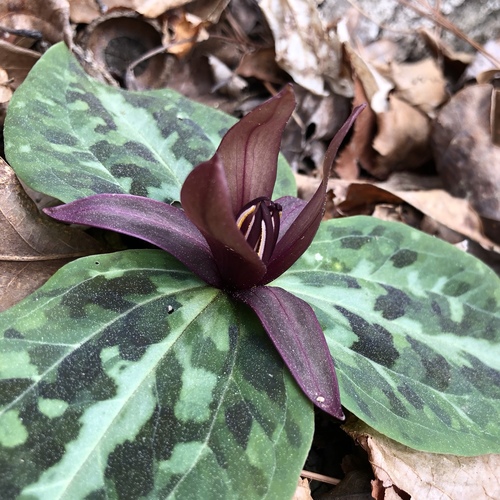
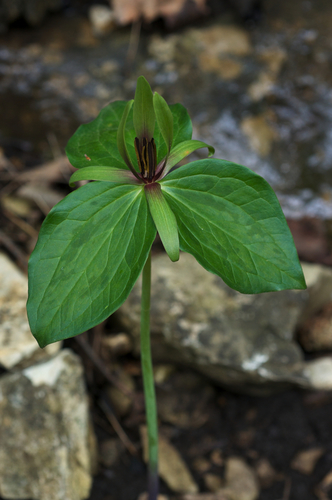
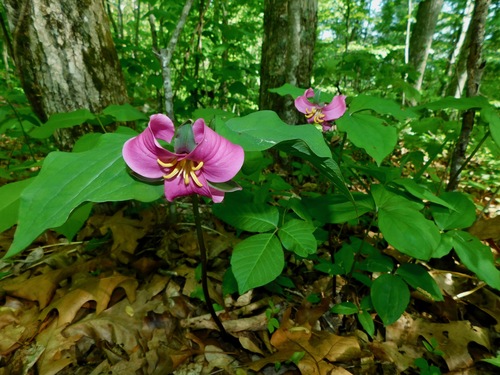
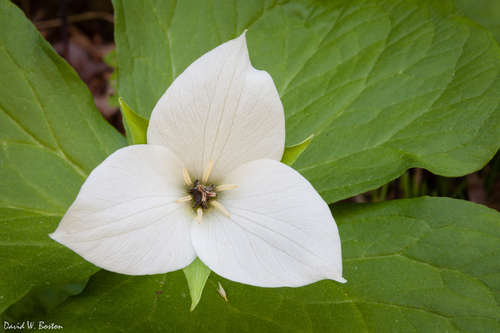
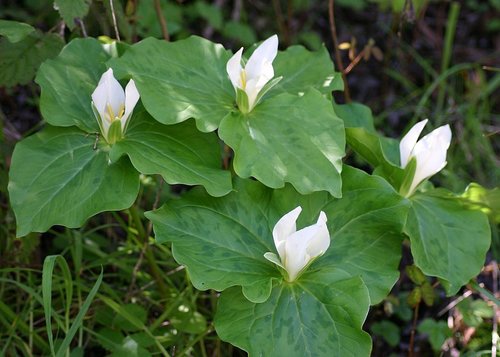
Trillium albidum J.D.Freeman is a perennial herbaceous plant that survives via underground rhizomes. It has three large leaf-like bracts arranged in a whorl around a scape that grows directly from the rhizome, reaching a height of 22 to 58 cm (8.5 to 23 in). The bracts are sessile, broadly ovate, and measure 10 to 20 cm (4 to 8 in) long and 12 to 15 cm (4.5 to 6 in) wide. They are green, weakly mottled with brown or dark green spots, which often fade later in the growing season. Each scape produces a single fragrant flower held at the top of the whorl of bracts. The flower has three lance-shaped green sepals and three wider petals, usually white and sometimes pink or purple-tinged, that are 4.8 to 8 cm (2 to 3 in) long and 2.2 to 3 cm (1 to 1 in) wide. There is also a conspicuously small-flowered subspecies. Two subspecies are recognized: Trillium albidum subsp. albidum and Trillium albidum subsp. parviflorum, which are distinguished by multiple traits. In the region between Corvallis, Oregon and the Columbia River, the species is variable and difficult to assign to subspecies. Trillium albidum is the only sessile-flowered Trillium species that has white flowers. For most of its range, this characteristic is enough to correctly identify the species. However, in the San Francisco Bay Area, where both T. albidum and a white-flowered variety of T. chloropetalum grow, the two species can be told apart by their reproductive organs. T. chloropetalum has dark purple stamens and carpels, while the stamens and carpels of T. albidum are almost always white or pale green, with occasional purple staining. This plant has been awarded the Royal Horticultural Society's Award of Garden Merit. Trillium albidum has the widest distribution of any sessile-flowered trillium in western North America, growing from central California through Oregon to southwestern Washington. In northern California, its range extends east from the Pacific coast through the Klamath Mountains into the Sierra Nevada. The type specimen was collected in Josephine County, southern Oregon. The southern edge of its range overlaps with the range of T. chloropetalum in the San Francisco Bay Area. Intermediate populations in this region may be the result of hybridization between the two species. The typical subspecies Trillium albidum subsp. albidum ranges from northern California to central Oregon, while T. albidum subsp. parviflorum occurs in northwestern Oregon and southwestern Washington. In the overlap zone of the two subspecies, from the Umpqua River north to the Columbia River, populations show considerable variation that makes subspecies identification based on morphology alone difficult. In southwestern Oregon, just north of the California border, there is a population of plants with pale yellow or creamy (not white) flowers with no purple pigments at all. Because these plants grow at higher elevations, their flowering is delayed to May or early June. This population has not yet been formally named as a taxon. Trillium albidum grows in a diverse set of habitats, including moist slopes of mixed deciduous-coniferous forests, among shrubs and thickets, and along stream banks and river beds. Flowering typically occurs in spring, from mid-March to early May. In California, flowering takes place between February and June. Like other Trillium species, T. albidum begins with a one-leaf vegetative growth stage, followed by a three-leaf vegetative (juvenile) stage. After several years of vegetative growth, the plant finally reaches its three-leaf reproductive (flowering) stage. It has an indefinite lifespan of many years.