About Trigonostigma heteromorpha (Duncker, 1904)
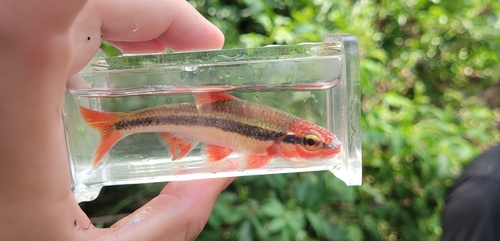
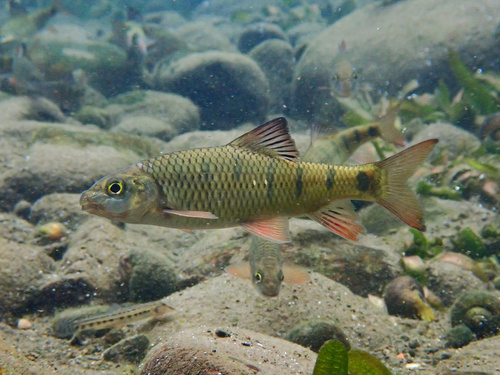
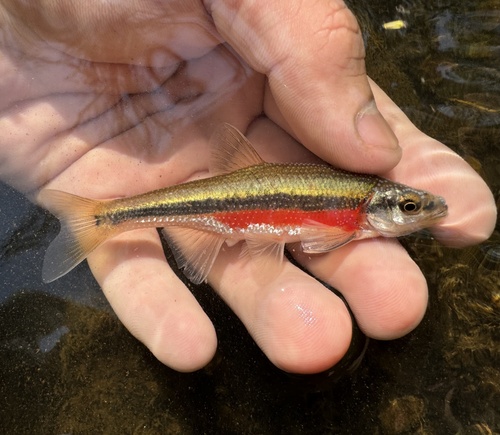
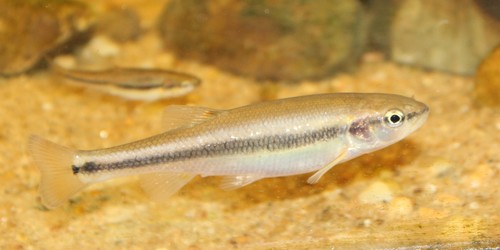
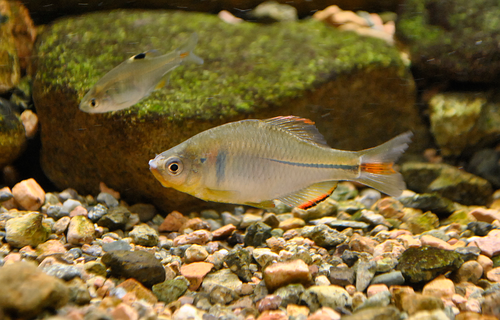
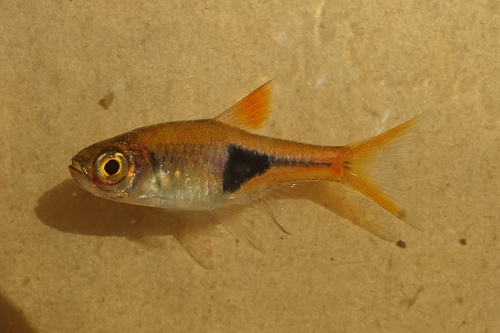
The harlequin rasbora, scientifically named Trigonostigma heteromorpha (Duncker, 1904), has an approximately lozenge-shaped body. Its base body color from head to caudal peduncle is orange-pink, and the exact shade changes based on water conditions and the original population the fish comes from. The back half of its body has a large, roughly triangular black marking that tapers toward the end of the caudal peduncle. This marking begins around the midpoint of the dorsal fin’s base, and is commonly called a "black wedge". Like all cyprinids, this species follows the typical fin arrangement for the group: pectoral fins sit just behind the gill cover (operculum), while pelvic fins are located further back along the fish’s underside, almost directly in vertical alignment with the dorsal fin. This pectoral-pelvic fin arrangement is shared by characins and all ostariophysans, a group of fish that have an auxiliary sound-detecting system made of internal bones called Weberian ossicles. The dorsal, anal, caudal and pelvic fins all have a red tint. The caudal fin is forked: red color is concentrated in its outermost rays, while the inner part of the fin is more transparent (hyaline). Harlequin rasboras can be easily confused with two similar species, Trigonostigma espei and Trigonostigma hengeli, which were originally classified as subspecies of T. heteromorpha. Both similar species have more slender bodies than T. heteromorpha, and their black marking is not triangular. Instead, it forms a horizontal stripe that tapers toward the caudal peduncle, and is greatly thickened and extended downward below the dorsal fin. This shape resembles a lamb chop butchery cut, so these species are commonly called "lamb chop rasboras". Fully mature harlequin rasboras reach a standard length of 4 cm to 4.5 cm, and the maximum recorded length is 5.1 cm (two inches). Males have a slightly larger black body patch than females, and the edge of the patch next to the anal fin is more rounded in males. Ripe females have a noticeably fuller body outline. The harlequin rasbora is native to Malaysia, Singapore, Sumatra and Borneo. Populations previously recorded in southern Thailand were reclassified as the separate species Trigonostigma truncata in 2020. It lives in streams and other watercourses that have low mineral content and high concentrations of dissolved humic acids, which form because these waterways flow through peat swamp forests. Waterlogged soil in these forests prevents full decay of leaf litter, leading to peat formation that leaches humic acids and related compounds into the water. These habitat conditions are very similar to the blackwater habitats of South America, and the water chemistry of the harlequin rasbora’s Asian home matches that of the Rio Negro. The harlequin rasbora has very different breeding habits compared to other popular aquarium rasboras. While other rasboras are egg-scattering spawners, the harlequin rasbora lays adhesive eggs on the underside of plant leaves, most commonly species like Cryptocoryne and Aponogeton. To prepare for spawning, the female swims upside down under a chosen leaf and rubs her belly along the leaf, an action that encourages the male to join her. When the male joins, he also positions himself upside down alongside the female. As the female releases eggs and attaches them to the underside of the leaf, the male curls his tail fin around the female’s body and releases sperm to fertilize the eggs with a trembling motion. Each mating embrace deposits 6 to 12 eggs, and the fish repeat this process over two hours or more. A large, well-conditioned female can lay up to 300 eggs total, though 80 to 100 eggs is a more typical number. A breeding aquarium for harlequin rasboras must have suitable plants, with Cryptocoryne species being the preferred choice. Breeding water needs to be soft and acidic; fish are unlikely to spawn in hard, alkaline water, and even if spawning occurs, egg fertility is negatively affected in these conditions. Hobbyists who want to closely replicate natural conditions can filter aquarium water over peat to match the humic acid concentrations of the fish’s native habitat, but this is not strictly required if the basic water chemistry parameters are met: water hardness no higher than 4°dH, and a pH around 6.4. Breeding temperature should be kept at 28 °C (82 °F). Before attempting spawning, breeders should condition parent fish heavily with live foods such as Daphnia and mosquito larvae. After spawning is complete, parent fish should be removed from the breeding aquarium to stop them from eating the eggs, a behavior that is common in this species. A black-and-white illustration showing the female’s inverted pre-spawning position can be found on page 171 of William T. Innes' book Exotic Aquarium Fishes.