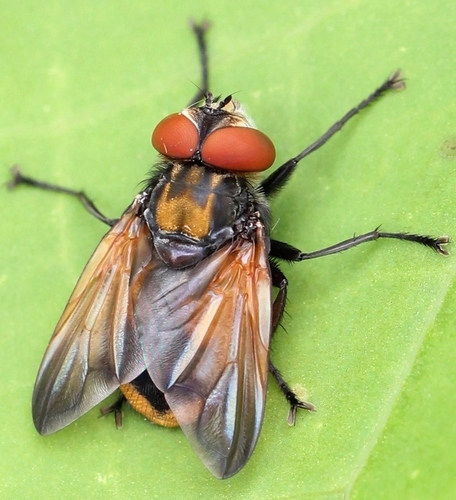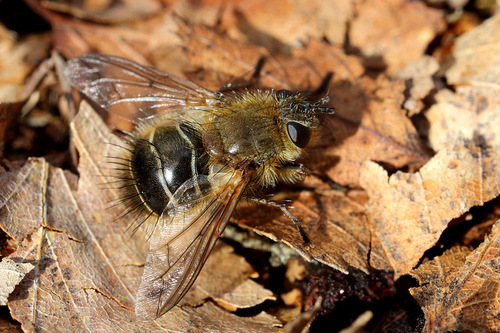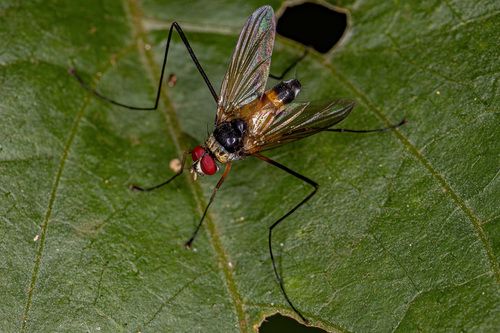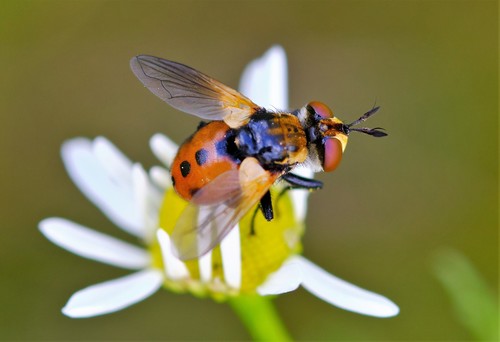
About Trigonospila brevifacies (Hardy, 1934)
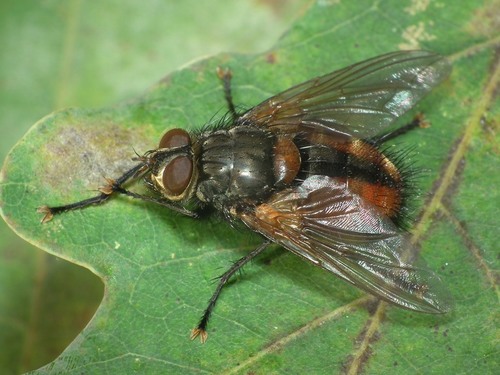
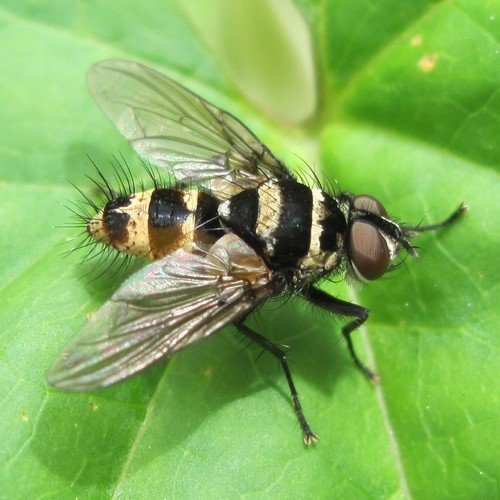
Identification: Like all species in the Trigonospila genus, Trigonospila brevifacies can be recognized by its distinctive markings. It is primarily black with pearly whitish to golden transverse bars across the thorax and abdomen. In regions where both species co-occur, T. brevifacies is frequently confused with T. cingulata. T. cingulata appears to be much more common than T. brevifacies, especially in Queensland, New South Wales, and the Australian Capital Territory. It is thought that T. cingulata is a parasitoid of chrysomelid beetle larvae in the genus Paropsis, which are abundant herbivores in many Australian environments. Only T. brevifacies is confirmed to be present in New Zealand. T. brevifacies can be easily distinguished from T. cingulata by the colouration of the abdomen. The black and white abdominal markings of T. cingulata form continuous, crisp stripes that run from the dorsal to ventral sides of the abdomen. In contrast, the black markings of T. brevifacies are typically more or less triangular spots located on the anterior margin of each of the third, fourth, and fifth abdominal tergites, and these spots may or may not be quite diffused. The sides of the abdomen of both sexes of T. brevifacies are yellow.
Distribution: Trigonospila brevifacies is native to the eastern states of Australia, and has been collected from Tasmania, New South Wales, Victoria, and southern Queensland. It is also present in New Zealand, where it was introduced to control a number of agricultural pests.
Host range: Trigonospila brevifacies is the only Trigonospila species for which substantial host records exist. This species is polyphagous, and is known to parasitise at least 18 species of Lepidoptera across 8 families. Some of these are non-target species, and T. brevifacies has been found to compete with many native parasitoids. Recorded host species are as follows: Carposinidae: Carposina adreptella (Walker) Gelechiidae: Helcystogramma sp., Phthorimaea operculella Zeller Geometridae: Pasiphila lunata (Philpott) Tortricidae: Cnephasia jactatana (Walker), Ctenopseustis obliquana (Walker), Epalxiphora axanana (Meyrick), Epiphyas postvittana (Walker), Planotortrix excessana (Walker), Planotortrix notophaea (Walker), Pyrgotis lagiatana (Walker), Strepsicrates macropetana (Meyrick) Oecophoridae: Eutorna phalocosma (Meyrick), Hierodoris atychioides (Butler) Pterophoridae: Aciptilia monospilalis (Walker), Platyptilia falcatalis (Walker) Pyralidae: Epipaschia costigeralis (Walker) Stathmopodidae: Stathmopoda skelloni (Butler)