About Trigona fulviventris Guérin-Méneville, 1844
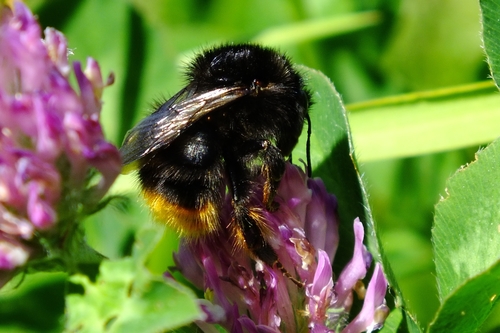
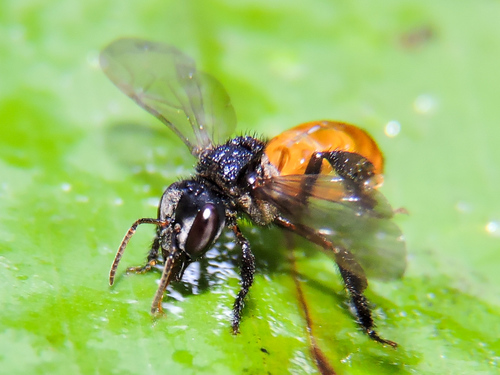
Individual Trigona fulviventris have two key morphological features for identification: two small projections called tubercles on their labra, and four mandibular teeth. There are two recognized subspecies of T. fulviventris, which can be told apart by differences in the coloration of their metasoma. The metasoma of T. f. fulviventris is rust-colored, with slight tone variation between individual bees. For T. f. guianae, both the metasoma and the rest of the body are black, occasionally showing faint reddish tones. T. fulviventris is among the largest species in the genus Trigona, with individual body lengths ranging from 5 to 6.5 millimeters. This species is one of the most widely distributed members of the genus Trigona. It occurs naturally in Mexico, Belize, Colombia, Costa Rica, El Salvador, Guatemala, Honduras, Nicaragua, Panama, and the Panama Canal Zone. It is most common at low to mid altitudes, and has been observed tolerating a broad range of humidity levels. Colonies of T. fulviventris nest in both tropical dry forests and tropical wet forests.