About Trifolium squamosum L.
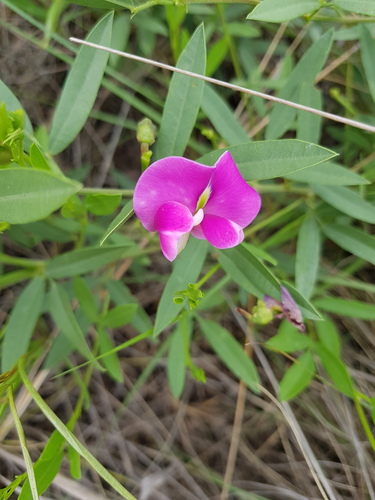
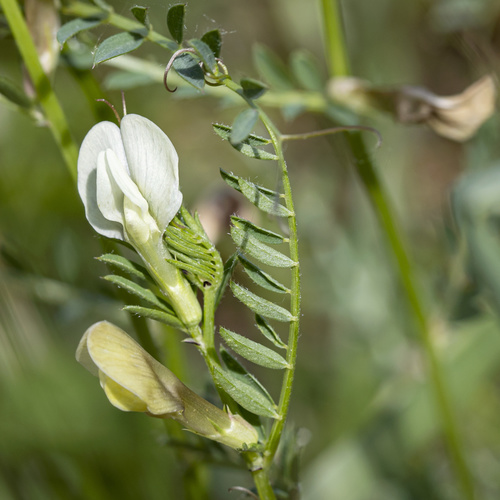
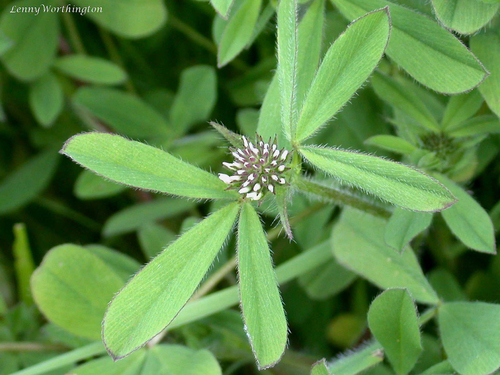
Trifolium squamosum, commonly called sea clover, is an annual herb that forms patches growing up to around 1 meter in diameter and 20 to 30 cm high, most often found in coastal grassland. It has fibrous roots and many ascending to erect branched stems; these stems are hairy when young and become hairless (glabrous) as they mature. Leaves are arranged alternately along the stems, except for the uppermost pair. Each leaf has a prominent green stipule up to 20 mm long at the base of its petiole, which is shorter than the stipule. Like other clovers, sea clover leaves are split into three leaflets, but are distinctively narrower than most other clover species. The leaflets are approximately oblong in shape, around 20 mm by 8 mm, with a small point at the tip. Leaves have translucent veins and are covered with flattened, soft, simple hairs. Flowering happens in early summer, from April to July in Britain. The oval flowerheads grow at the end of stems, are positioned below an opposite pair of leaves, and are either stalkless or carried on a short stalk (peduncle) up to 0.5 cm long. Each flowerhead holds 20 to 30 small individual flowers, each made up of a green calyx and a pink corolla. The calyx may be hairy or glabrous, with a 5 mm long whitish tube marked with 10 prominent veins, ending in 5 green triangular lobes; the lower lobe is considerably longer than the four upper lobes. The corolla is around 7 mm long, formed of 5 petals shaped like the typical pea flower, with a hooded standard petal, two wing petals, and the two lower petals fused together to form a keel. Each flower has 10 stamens with yellow anthers and one style with a brown stigma. After flowering finishes, the calyx teeth curve outward, giving mature fruiting heads a star-shaped appearance. The fruit is an obovoid legume around 2.5 mm long, holding round seeds approximately 2 mm in diameter. The native range of sea clover is along the Atlantic coasts of Europe, from Britain to Spain, and in the western Mediterranean including North Africa. It becomes rare beyond Greece and into the Black Sea. While it is generally a coastal species, it extends inland in parts of France, Spain, and Greece. Further north, it is considered an introduced species in Belgium, Germany, and the former Czechoslovakia, and it has become established in some more distant regions, including California and southern Australia. Its global threat status has not been evaluated, but in England and Wales it is classified as LC (Least Concern) on the basis that it is not currently declining, despite its range decreasing dramatically since the 1930s with ongoing losses. One author has calculated that it has declined by 49% in less than a century. In the 1990s, it was considered 'nationally scarce' because only 60 hectads (10 km × 10 km grid squares used for species mapping) recorded the species. A study of clovers in the Mediterranean classified it as very common in Greece, common in Portugal, Spain, France, and Italy, and rare in Croatia. Where it occurs in England and Wales, it is classified as an axiophyte, meaning it is considered important for nature conservation. In Britain, sea clover grows mostly in coastal areas, typically in grassy upper saltmarsh habitats. Because it has an upright growth habit, it cannot tolerate heavy grazing or mowing, and as an annual species it tends to grow on patches of bare ground. This makes it hard to assign to a single vegetation community: most of its sites are likely in upper saltmarsh communities such as sea rush swards (classified as A2.532 in the EUNIS habitat system), sea couch saltmarsh (SM24 in the British National Vegetation Classification, NVC) or tall fescue grassland (MG1 in the NVC, though the species was not recorded at all during the original NVC survey project). It typically occurs in disturbed areas that are not typical of these core habitat types. Sea clover is classified as a therophyte, meaning it grows quickly to exploit its available growing niche, and produces seeds early in the year. In modern Britain, the most likely place to find sea clover is behind sea defences, particularly in the estuaries of the Thames and Severn. In these areas, it often grows alongside access tracks that run along the landward edge of sea walls. Disturbance from roads and tracks also explains its presence in inland sites, though it does not usually persist in these inland locations. Further south in its range, sea clover is much less restricted to coastal areas. In Greece, for example, it grows in fields, grasslands, and forests up to 1,000 m above sea level. Its Ellenberg-type indicator values are L=9, F=6, R=6, N=7 and S=2, which indicate that it prefers full bright sunlight, slightly (or seasonally) damp conditions, neutral soil pH, low soil fertility, and moderate soil salinity. A few insect pests have been recorded feeding on this species in Europe, though none have been found in Britain to date: the weevil Protapion difforme feeds on sea clover; larvae of the beetle Bruchidius pygmaeus bore into its seeds; the scale insect Pseudococcus aridorum lives on its stems. One species of fungus, Uromyces fallens, has been recorded causing pustules on the leaves.