About Trifolium repens L.
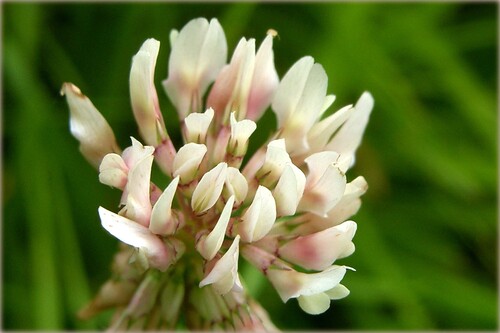
Trifolium repens L. (white clover) is a low-growing herbaceous perennial plant. It produces flowering heads made up of whitish florets, which often develop a pink or cream tinge as the plant ages. These flower heads are typically 1.5–2 centimetres (1⁄2–3⁄4 in) wide, and grow at the end of 7 centimetre (2+3⁄4 in) inflorescence stalks called peduncles. Bumblebees most commonly visit its flowers, and honey bees often visit them as well. Its leaves are trifoliolate, smooth, elliptic to egg-shaped, long-petioled, and usually bear light or dark markings. Its stems act as stolons, so white clover often grows in dense mats; stems can creep up to 18 cm (7 in) per year, and root at the nodes. Trifoliate leaves of this plant form the symbol known as the shamrock. White clover is almost always trifoliolate, but occasionally individual plants develop four or more leaflets. White clover is native to Europe and Central Asia, and is ubiquitous across the British Isles. It has been introduced to North America, South Africa, Australia, New Zealand, Japan, and other regions, and is globally cultivated as a forage crop. White clover has been used as a model organism for global research into ecology and urban evolution. As part of the Global Urban Evolution Project (GLUE), scientists from 26 countries studied cyanide production in more than 110,000 clover plants collected from 160 cities. For clover plants, cyanide acts as a deterrent to herbivores. When analyzing urban-rural differences, scientists found that cyanide production generally increases with increasing distance from city centers. This suggests that clover populations are adapting to factors common in urban centers around the world. Possible factors that may drive this adaptation include temperature (freezing is linked to cyanide content), herbivory pressures, and drought stress. As habitats for clover, city downtowns are often more similar to other distant cities than they are to nearby rural areas. In addition to being an excellent forage crop for livestock, white clover's leaves and flowers are a valuable survival food: they are high in protein, and are widespread and abundant. Fresh white clover plants have been used for centuries as an additive to salads and other leafy green meals. Raw white clover is not easily digested by humans, but this issue is easily resolved by boiling harvested plants for 5–10 minutes. Native Americans ate some clover species raw. Dried white clover flowers may be smoked as a herbal alternative to tobacco. In India, Trifolium repens is used in folk medicine to treat intestinal helminthic worm infections. An experimental in-vivo study has confirmed that the aerial shoots of T. repens have significant anticestodal (anti-tapeworm) properties.