About Trifolium incarnatum L.
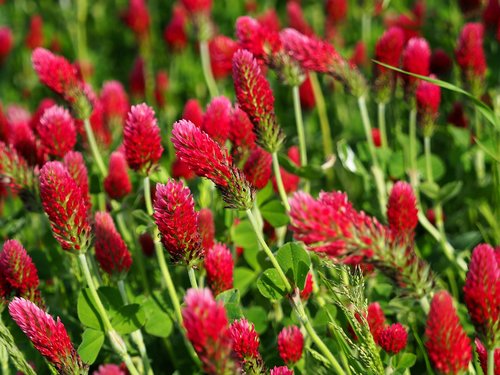
Trifolium incarnatum L., commonly called crimson clover, is an upright annual herb that reaches 20–50 cm (8–20 in) in height. It is typically unbranched, or only branches at its base. Its leaves are trifoliate with long petioles; each leaflet is hairy, 8–16 mm across, and has a truncated or bilobed apex. Flowers bloom through spring and summer, and range in color from creamy white to rich red or crimson. They are clustered densely in an elongated spike inflorescence that measures 3–5 cm tall and 1.5 cm broad. Individual flowers reach 10–13 mm long, have five petals, and their banner petal folds forward rather than sitting upright. In regions with mild winters, crimson clover usually acts as a winter annual. Its seeds germinate with the first late summer or autumn rains, the plants grow over winter, and produce a main flowering flush in late spring. In dry summer climates like the Mediterranean, plants die after their seeds mature. Where summer moisture is sufficient, plants can continue growing and flowering, and may even act as short-lived perennials. This plant forms associations with Rhizobium bacteria to fix atmospheric nitrogen. Outside its native range, crimson clover has been introduced to many regions, including northwestern Africa, Australia, Chile, India, Japan, Pakistan, and the United States. In agriculture, it is commonly grown as a nitrogen-fixing cover crop. It is also widely cultivated as a protein-rich forage crop for cattle and other livestock, and can be made into hay. It is grazed regularly by both domestic and wild ruminants. It is often planted along roadsides for erosion control and ornamental beautification, but can outcompete and exclude other desirable native spring and early-summer plant species in planted areas. It is sown as soon as possible after grain crop harvest, at a seeding rate of 20–22 kg per hectare. It performs better when only the soil surface is tilled with a scarifier and harrow, compared to full ploughing. It grows rapidly in spring and produces an abundant volume of greenery, but only one cutting can be harvested because it does not regrow after mowing. The flowers and young seedling sprouts of crimson clover are edible, with a taste and appearance similar to alfalfa sprouts. They can be added to salads, sandwiches, and other dishes, made into herbal tisanes, or dried and ground into flour. A 100 gram serving of crimson clover sprouts contains 23 calories, 4 grams of protein, 2 grams of fiber, provides 38 percent of the recommended daily intake (RDI) of vitamin K, and 14 percent of the RDI of vitamin C. It contains only extremely small amounts of calcium, iron, phosphorus, zinc, selenium, and magnesium. As with all raw eaten sprouts, there is a risk of contamination with pathogenic bacteria including Escherichia coli, Salmonella, Listeria, and Bacillus cereus. However, many reputable production facilities implement regulation and testing practices to check for these harmful bacteria.