About Trifolium fragiferum L.
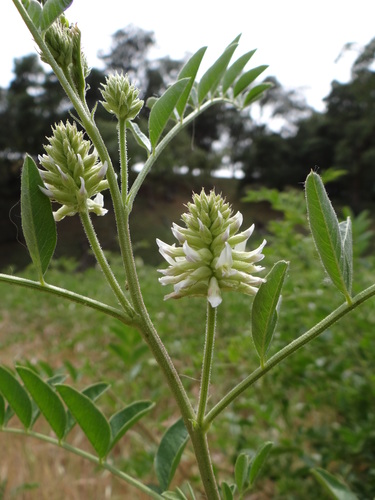
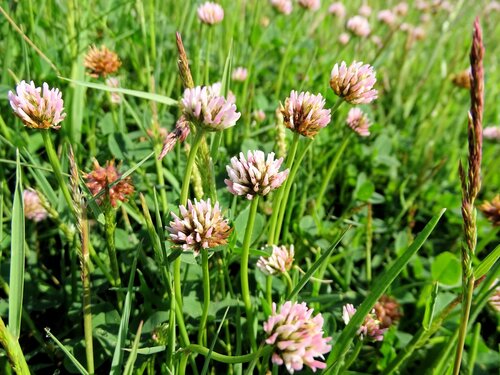
Strawberry clover (Trifolium fragiferum L.) is a perennial herb with tough roots. It usually grows around 10 cm tall, but its much-branched stems can grow up to 40 cm long, rooting at the nodes to form patches that reach up to 80 cm across. Leaves grow alternately along the stems, with a short 15 mm petiole and narrow stipules at the petiole base that measure around 20 mm long. Each leaf is made of three oval leaflets, each roughly 20 mm by 10 mm, with prominent veins that reach the edge of the leaflet at the tips of its pointed teeth. The entire plant is either glabrous or sparsely hairy. Inflorescences grow from the leaf axils, holding many small flowers clustered into a round head up to around 15 mm in diameter. Peduncles grow up to 20 mm long, while the pedicels of individual flowers are very short. At the base of the flowerhead are involucral bracts around 2 mm long, and there is another tiny bract around 0.5 mm long at the base of each individual flower. The flower corollas are white before turning pink, measure 7 mm long, and have 10 stamens and 1 style. The fruit is especially distinctive: the calyx ripens to form a pinkish ball with a net-like (reticulate) surface that resembles a strawberry. Each flowerhead holds many fruits, and each fruit contains 2 small, brown seeds around 1.5 mm long. Strawberry clover is cultivated as a cover crop, for hay and silage, as green manure, and as a plant to support bees. It works well as cover on flood-prone land or areas with saline soil. It is classified as a weed in some regions, and several agricultural cultivars have been developed, including 'Salina', 'Palestine', and 'Fresa'.