About Tridacna squamosa Lamarck, 1819
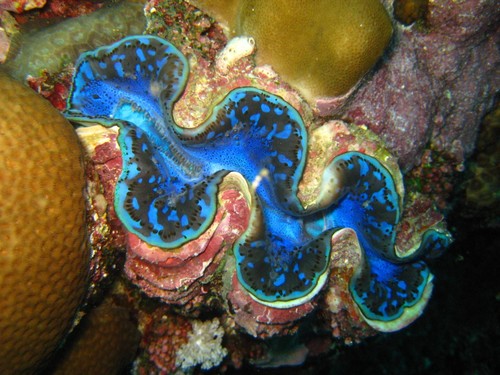
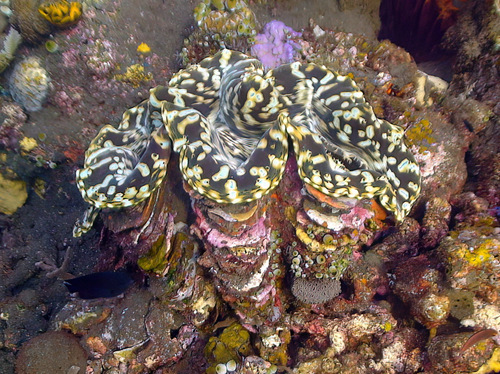
Tridacna squamosa, commonly called the fluted giant clam or scaly clam, is a bivalve species in the family Cardiidae. It is one of several large clam species native to the shallow coral reefs of the South Pacific and Indian Oceans. It can be distinguished by the large, leaf-like fluted edges on its shell called 'scutes', and by a byssal opening that is smaller than the openings of other members of the subfamily Tridacninae. The mantle of this species normally ranges in color from brown and purple to green and yellow, arranged in elongated linear or spot-like patterns. Tridacna squamosa can grow to 40 centimeters (16 inches) across. Adult Tridacna squamosa are sessile, and their mantle tissue forms a habitat for symbiotic single-celled dinoflagellate algae called zooxanthellae. The clam gets most of its nutrition from these algae. During the day, the clam extends its mantle tissue outward to allow the algae to receive the sunlight they need for photosynthesis. The native distribution of Tridacna squamosa spans from South Africa to the Red Sea, and extends east to the Marshall Islands.