About Tridacna gigas (Linnaeus, 1758)
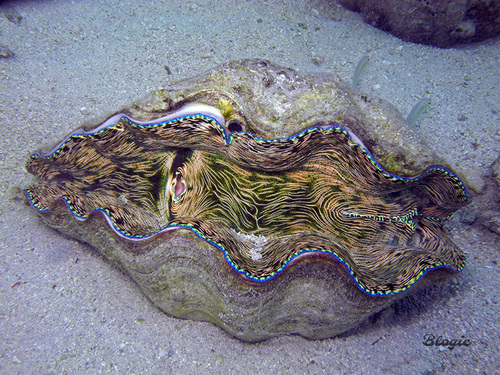
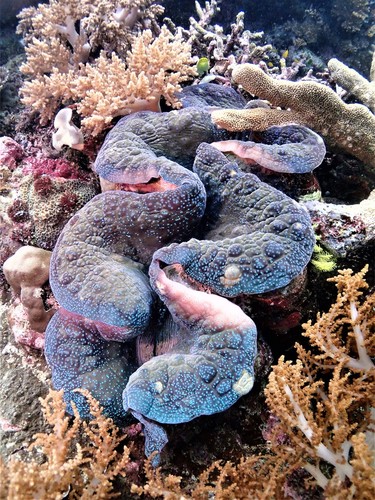
Tridacna gigas, commonly called the giant clam, is the most well-known species in the giant clam genus Tridacna. Giant clams are the largest living bivalve molluscs, and several other "giant clam" species in the genus Tridacna are often misidentified as T. gigas. Indigenous peoples of East Asia have known about these clams for thousands of years, and Venetian scholar and explorer Antonio Pigafetta first documented them in a journal as early as 1521. T. gigas is one of several large clam species native to shallow coral reefs of the South Pacific and Indian oceans. Adult individuals can weigh more than 200 kilograms (440 lb), reach up to 120 cm (47 in) across, and have an average wild lifespan of over 100 years. They are also found in coral reefs off the shores of the Philippines, in the South China Sea, and off the coast of Malaysia. Giant clams inhabit flat coral sand or broken coral, and can be found at depths of up to 20 m (66 ft). Their overall range covers the Indo-Pacific, but populations are declining rapidly, and the species has become extinct in many areas where it was once common. Among giant clam species, the maxima clam has the largest geographical distribution, and can be found near high- or low-elevation islands, in lagoons, and on fringing reefs. The rapid growth rate of T. gigas is likely due to its ability to host and grow algae within its body tissue. While larval giant clams are planktonic, they become sessile once they reach adulthood. Symbiotic single-celled dinoflagellate algae called zooxanthellae live within the clam's mantle tissues, and adult clams get most of their nutrition from these algae. During the day, the clam opens its shell and extends its mantle tissue so that the algae receive the sunlight they need for photosynthesis. This algal cultivation method is currently studied as a model for highly efficient bioreactors. Tridacna gigas reproduces sexually and is a hermaphrodite, meaning a single clam produces both eggs and sperm. Self-fertilization is not possible, but this hermaphroditic trait allows T. gigas to reproduce with any other member of the species. Like all sexual reproduction, hermaphroditism allows new gene combinations to be passed to future generations. This reproductive flexibility reduces the challenge of finding a compatible mate, while also doubling the number of offspring an individual can produce. Because giant clams cannot move, they use broadcast spawning, releasing both sperm and eggs directly into the water. A signaling molecule called spawning induced substance (SIS) helps synchronize the release of sperm and eggs to ensure successful fertilization. SIS is released through a siphonal outlet, and other clams can detect the substance immediately. Incoming water passes over chemoreceptors located near the incurrent siphon, which transmit detection information directly to the cerebral ganglia, a simple brain structure. When SIS is detected, the giant clam responds by swelling the central region of its mantle and contracting its adductor muscle. Each clam then fills its internal water chambers and closes its incurrent siphon. The adductor muscle contracts the shell forcefully, pushing the contents of the excurrent chamber out through the excurrent siphon. After a few contractions that expel only water, eggs and sperm enter the excurrent chamber and are released into the water through the excurrent siphon. Female eggs have a diameter of 100 micrometres (0.0039 in). Egg release starts the reproductive process, and an adult T. gigas can release more than 500 million eggs in a single spawning event. Spawning typically aligns with incoming tides near the full moon (second quarter), and new moon (fourth quarter) moon phases. Spawning contractions occur every two to three minutes, and intense spawning can last between thirty minutes and two and a half hours. Clams that do not respond to neighboring clams' spawning are likely reproductively inactive.