About Tridacna derasa (Röding, 1798)
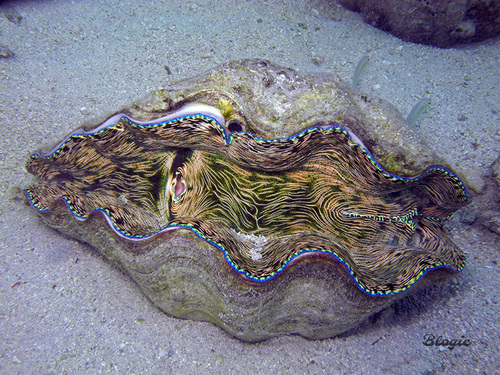
Tridacna derasa, commonly called the southern giant clam or smooth giant clam, is one of the largest giant clam species, reaching up to 60 centimeters in length. It gets its common name smooth giant clam from the relative lack of ribbing and scales covering its thick shell. The smoothness of its shell, paired with six to seven vertical folds, distinguishes it from the larger Tridacna gigas, which only has four to five vertical folds and a rougher shell texture. A defining characteristic of this species is the complete lack of scutes — scale-like shell protrusions that are present in most other Tridacna species — though one abnormal case of scute development has been recorded in aquaculture-raised specimens. The mantle of Tridacna derasa typically features a pattern of wavy stripes or spots, and can come in various mixtures of orange, yellow, black, and white, often with bright blue or green lines. Unlike Tridacna maxima, which clusters red, blue, and green cells to create color, Tridacna derasa produces white coloring in its mantle using multi-colored crystalline pigment cells. This species is native to the waters surrounding Australia, the Cocos Islands, Fiji, Indonesia, New Caledonia, Palau, Papua New Guinea, the Philippines, the Solomon Islands, Tonga, and Vietnam. Populations have been introduced to American Samoa, the Cook Islands, the Marshall Islands, and Samoa, and have been reintroduced to Guam, the Federated States of Micronesia, and the Northern Mariana Islands after the species went locally extinct there. Southern giant clams live on the outer edges of reefs at depths between 4 and 10 meters.