About Tridacna crocea Lamarck, 1819
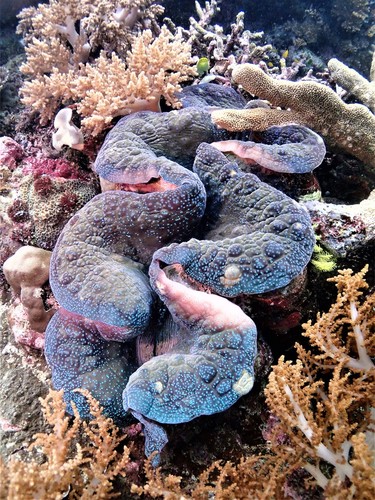
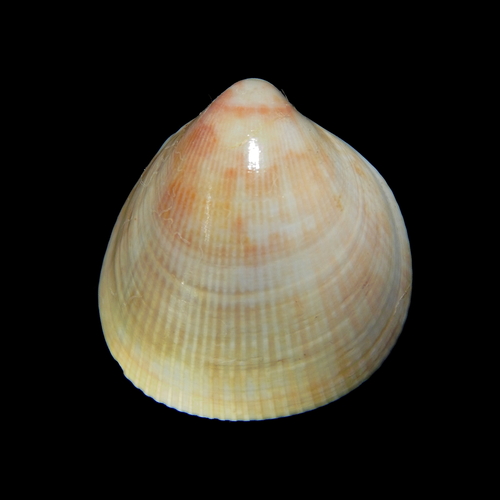
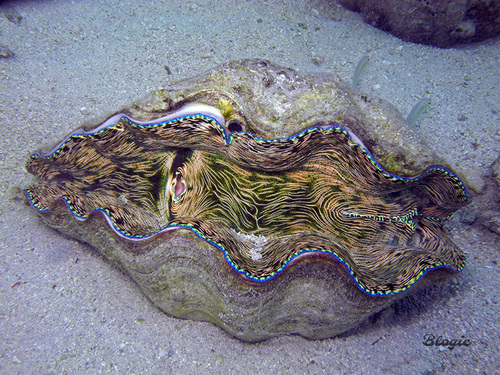
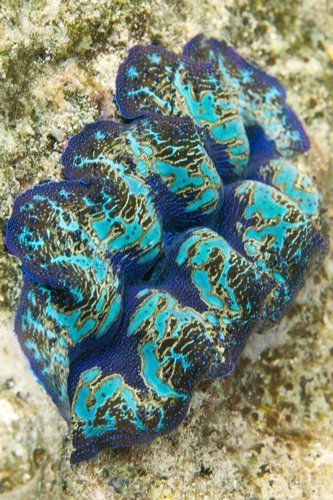
The boring clam, Tridacna crocea Lamarck, 1819, is the smallest species in the subfamily Tridacninae, reaching a maximum shell size of 15 cm (6 in). It has two thick valves joined by a hinge that typically measures between one third and less than half the total width of the shell. Its shells are usually slightly to moderately elongate, and the clam's body is strongly inflated, particularly near the hinge. The upper valve has six to ten flattish folds that interlock at the margin with matching folds on the lower valve, allowing the valves to clamp together and close the shell tightly. The lower valve has slits for byssal threads to emerge; these threads secure the clam to the seabed. This species burrows into its substrate, a process that wears away and smooths the outer surface of the valves. Valves may also become distorted when the clam burrows into substrates with uneven hardness. The valves are generally greyish-white, sometimes with hints of pink-orange, yellow, or orange. This additional colour can form a band near the top margin, especially on the valve's interior surface. When the valves are open, the brightly coloured mantle (the soft body wall that covers the clam's internal organs) extends out from between the valves. The mantle can be various shades of blue, green, purple, gold, orange, or brown, and is often patterned with spots, stripes, or squiggles. It has many small protrusions on its exposed surface, and a line of simple eyes runs near its margin. The inhalent siphon, which draws water into the shell, is surrounded by many small tentacles, while the exhalent siphon is often long and tubular. The boring clam is native to the Indo-Pacific. Its range extends from Malaysia, Vietnam, and Japan to Indonesia, the Philippines, Palau, New Guinea, Australia, the Solomon Islands, and Vanuatu. While it was once recorded in Guam and the Northern Mariana Islands, it may now be locally extinct in these areas. Its typical habitat is embedded in massive corals.