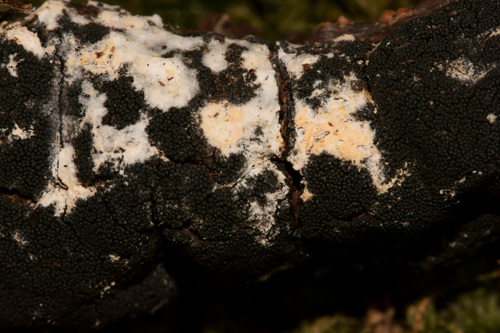
About Trichothecium roseum (Pers.) Link
Morphology: Colonies of Trichothecium roseum are flat, granular, and powdery in appearance. Initially white, colonies mature to a light pink to peach color; the entire genus Trichothecium is characterized by pinkish colonies. Conidiophores of T. roseum are typically erect, measuring 200 to 300 micrometers in length. They grow singly or in loose groups. These conidiophores are simple, septate in their lower half, and bear clusters of conidia at their tips. They cannot be distinguished from vegetative hyphae until the first conidium is produced. The development of T. roseum conidia is distinctive, and was first described by Ingold in 1956. Conidia form as blowouts from the side of the conidiophore apex, which becomes incorporated into the base of each spore. After the first conidium blows out and before it matures, the conidiophore apex directly below blows out a second conidium from the opposite side. Conidia are pinched off the conidiophore one after another in alternating directions to form a characteristic zigzag-patterned chain. T. roseum conidia measure 15–20 × 7.5–10 μm, are smooth, and clavate in shape. Each conidium has two cells, with the apical cell larger than the curved basal cell. Under the microscope, conidia are light pink and translucent; when grown in masses in culture or on a host surface, they display a more saturated pink color. Habitat and ecology: Trichothecium roseum is a saprophyte with a worldwide distribution. It has been recorded in soils from Poland, Denmark, France, Russia, Turkey, Israel, Egypt, the Sahara, Chad, the Democratic Republic of the Congo, central Africa, Australia, Polynesia, India, China, and Panama. Documented habitats for T. roseum include uncultivated soils, forest nurseries, forest soils under beech trees and teak, cultivated soils with legumes, citrus plantations, heathland, dunes, salt-marshes, and garden compost. This fungus is commonly isolated from the tree leaf litter of birch, pine, fir, cotton, and palm. It has also been isolated from multiple food sources: barley, wheat, oats, maize, apples, grapes, meat products, cheese, beans, hazelnuts, pecans, pistachios, peanuts, and coffee. Levels of T. roseum are generally low in foods other than fruits.

