About Trichosurus vulpecula (Kerr, 1792)
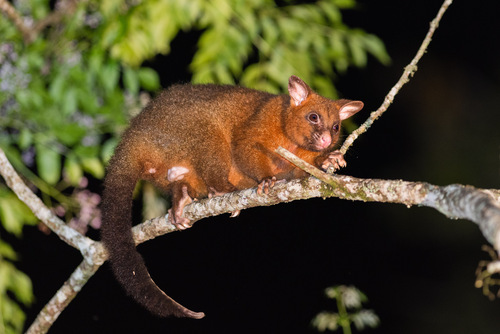
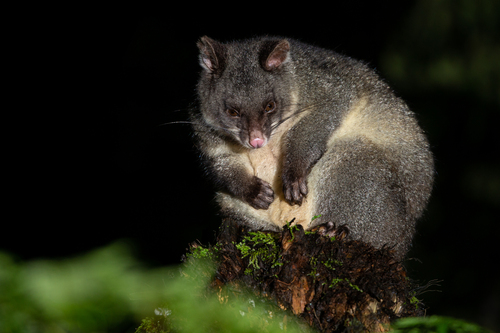
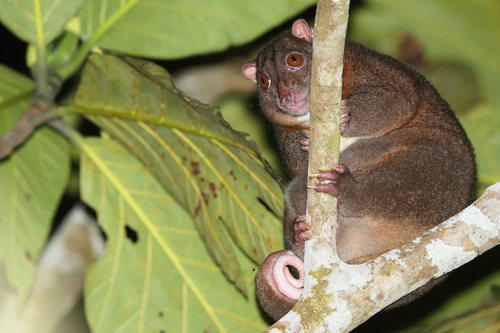
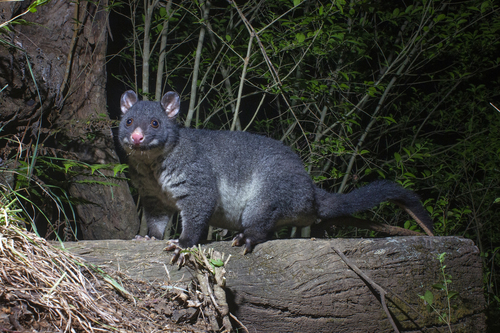
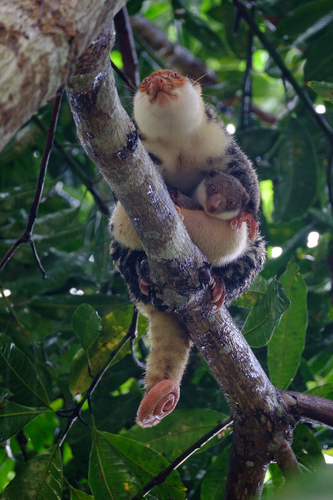
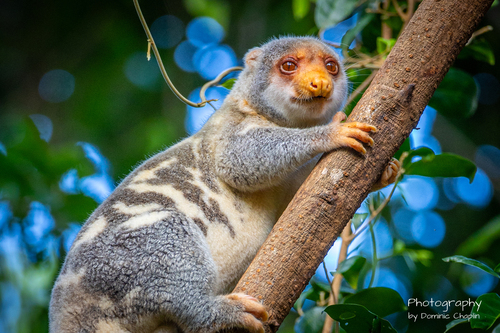
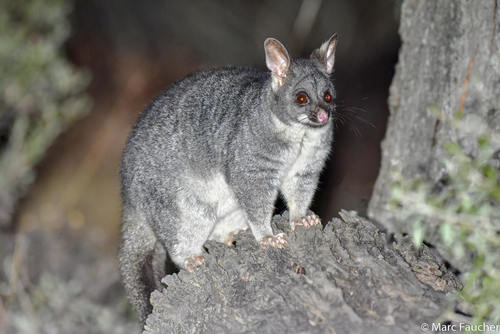
The common brushtail possum (Trichosurus vulpecula) has large, pointed ears and a bushy prehensile tail (the source of its common name) adapted for grasping branches, with a hairless patch on its lower ventral surface. Its forefeet have sharp claws, while the first toe of each hind foot is clawless but has a strong grip. The possum grooms itself using its third and fourth hind toes, which are fused together. It has a thick, woolly coat that varies in color by subspecies, with common overall colorations including silver-grey, brown, black, red, or cream. Its ventral areas are typically lighter than the rest of its body, and its tail is usually brown or black. Dark patches mark its muzzle. Head and body length ranges from 32 to 58 cm (13 to 23 in), and tail length ranges from 24 to 40 cm (9.4 to 16 in). Body weight falls between 1.2 and 4.5 kg (2.6 to 9.9 lb). Males are generally larger than females, and males often have reddish fur on their shoulders. Like most marsupials, females have a forward-opening, well-developed pouch. Both sexes have a scent gland on the chest that produces a reddish secretion which stains the surrounding fur, and the possum uses this secretion to mark its territory.
The common brushtail possum is one of the most widely distributed marsupials in Australia. It is found throughout eastern and northern Australia, as well as some western regions, Tasmania, and multiple offshore islands including Kangaroo Island and Barrow Island. In Western Australia alone, there are several scattered local populations with distinct indigenous names: nunguin in Kimberley, walambari in Pilbara, wayurta in desert areas, and bilda in the Nullarbor Plain (shared with South Australia), among many others. It has also become widespread in New Zealand after being introduced there in 1850. This species can live in a wide range of habitats, including forests, semi-arid areas, cultivated land, and even urban areas. It is primarily a forest-dwelling species, but it also occurs in treeless areas. In New Zealand, common brushtail possums prefer broadleaf-podocarp forests near farm pastures, and are less common in southern beech forests and pine plantations. Overall, common brushtail possums reach higher population densities in introduced New Zealand than in their native Australia. This may be because Australia has more fragmented eucalypt forests and more predators. In Australia, the species is threatened by humans, tiger quolls, dogs, foxes, cats, goannas, carpet snakes, and powerful owls. In New Zealand, it is only threatened by humans and cats. The IUCN records that the species' population is decreasing in Australia. The northern subspecies of the common brushtail possum has declined substantially: one study in Australia's Northern Territory found a 22% reduction in the species' extent of occurrence and a 50% reduction in the breadth of occupied environmental space. Analysis of contemporary occurrence data suggests the species is contracting its range toward areas with higher rainfall, lower fire frequency, and higher vegetation cover. Little is known about the species' distribution in the Pilbara. However, a paper published in the mid-2020s found that populations in the Pilbara and the Mid-West of Western Australia (where the species is almost extinct) are genetically closer to the subspecies found on Australia's east coast, in South Australia, and the now presumed extinct Central Australian subspecies, than to populations in South West Western Australia.
Common brushtail possums can breed at any time of year, but breeding activity peaks in spring (September to November) and autumn (March to May) in some regions. Mating is promiscuous and random; some males sire multiple young in a single breeding season, while over half of males sire no young at all. In one Queensland population, males appear to require a month of associating with females before they can mate. Females have a gestation period of 16 to 18 days, after which they give birth to a single young. Newborn common brushtail possums are only 1.5 cm (0.6 in) long and weigh just 2 g (0.07 oz). As is typical for marsupials, the newborn climbs unaided through the female's fur to the pouch, where it attaches to a teat. The young develops and remains inside the mother's pouch for an additional 4 to 5 months. A preliminary study that induced ovulation via hormone exposure observed changes in female mammary gland appearance, suggesting mammary glands provide immunological protection to newborns through milk secretions. Once the young is too large for the pouch, it is left in the den or rides on its mother's back until it is 7 to 9 months old. Females reach sexual maturity at one year old, while males reach sexual maturity at the end of their second year. Common brushtail possums can live up to 13 years in the wild.
Female offspring have a higher survival rate than male offspring, because female offspring establish home ranges closer to their mothers, while males travel farther to find new nesting sites, and are more likely to be forcibly ejected from established territories held by other possums. In the Ōrongorongo population of New Zealand, female offspring continue to associate with their mothers after weaning, and some inherit prime den sites. Competition for dens may occur between mothers and daughters, and daughters may be excluded from dens occupied by their mothers. In forests with limited den sites, females tend to produce more sons (which do not compete directly for dens with the mother), while in forests with abundant den sites, more female offspring are born.
The common brushtail possum can adapt to many types of vegetation and is largely omnivorous. It prefers Eucalyptus leaves, but also feeds on flowers, shoots, fruits, and seeds. It may also eat animal matter including insects, birds' eggs and chicks, and other small vertebrates. During a single foraging trip, common brushtail possums typically eat three or four different plant species, unlike other arboreal marsupials such as koalas and greater gliders, which focus on a single plant species. The possum's rounded molars cannot cut Eucalyptus leaves as finely as the teeth of more specialized feeders, and are instead more adapted for crushing food, which allows more effective chewing of fruit and herbs. The common brushtail possum's caecum lacks internal ridges and cannot separate coarse and fine food particles as efficiently as some other arboreal marsupials. The species cannot get sufficient protein from Eucalyptus alone, but its generalized mixed diet provides adequate nitrogen.