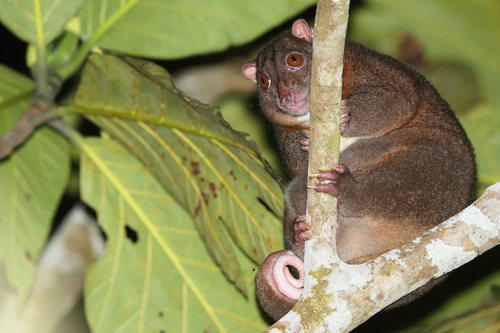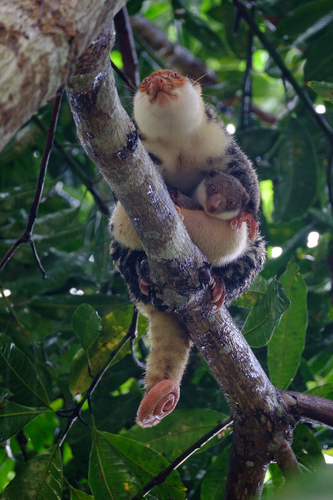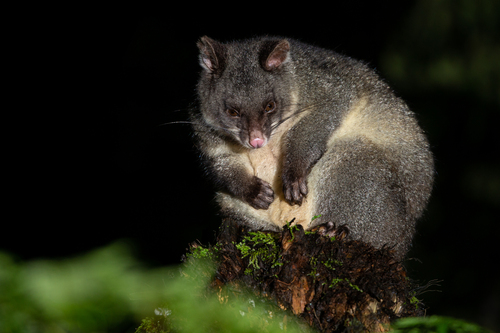
About Trichosurus cunninghami Lindenmayer, Dubach & Viggers, 2002
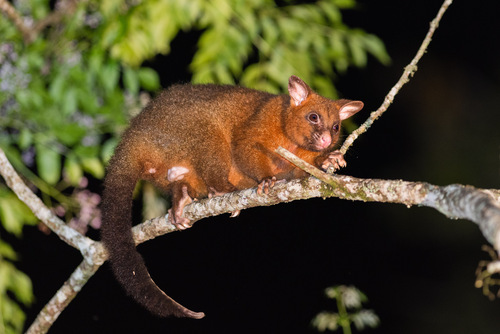
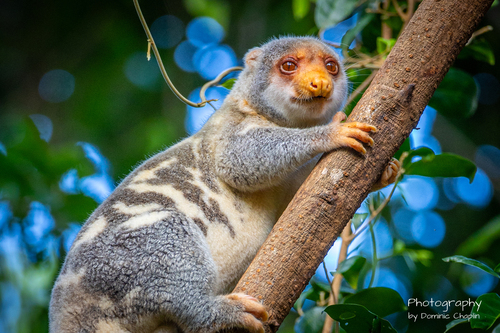
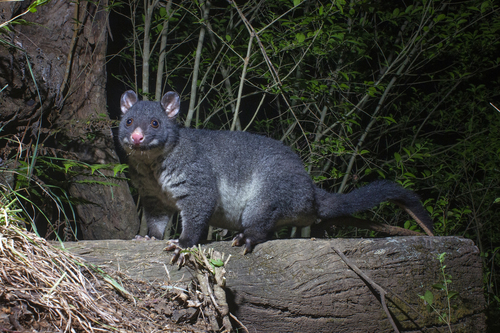
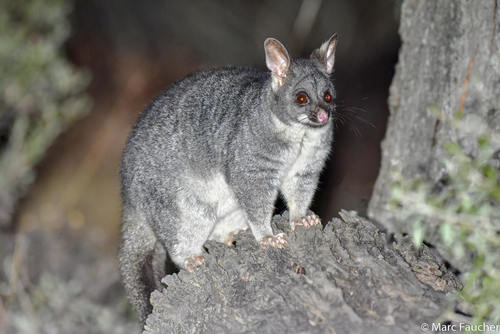
Trichosurus cunninghami, commonly called the mountain brushtail possum or bobuck, along with its close relative the short-eared possum (T. caninus), is generally reported to live in wet sclerophyll forest in southeastern Australia. This range lies along, and to the south and east of, the Great Dividing Range of eastern Australia, extending from southern Victoria to southeastern Queensland. These possums typically live at altitudes greater than 300 metres (980 ft). Bobucks are medium-sized semi-arboreal, nocturnal marsupials, weighing between 2.5–4.5 kg (5.5–9.9 lb).
The habitat and dietary needs of both the mountain brushtail possum and the short-eared possum are reported to be more specialised than those of their close relative, the common brushtail possum (T. vulpecula). Because of this specialisation, the common brushtail possum can colonise a wider variety of habitats than either bobuck species. Unlike common brushtail possums, bobucks are not found in urban areas, and are thought to be obligately adapted to stable forest environments.
During the day, the mountain brushtail possum dens in tree hollows, and sometimes dens in dense ground cover. It emerges at night to forage. In mountain country, the mountain brushtail possum is reported to depend mainly on Acacia species for food, particularly the silver wattle (Acacia dealbata). In lowland Gippsland, however, these animals have no association with any specific vegetation type, and can be found in a variety of Eucalypt stands or Tea Tree. The mountain brushtail possum is known to feed at ground level, and can use hypogeal and epigeal fungi as well as ground-level plant food resources. It also requires tree hollows to use as dens. In Victoria, the availability of both hollow-bearing trees and silver wattle is thought to determine the population density and distribution of the mountain brushtail possum.
The mountain brushtail possum shows very little sexual dimorphism. Mating occurs over a 2–3 week period in autumn, between March and June. Female oestrus is highly synchronised, and most females give birth to one offspring each year. Males do not appear to provide any care for the young. Young leave the pouch after several months, and are then carried on their mother's back. Over summer, between December and February, young begin to accompany their mothers on foot as an initial step toward full independence. Neither males nor females reproduce until they are at least two years of age. There is evidence that female offspring are often philopatric, while young males disperse up to 8 km (5 mi). Once they reach reproductive maturity, mountain brushtail possums keep the same home range for life. This species has an unusually high longevity, and may be the longest-lived marsupial species.
Recent research shows that the mountain brushtail possum's mating system is variable. Intensive study of two mountain brushtail possum populations found that one population was polygynous, while the other was monogamous. The two populations lived within 2 km of each other. The polygynous population occupied a linear habitat strip along a roadside that had not been logged for over 100 years, while the monogamous population inhabited a forest patch that had been logged 40 years prior. It remains unclear whether this difference in mating system is caused by the geographic shape of the habitat or the quality of its resources.