About Trichostigma octandrum (L.) H.Walter
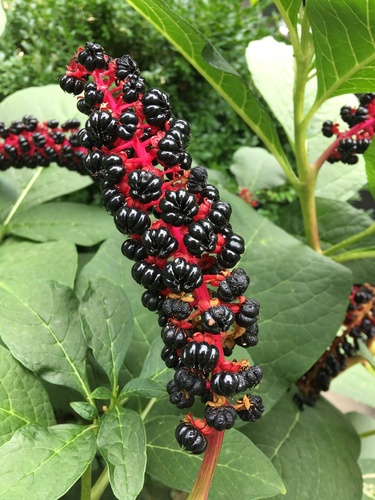
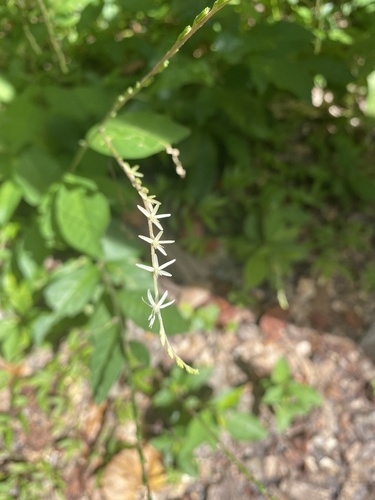
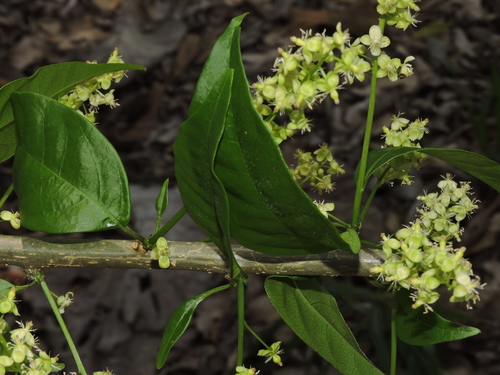
Trichostigma octandrum (L.) H.Walter strongly resembles pigeonberry (Rivina humilis). It grows as shrubs or free-standing vines reaching up to 10 m wide and 6 m tall, with hairless twining, trailing or climbing stems that measure 4–15 cm in diameter. Its leaves have entire, ovate blades 4–9 cm long borne on long petioles, with a short, glabrous apex. Flowers grow in narrow raceme clusters 5–7 cm long, with individual flowers attached to stalks 4–6 cm long. The oval sepals, which measure 4–6 mm long and are glabrous, curve reflexed away from the fruit. The fruits are reddish-purple, fleshy, oval berries 4–5 mm long. Its pollinator is not confirmed, but is hypothesized to be mosquitoes. This species is spread by birds that eat its fruit, and it is also cultivated for multiple uses. It can be grown as a decorative plant or for creating bowers, used to produce fiber, and used for medicinal and food purposes. It is distributed across Florida, Mexico, Central America, the Caribbean, and South America extending as far south as Argentina. In Puerto Rico, it grows in farmland and urban areas, occurring along roadsides, fencerows, in woodlots, brushy pastures, brushy vacant lots, and stream bottom gallery forests. This shrub can cover windfalls, fences, and rocks, and forms mounds of tangled stems up to 2 m high in open areas. Hoopvine (the common name of this species) grows in all soil textures across a wide range of pH levels, developing from parent material including igneous, metamorphic (including ultramafic) and sedimentary (including limestone) rocks. In Puerto Rico, it grows in areas that receive 900 to 2500 mm of precipitation annually. It also grows in tropical swamps near the edges of hammocks and thickets. It is most common near coasts, but also occurs rarely in the Florida Everglades. Split stems and bast fibers from Trichostigma octandrum have been used to make barrel hoops, baskets, bent furniture, and crafts. Young leaves can be boiled and eaten as a vegetable after the bitter water is discarded. It is grown as an ornamental plant; as a large sturdy species, it can be trained to form bowers and enclosures. The purple juice from its berries stains and can be used to produce dye. Vegetative parts of the plant are used to treat heart palpitations. Bark powder is used to treat colds and water retention. Colombians use the leaves to help heal wounds. People in Hispaniola use a leaf tea to help with asthma or choking. The fruits are also used in medicines. Related genera Petivera and Phytolacca are known to contain many bioactive compounds.