About Trichopodus pectoralis Regan, 1910
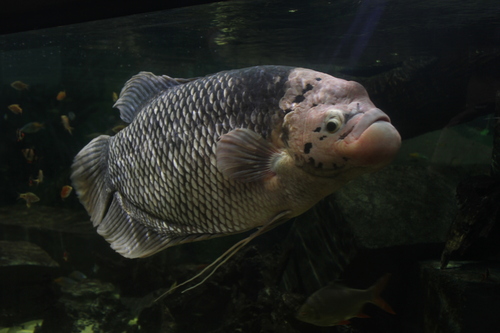
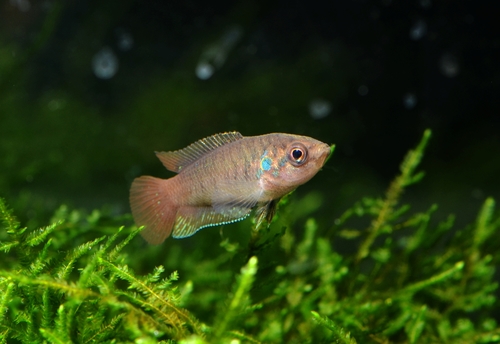
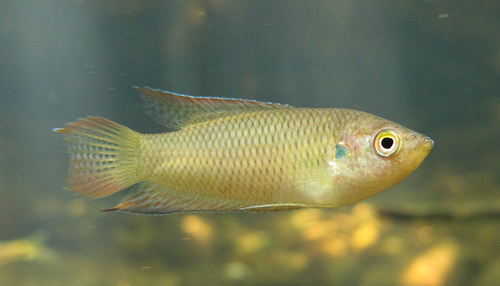
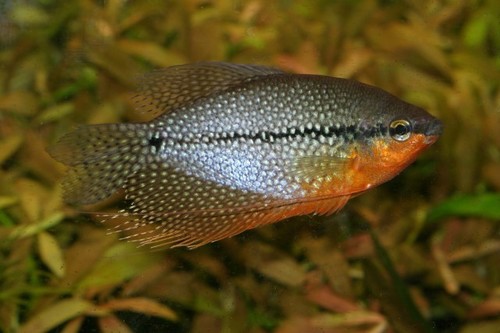
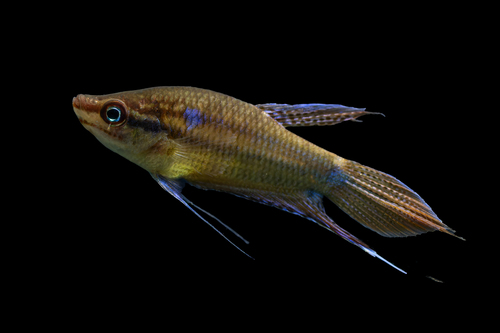
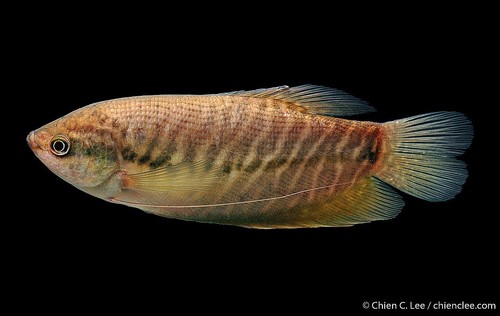
Trichopodus pectoralis Regan, 1910, commonly known as the snakeskin gourami, is an elongated, moderately compressed fish with a small dorsal fin. Its anal fin runs nearly the entire length of the body, while its pelvic fins are long and thread-like. This species has an olive-colored back, greenish-gray flanks with silver iridescence, white underparts, and an obvious irregular black band that extends from the snout through the eye to the caudal peduncle. The rear section of the body may have faint transverse stripes. Its fins are also gray-green, and the iris of the eye can appear amber when in favorable water conditions. Males differ from females by having pointed dorsal fins, orange to red pelvic fins, a slimmer body shape, and more intense coloration. Juvenile snakeskin gouramis have notably prominent, strong zig-zag lines that run from the eye to the base of the tail. The maximum recorded total length for this species is 25 centimeters (9.8 inches), though most individuals only reach approximately 15 centimeters (5.9 inches) in length. This species is native to the Mekong and Chao Phraya basins, occurring mainly in Thailand, as well as in southern Vietnam, Laos, and Cambodia. It has also been introduced to the Philippines, Malaysia, Indonesia, Singapore, Papua New Guinea, Sri Lanka, and New Caledonia. Snakeskin gouramis inhabit rice paddies, shallow ponds, and swamps. They occupy shallow, sluggish or standing water environments that contain abundant aquatic vegetation. They also live in the flooded forests of the lower Mekong, and gradually move back into rivers as floodwaters recede. Snakeskin gouramis generally feed on aquatic insects and other small living organisms found in their habitat. Like other labyrinth fish, they can breathe air directly, in addition to absorbing oxygen from water through their gills.