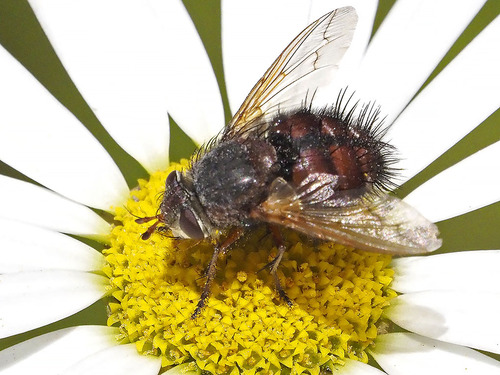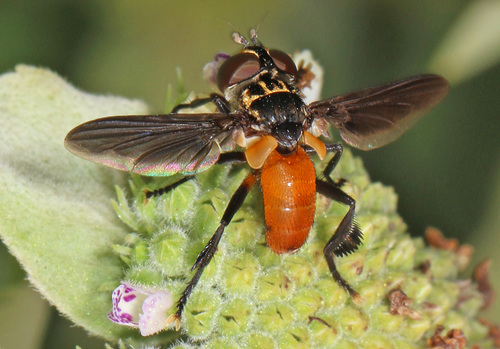
About Trichopoda pennipes (Fabricius, 1781)
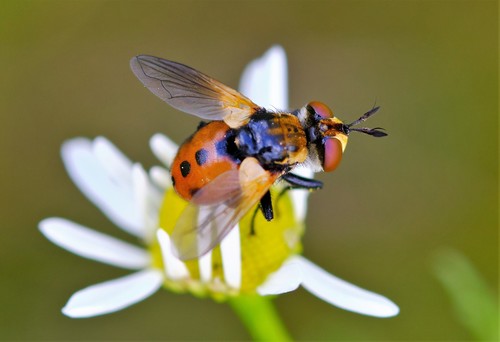
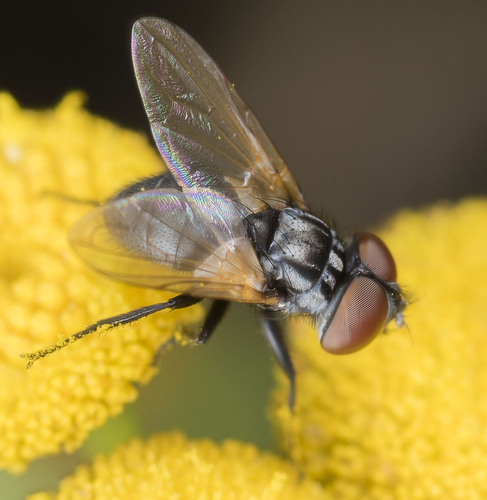
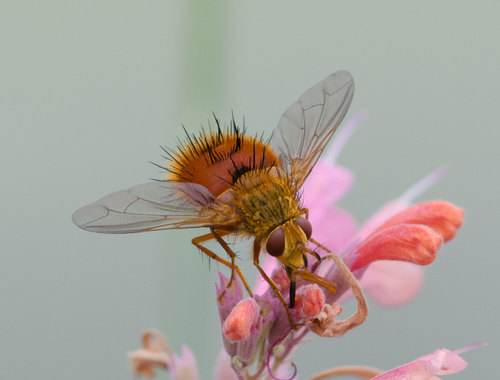
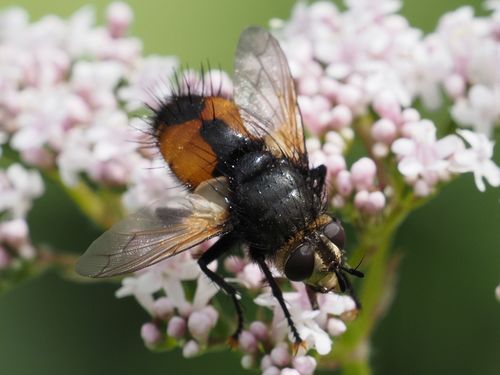
Trichopoda pennipes is a medium-sized fly first described by Fabricius in 1781. It reaches a body length of 10.5 millimetres (0.41 in), which is roughly the size of a large housefly. These flies have a velvety black head, large brown eyes with yellow coloring in the space between the eyes, and a black or brown thorax marked with a few yellow stripes. The slender abdomen varies in color from bright orange to completely black. Females usually have a dark-tipped abdomen, while males have a dark orange abdominal apex. The wings are transparent, smoky, and have prominent visible veins. Female wings are evenly dusky, with a sub-hyaline posterior margin; male wings have a ferrugineous marking. This species has very large halteres, and its legs are black with yellow tarsi (feet). The hind legs carry a prominent feather-like fringe made of flattened hairs. This species is native to North America (including the United States and Mexico), the Hawaiian Islands, and South America, and has been introduced into southern European countries including France, Italy, and Spain. It lives in grasslands, hedgerows, and agricultural fields where its key host species are present. Adult Trichopoda pennipes first emerge in late spring or early summer, and feed on nectar from flowers such as Queen Anne's lace and meadowsweet. Adults can be seen hovering above plants while searching for host bugs to lay their eggs on, most commonly squash bugs and southern green stinkbugs. Females lay several small, pale, oval eggs on the body of large nymph or adult host bugs. Trichopoda pennipes larvae are parasitoids that develop inside several species of true bugs. Common host groups include squash bugs and leaf-footed bugs in the family Coreidae (including the large western conifer seed bug, Leptoglossus occidentalis), stinkbugs in the family Pentatomidae, and other pentatomorph bugs from the Largidae and Scutelleridae families. After eggs hatch, larvae burrow into the host bug's body. If multiple larvae develop inside a single host, only one larva will survive. When the larva finishes feeding on the host bug's tissues, it emerges as a cream-colored larva and drops to the ground, where it pupates inside a reddish-brown puparium formed from the last larval skin. The host bug dies after the larva emerges. An adult fly emerges from the pupa after approximately two weeks. After mating, a total female can lay several hundred eggs in total. This species can produce up to three generations per year, and overwinters as a second instar larva inside the body of its overwintering host bug. Trichopoda pennipes is used as a biological control agent for agricultural pest bugs. One of its main host species is the southern green stinkbug, Nezara viridula, an invasive crop pest originally from Ethiopia that now has a worldwide distribution. This stinkbug is named for the foul-smelling defensive secretion it produces from a thoracic gland. While this secretion is fairly effective at deterring predation by birds, Trichopoda pennipes tolerates it well. T. pennipes is highly attracted to the aggregation pheromone produced by male southern green stinkbugs, which leads to a higher proportion of male stinkbugs being parasitized than females. Different biotypes of T. pennipes exist across the United States, each targeting different host species in different regions. In northern California, a native population of the fly parasitizes the bordered plant bug Largus succinctus, but does not attack squash bugs (Anasa tristis). In a biological control introduction experiment, T. pennipes collected from squash fields in New York State were released near California squash fields. The introduced New York population successfully targeted squash bugs and established permanent populations. Currently, T. pennipes eggs can be found on nearly 50% of squash bugs in the area, though the overall effectiveness of this population for crop pest control remains unclear. Parasitism rates can reach as high as 93% for southern green stink bugs, and up to 80% for squash bugs. However, T. pennipes does not prevent all crop damage, because parasitized host bugs continue to feed and reproduce after infection. Once the parasitoid reaches the second instar stage of development, the host bug's reproductive organs begin to atrophy. Pest control is more effective when host nymphs are parasitized: around half of parasitized nymphs die before reaching adulthood, and any parasitized nymphs that survive to overwinter will die before they can lay eggs.