About Trichophorum cespitosum (L.) Hartm.
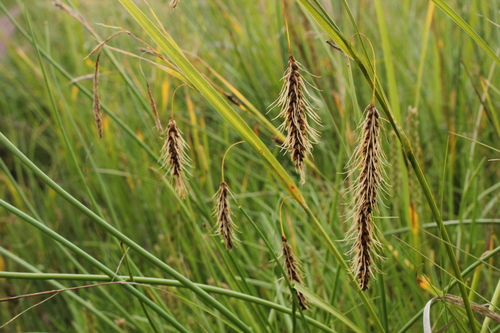
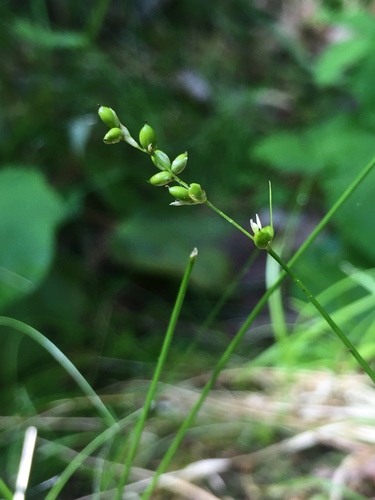
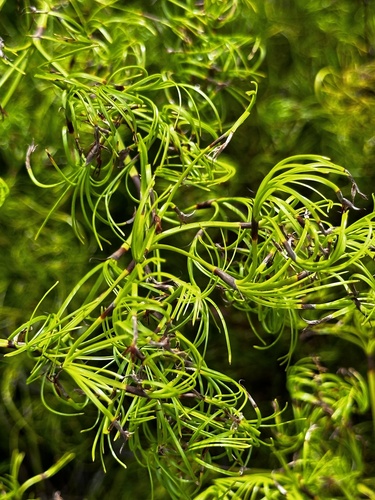
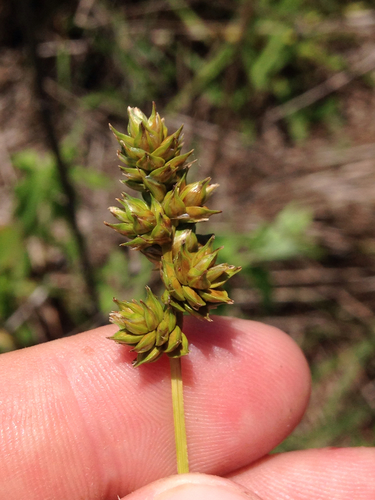
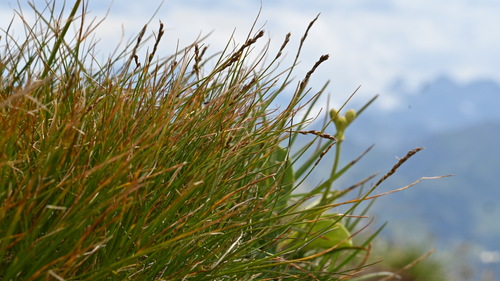
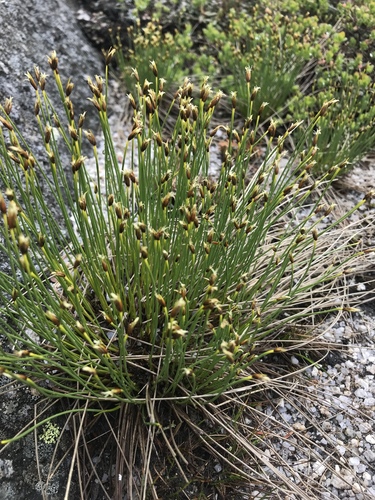
Trichophorum cespitosum (L.) Hartm. is a densely tufted perennial sedge that often grows in large gregarious groups. Its wiry stems are round in cross-section, slightly ridged, and reach up to 1 foot (30 centimeters) in length. Its leaves are reduced to several pointed sheaths at the base of the stem. The blade from the uppermost sheath is longer than the equivalent blade in the similar-looking few-flowered spike-rush (Eleocharis quinqueflora), which has a small, squarish upper leaf blade. Its brownish inflorescence forms a very small, narrow terminal head. The basal, pointed, ribbed green glume of this head is the same length as the rest of the head structure. The fruit is an ovoid, three-sided nut 2 millimeters (0.08 inches) in diameter.
This species has a circum-boreal montane distribution. Within the British Isles, it is found in Scotland, Northwest England, Wales, Southwest England, and most of Ireland, and its occurrence becomes sparser in Southeastern England. It grows in wet acidic soils and peats, in habitats including bogs, moorland, and wet heaths. It persists even in burned areas and sites with high grazing pressure from deer. In Britain, it grows from sea level up to at least 1,190 meters (3,900 feet) above Caenlochan in Angus, and is a common species that grows abundantly in suitable conditions.
In the Alps and other montane regions, flatter mires are often dominated by this species and cottongrass (Eriophorum angustifolium), forming a plant community that turns brown in winter. This species only grows along the margins of active bogs, where the raised central bog areas are dominated by sphagnum moss (Sphagnum spp.). Trichophorum cespitosum becomes the dominant species at bog sites when drainage occurs. In wet heathland, it may grow alongside heather (Calluna vulgaris) and purple moor grass (Molinia caerulea), and provides grazing for deer, cattle, and sheep.