About Trichonephila clavipes (Linnaeus, 1767)
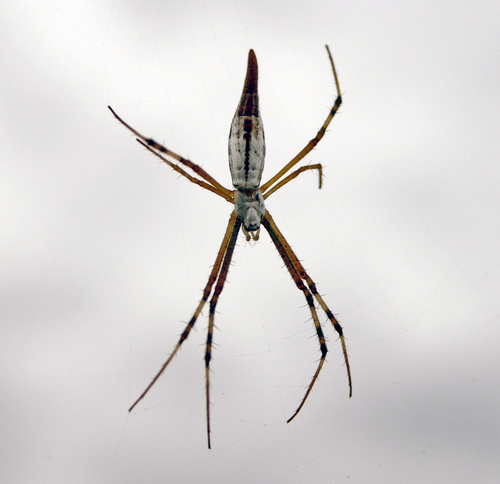
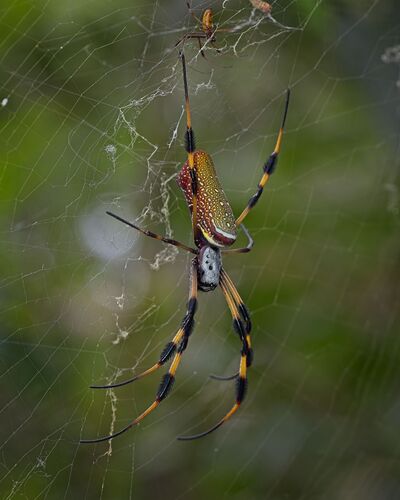
Like most orb-weavers, Trichonephila clavipes shows clear sexual dimorphism in both size and color pattern. Mature female T. clavipes are among the largest non-tarantula spiders in North America, reaching 24 mm to 40 mm in body length, and may even be the largest native orb-weaver species in the United States. Females have distinct, recognizable coloring: a silvery white cephalothorax, a longer orange-brown abdomen marked with two rows of small white-yellow spots. The abdomen changes color as the spider matures. Their legs have dark yellow and brown banding, and the first, second, and fourth leg pairs also have black brush-like hair tufts near the joints. Males are far smaller, with a more slender build, reaching roughly 6 mm in length, or one-third to one-quarter the size of females. Their mass is only between 1/30th and 1/70th that of a large female. Male coloration is much simpler, consisting of a dark brown body and legs, with a black band on the tibial segment of each leg located in the same area where females have black hair tufts. Female T. clavipes share a trait with female Trichonephila plumipes: both have stiff hair collections on their legs. However, the hairs of T. plumipes are more closely spaced than those of T. clavipes. T. clavipes is most common in the Antilles and Central America, ranging from Mexico in the north to Panama in the south. It occurs less abundantly as far south as Argentina, and as far north as parts of the southern continental United States. Seasonally, the species can range more widely; in summer, it may be found as far north as lower Eastern Canada. Seldom do these spiders survive the winter north of 40° N latitude. T. clavipes may also be found inside or near colonies of Metepeira incrassata, a Mexican colonial orb-weaver that typically forms large groups ranging from hundreds to thousands of individual spiders. Human accidental transport of T. clavipes in cargo containers, plant nursery stock, and similar goods causes the species to occur very unevenly across large areas, with patches of high local density often found far from other populations. Accidental human transport of this species peaks in late August to early September, when the spiders reach their reproductive peak. Unlike many other species, T. clavipes can benefit from urban habitats and human development: multiple individuals in more developed areas have been observed growing significantly larger than their rural counterparts. The silk of T. clavipes has recently been studied to assess its usefulness for surgically improving neuronal regeneration in mammals. In vitro experiments found that a single silk filament can guide a severed neuron through the body back to its original cut site. The silk does not trigger an immune system response, so it is not rejected by the host body.