About Tricholoma vernaticum Shanks
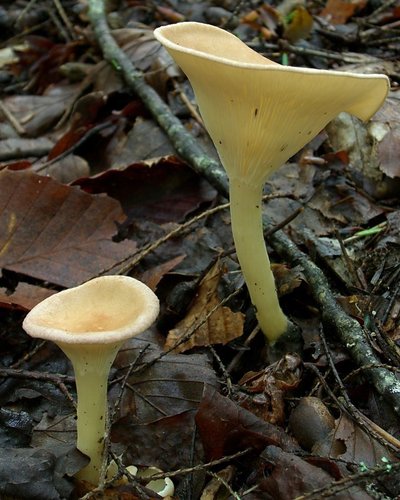
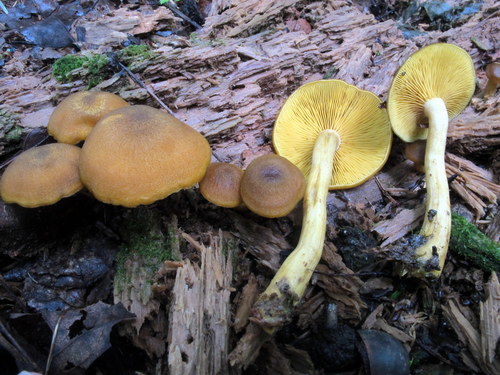
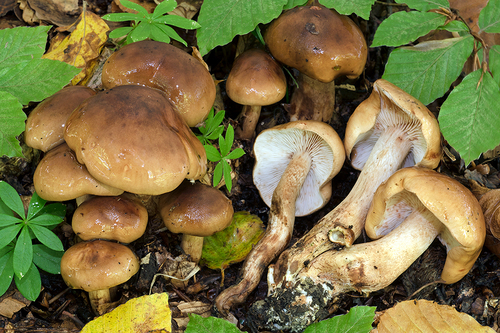
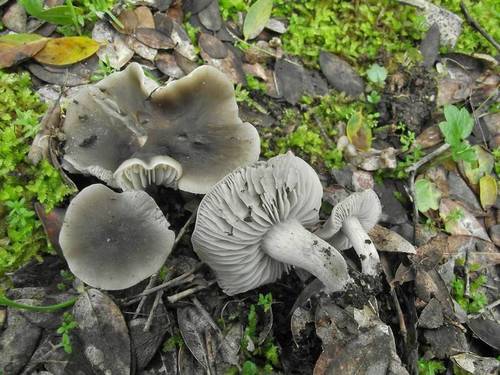
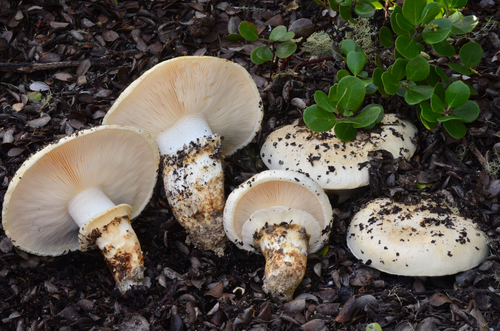
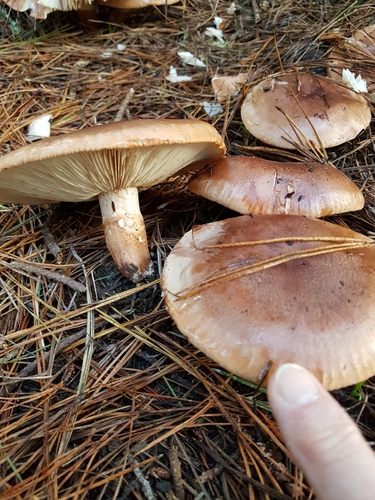
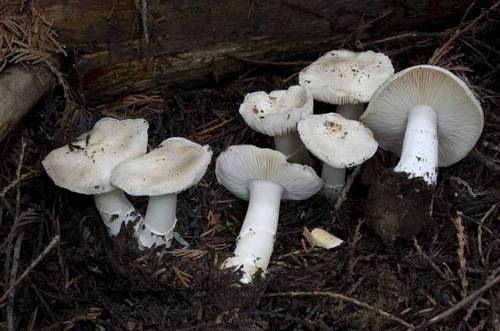
Tricholoma vernaticum Shanks has a cap that starts convex to broadly convex, then flattens as it ages, reaching 6 to 15 cm (2.5 to 6 in) in diameter. The cap surface is smooth, and ranges from dry to moist; mature caps may have white patches of remaining veil. As the mushroom grows older, the cap color changes from white to fuscous (dusky brownish grey) or brown, and usually has regions of olive, grayish, or pale tan. The cap margin is initially curved downward, then lifts with age to become lobed or irregular in shape. The flesh is thick and white, with a strong farinaceous odor that resembles cucumber or watermelon rind. The gills initially attach to the stipe in an emarginate (notched) to adnate arrangement, but pull away from the stipe as the mushroom matures to become seceding or almost free of attachment. They are thick, closely spaced, whitish, and sometimes develop pale pink tints. The solid stipe is 4–14 cm (1.6–5.5 in) long and 1.3–4 cm (0.5–1.6 in) thick, and is either equal in width along its length, or bulged at the base. The dry stipe surface has a texture ranging from smooth to silky fibrillose above the ring, and appressed fibrillose to scaly below the ring. The ring sits on the middle to upper half of the stem, and is sometimes inconspicuous. It is not known for certain whether this mushroom is edible; it has a strongly farinaceous taste, and an unpleasant odor strongly reminiscent of rotting white potatoes. The spore print of Tricholoma vernaticum Shanks is white. Its spores are elliptic or narrowly elliptic, and measure 8–12 by 4.8–6.2 μm. Clamp connections are present in the hyphae. The spore-bearing basidia are four-spored, club-shaped, and measure 23–30 by 8–10 μm. Cystidia are absent from the hymenium. The cap flesh is made of uniform, interwoven hyphae 3–5 μm in diameter, while the cap cuticle is a 200 to 300 μm thick layer made of interwoven, gelatinous hyphae up to 4 μm in diameter. Fruit bodies grow singly or in groups under conifers during late spring and early summer. A fairly common species within its range, it is found at high elevations from California north to Oregon and Washington. It is classified as a snowbank fungus, meaning it is commonly found growing at the edge of melting snowbanks. Fruit bodies are often buried under humus, forming barely visible "mushrumps" that only appear as cracked bumps on the ground.