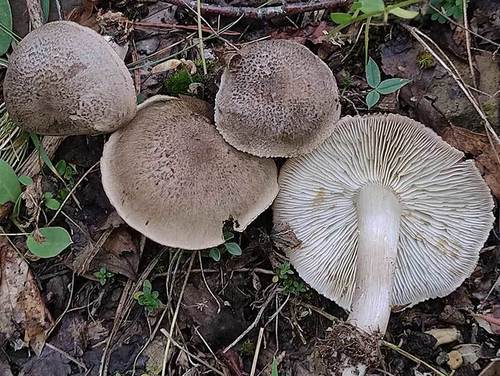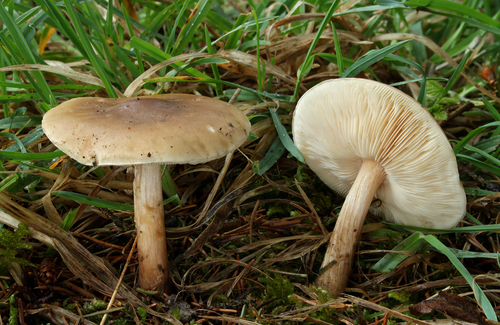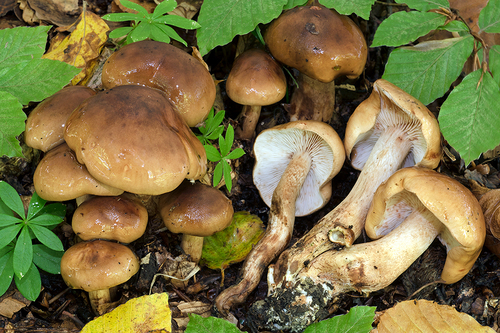
About Tricholoma ustale (Fr.) P.Kumm.
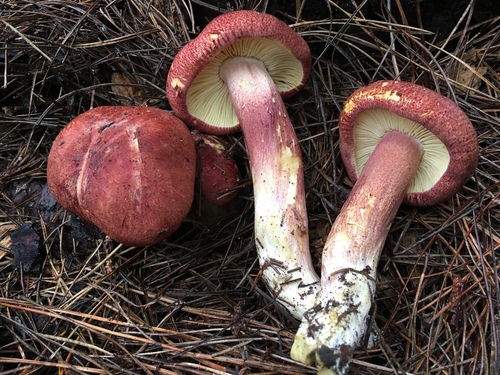
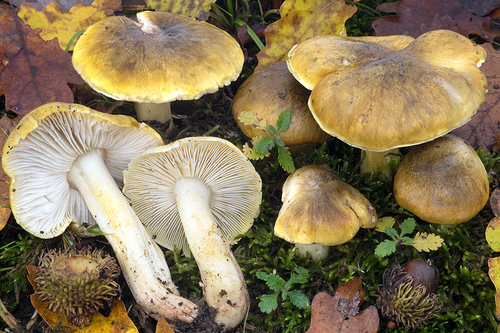
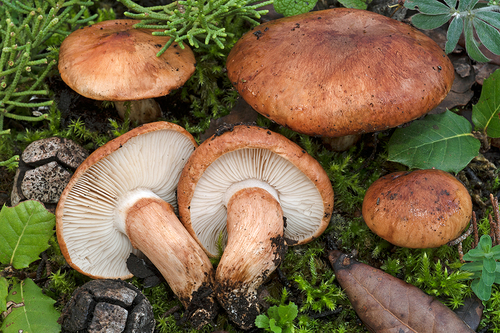
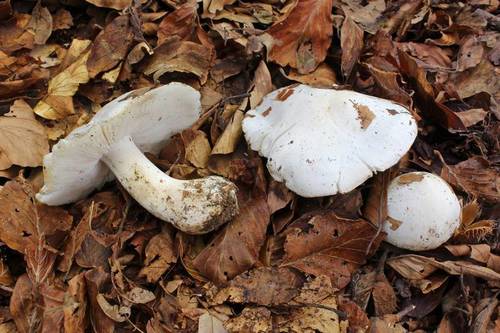
Tricholoma ustale (Fr.) P.Kumm. has a bell-shaped, conical, or convex cap that is 3–10 cm (1.2–3.9 in) in diameter and colored orange-red-brown. The cap margin is initially curled inward, straightening as it ages, when the edge becomes lobed and wavy. The gills are somewhat crowded, with adnate to emarginate attachment to the stem. They are cream to pale yellow when young, and turn pale brown with brown spots as they age. The stem is cylindrical, 3–9 cm (1.2–3.5 in) long by 1–2.5 cm (0.4–1.0 in) thick, and is somewhat thicker at the base. The mushroom's flesh is white, but turns brown when bruised or injured. Its roughly spherical to ellipsoid spores are typically 6.0–7.5 by 5.0–6.0 μm, and have a hilum. Tricholoma ezcarayense, first described from Spain in 1992, is similar in appearance to T. ustale and also grows in association with beech. It can be distinguished in the field by its less robust stature, minute flat scales on its cap, and green tints mixed into its reddish-brown cap color. It can be distinguished more reliably by microscopic characteristics: the hyphae in its cap cuticle have abundant clamp connections, which T. ustale does not have. Tricholoma ustale is an ectomycorrhizal species that grows in association with beech. In England, it can be locally common in the southern counties. Tricholoma ustale is one of the three species most commonly linked to mushroom poisoning in Japan, the other two being Omphalotus japonicus and Entoloma rhodopolium. Eating this mushroom causes gastrointestinal distress, including symptoms such as vomiting and diarrhoea. Chemical analysis of Japanese populations has identified the toxic principles ustalic acid and several related compounds. When force-fed to mice, ustalic acid causes them to sit still in a crouched position, be hesitant to move, and induces tremors and abdominal contractions. A high enough concentration of the toxin (10 milligrams per mouse) causes death. Ustalic acid is an inhibitor of the sodium-potassium pump (Na+/K+-ATPase) found in the plasma membrane of all animal cells, and has been chemically synthesized. The toxicity of North American populations of Tricholoma ustale is unknown.