About Tricholoma saponaceum (Fr.) P.Kumm.
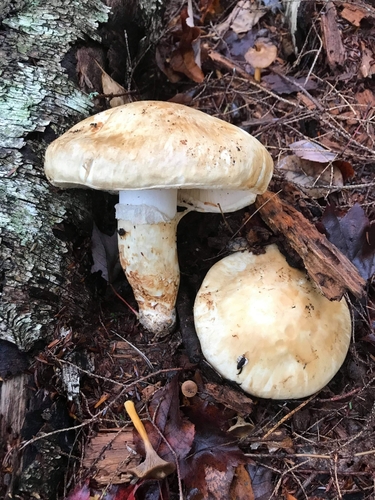
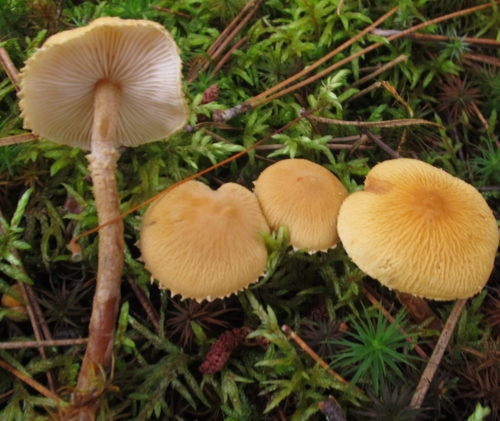
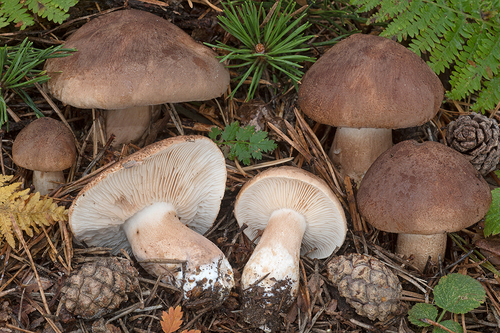
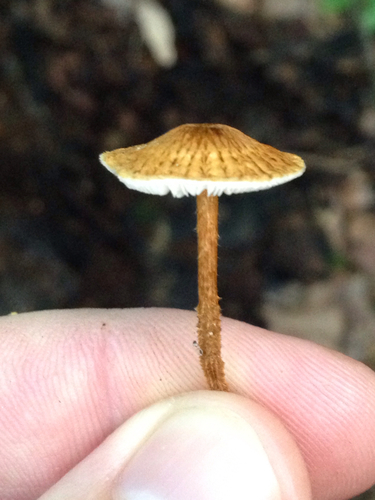
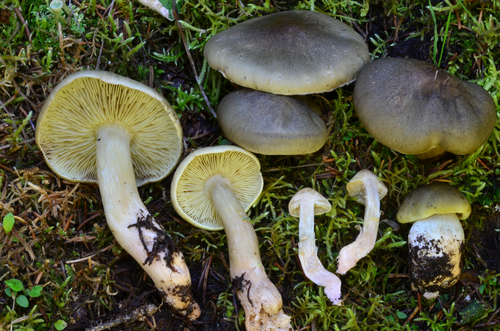
Tricholoma saponaceum has a convex cap 4–15 cm (1.6–5.9 in) across, with a faint umbo that flattens as the mushroom ages. Its cap color is highly variable, with recorded shades of greyish, greenish, olive, yellowish, and brownish. The cap margin is paler, and the entire cap fades with age. The widely spaced gills are adnexed and whitish, though they may be tinted pale green, and turn pink when bruised. The whitish stipe, which sometimes shows the same colors seen on the cap, has no ring, may be swollen in the middle, and grows 4–12 cm (1.6–4.7 in) tall by 1–3 cm (0.4–1.2 in) wide. The flesh may stain pink-orange (but does not always do so), and this pink-orange color may already be present in the flesh at the base of the stipe. The spore print is white, and the smooth oval spores measure 5–6 × 3–4 μm. It has a distinctive odor compared to newly scrubbed floors or soap. This is a terrestrial mushroom found in Europe and North America, and it is abundant in the Pacific Northwest and Rocky Mountains. It grows in coniferous and deciduous woodlands, and is more commonly found in coniferous woodlands in North America, fruiting from late summer to late autumn. In the western United States, it associates with spruce, live oak, tanoak, and madrone. In central and southern Europe, it associates with oak. The fungus has a bland or mild taste. Most guidebooks classify it as either inedible or poisonous, as it contains toxins that can cause severe gastric upset.