About Trichoderma cornu-damae (Pat.) Z.X.Zhu & W.Y.Zhuang
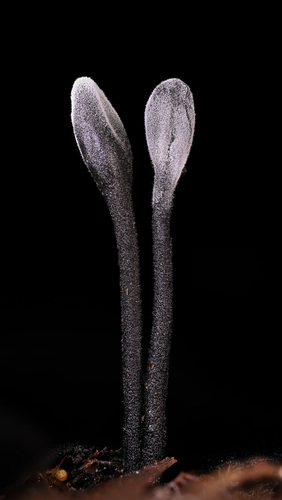
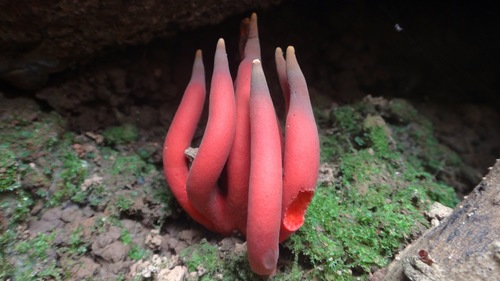
Trichoderma cornu-damae (Pat.) Z.X.Zhu & W.Y.Zhuang has conidiophores—specialized fungal hyphae that produce conidia—that reach up to 400 μm in height, with main axial hyphae measuring about 2–4 μm wide. Its phialides grow in tufts at the top at narrow angles, a structure similar to the branching hyphae seen in other Trichoderma species. The species' conidia are roughly spherical with a truncate base on each spore, pale green in color, 2.5–3.5 μm in diameter. Conidium surfaces are almost smooth, but sometimes appear very faintly roughened when viewed with light microscopy. This fungus was originally thought to grow only in mountainous areas of South Korea and Japan, but has recently been discovered in Indonesia, Papua New Guinea and Australia. Multiple cases of poisoning have been recorded in Japan after people consumed this fungus. In 1999, one person out of a group of five from Niigata Prefecture died two days after eating one to two grams of the fungus' fruit body that had been soaked in sake. In 2000, a person from Gunma Prefecture died after eating fried specimens of this fungus. Symptoms recorded in these poisoning cases include gastroenteritis, hemophagocytosis, leukocytopenia, thrombocytopenia, peeling skin on the face and hands, scalp hair loss, and cerebellum damage that causes speech impediment and problems with voluntary movement. In one fatal case, an autopsy found acute kidney and liver damage alongside associated disseminated intravascular coagulation. In one non-fatal poisoning case, the patient developed hemophagocytosis plus severe leukocytopenia and thrombocytopenia seven days after ingesting the fungus. Plasmapheresis and administration of granulocyte colony-stimulating factor were used to treat the patient's blood abnormalities. The reporting authors suggested these treatments, plus a large volume of intravenous saline—9 liters (2.0 imperial gallons; 2.4 U.S. gallons) over 12 hours—led to the patient's successful recovery. Symptoms of human poisoning from this fungus match symptoms seen in livestock that have consumed trichothecene mycotoxins. Japanese researchers have detected the macrocyclic trichothecenes satratoxin H, satratoxin H 12′,13′-diacetate, satratoxin H 12′-acetate, and satratoxin H 13′-acetate in the fungus. When grown in liquid culture, the fungus additionally produces roridin E and verrucarin J. With the exception of verrucarin J, a 500 microgram (one half milligram) dose of any of these compounds will kill mice within a day when injected into the abdomen. Unverified claims state that touching this fungus causes an uncomfortable rash.