About Trichocladus crinitus (Thunb.) Pers.
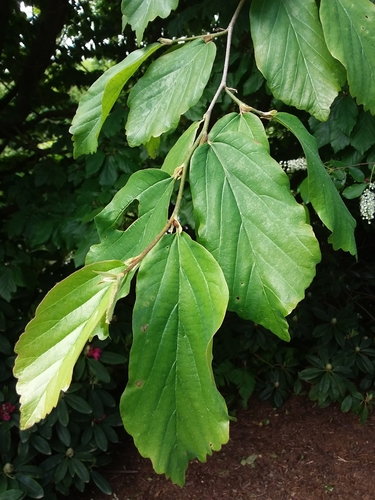
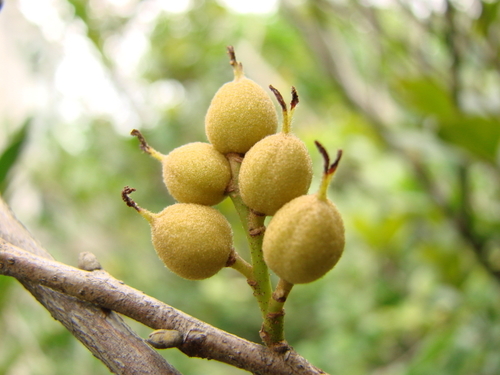
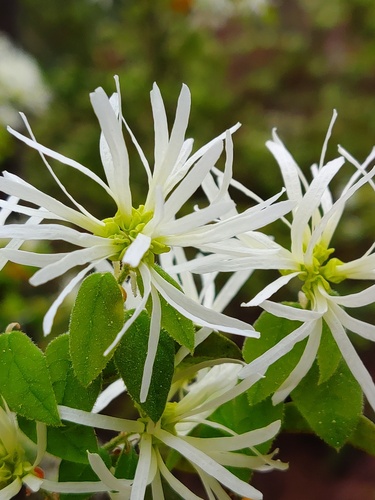
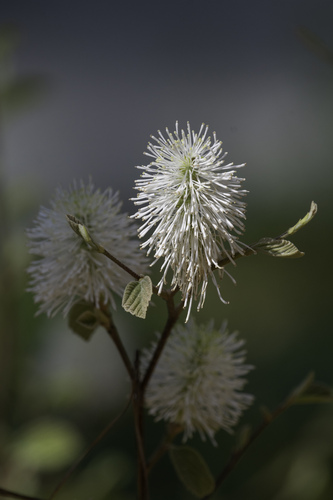
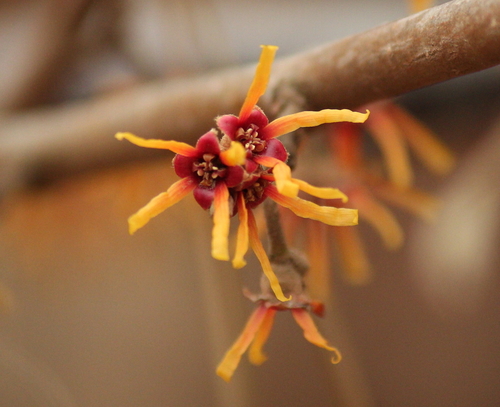
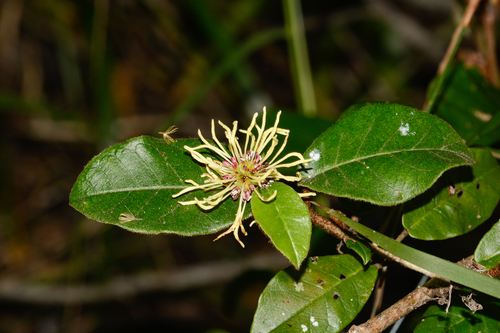
Trichocladus crinitus (Thunb.) Pers. is a species that can grow as a subshrub, shrub, or small tree reaching 3 to 4 meters in height. It is endemic to South Africa, where it is most often found growing in the understory of evergreen forests along the Garden Route. Its leaves grow opposite one another, and are elliptic with a tapering apex and a slightly lobed or square base. The upper surface of the leaves is dark and shiny green, while the lower surface is covered in dark brown velvety hairs, particularly along the midrib. Adult leaves usually measure between 2.5 cm and 10 cm in length and 1.5 cm to 7 cm in width, though they may occasionally grow slightly larger. The short, thick petiole is peltate. The bark of this species is smooth, and ranges in color from deep brown to pale grey. Its wood is white in color and very hard. Flowers of Trichocladus crinitus range in color from green to yellow or orange, and their shape closely resembles that of Hamamelis. Male and female reproductive structures are held on separate flowers; these separate flowers may occur on the same individual or on different individuals, meaning the species can be either monoecious or dioecious. This species flowers from April to August. It produces small, hairy fruits in the form of capsules, which are borne in clusters. The fruit color ranges from red to brown depending on its ripeness. Fruits are typically 5 to 7 millimeters in length, and ripen between October and November. In cultivation, Trichocladus crinitus grows well in cool temperate greenhouses, and requires compost and care similar to that needed for Gardenia.