About Trichius fasciatus (Linnaeus, 1758)
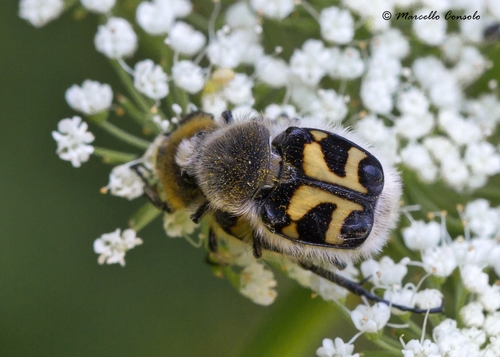
Trichius fasciatus (Linnaeus, 1758) reaches an adult body length of 9 to 12 millimetres, or 0.35 to 0.47 inches. Its head and pronotum are black, while its elytra range in color from light yellow to deep orange. The elytra are marked with several black bands, and the first of these black bands extends all the way to the scutellum. The sides of the beetle’s thorax and the back of its abdomen are covered in yellow-orange or white pubescence. This fuzzy, banded appearance gives the beetle a strong resemblance to a bumblebee, which provides better protection from predators. This resemblance to a bee is the reason the entire genus this species belongs to is commonly called bee beetles. Males and females of Trichius fasciatus are easily distinguished by traits of their legs and terminal abdominal segment. Females have strong outer teeth on their front legs, which are adapted for digging. On a female’s front leg, the first tarsal segment is small and only protrudes slightly from the tip of the terminal tooth. Females also have a pygidium that does not end in a rounded shape, instead ending with a clear indentation. In contrast, males have weaker digging teeth on their front legs. A male’s first tarsal segment clearly protrudes beyond the end tooth, and is bulbously thickened on its outer edge. Males also have a strong transverse ridge located about halfway along the mesotibia, and this ridge ends in a tooth. This species is found across most of Europe and the eastern Palearctic realm. It occurs most often in forest clearings within mountainous areas, and is rare in lowlands. It typically lives on flowers growing in forest meadows and along forest edges.