About Trichilogaster signiventris (Girault, 1931)
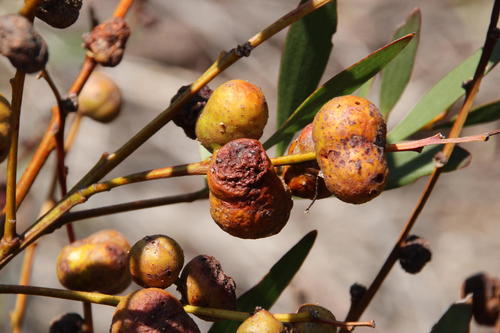
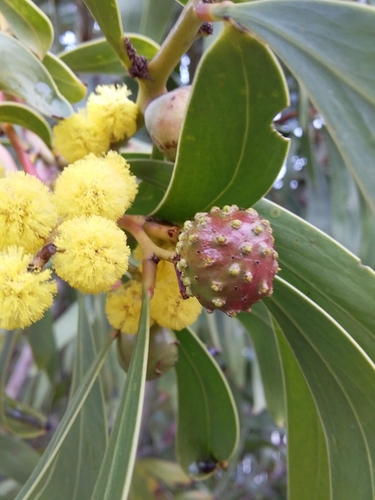
Trichilogaster signiventris, commonly known as the golden wattle bud-galling wasp, is a species of Australian chalcid wasp that parasitises, among other plants, Acacia pycnantha (golden wattle). It has been introduced into South Africa, where golden wattle has become an invasive pest. American entomologist Alexandre Arsène Girault first described this species in 1931 under the name Perilampella signiventris. Female T. signiventris are yellow and black, with high variation in the proportion of each colour and their overall patterning. Females range from 2.3 to 3.2 mm (23⁄256 to 1⁄8 inch) in length. Males are a similar size to females, and are almost entirely black, with black and yellow legs. After the related species Trichilogaster acaciaelongifoliae proved successful at managing invasive Acacia longifolia, scientists began searching for an additional species to control invasive A. pycnantha. T. signiventris was introduced twice for this purpose, and was initially considered a failed introduction. In 1987, wasps collected from Lake Natimuk, Victoria were transported and released in South Africa’s Western Cape. No galls were observed the first summer after release, so scientists suspected the first wasp cohort was incompatible with South African golden wattle populations, and conducted a second introduction in 1992, this time using wasps from Mount Compass, South Australia. Known host species for this wasp are golden wattle (Acacia pycnantha) and Acacia rivalis. Short-lived adult wasps lay their eggs into flower head buds during summer. The eggs hatch in May and June, after which the larvae induce formation of grape-like galls in the bud and prevent normal flower development. Galls can grow heavy enough to break the branches they form on. T. signiventris introduction has reduced the reproductive capacity of invasive golden wattle across its introduced range in South Africa. It is thought the galls may also reduce host plant resilience by absorbing nutrients, effectively starving the host plant. Galls can reach up to 3 centimetres (1+1⁄4 inches) in diameter, and each gall contains several wasp larvae.