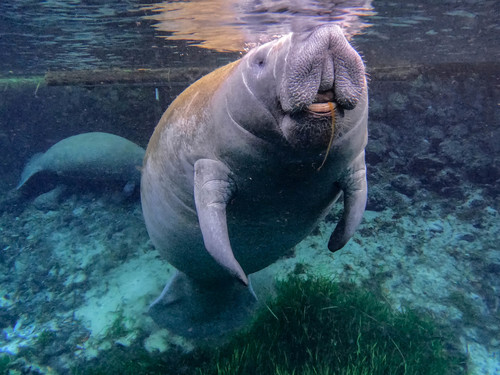
About Trichechus manatus Linnaeus, 1758
The West Indian manatee (scientific name: Trichechus manatus Linnaeus, 1758) averages 2.7–3.5 m (8.9–11.5 ft) in length and weighs 200–600 kg (440–1,320 lb), with females generally larger than males. The largest recorded individual weighed 1,655 kg (3,649 lb) and measured 4.6 m (15 ft) long. Wild West Indian manatees are estimated to live 50 years or more; one captive Florida manatee named Snooty lived 69 years, from 1948 to 2017. As mammals, West Indian manatees breathe air, are endothermic (warm-blooded), and produce milk. Like all sirenians, they have adapted fully to aquatic life and lack hind limbs, replaced by a spatula-like paddle that provides propulsion through water. They have streamlined bodies with no external ear flaps, which reduces water resistance. Sparse body hair (pelage) is distributed across their thick skin, which may help reduce algae buildup. Manatee skin is generally gray, but its color can change due to algae and other opportunistic organisms that grow on it, such as barnacles. Scar tissue on manatees is white and remains visible for decades, making individual identification easy. Florida manatees have three to four nails on each flipper. West Indian manatees have a prehensile snout (similar to that of their relative the elephant) that they use to grab vegetation and move it into their mouth. Each jaw quadrant holds six to eight molariform teeth. These teeth grow at the back of the mouth and slowly migrate forward at a rate of 1–2 mm per month, before eventually falling out. This "conveyor belt" tooth replacement system provides continuous new tooth production, which is well-suited to the manatee’s feeding habits: manatees feed on vegetation for four to eight hours per day, and consume 5–10% of their body weight daily. 3–5 cm long hairs cover the manatee’s entire body and provide somatosensory input. Manatee bones are dense and solid, acting as ballast to create negative buoyancy that counteracts the positive buoyancy from the species’ high fat content. Together with air held in the lungs, these opposing buoyancy properties allow manatees to achieve neutral buoyancy in water, which makes breathing, foraging, and swimming easier. Unlike most other mammals, manatees have a longitudinally oriented diaphragm that is split into two separate hemidiaphragms, each capable of independent muscular contraction. The West Indian manatee mostly inhabits shallow coastal areas, including rivers and estuaries. It can tolerate large changes in salinity, so it lives in both freshwater and saltwater. The species’ extremely low metabolic rate and lack of a thick insulating layer of body fat restrict it to warm waters in tropical regions. The Florida subspecies lives primarily along the Florida coast, but has been observed as far north as Dennis, Massachusetts, and along the Gulf Coast of Texas. On one inland foray in 2006, a manatee was spotted in the Wolf River near its confluence with the Mississippi in Memphis, Tennessee, over 700 river miles from the Gulf of Mexico. The Antillean subspecies has a sparse distribution across the Caribbean, ranging north to Mexico and south to Brazil. During the Pleistocene, the West Indian manatee had a wider range across North America, with fossils found in Texas, and the Mississippi River and Ohio River. Analysis of mitochondrial DNA shows the West Indian manatee is divided into three primary geographic groups: (1) Florida and the Greater Antilles; (2) Mexico, Central America and northern South America; and (3) northeastern South America. The West Indian manatee’s seasonal distribution changes with water temperature. Temperatures below approximately 20 °C (68 °F) increase the risk of cold-induced stress or death for manatees. Because of this, Florida manatees seek out warm-water refuges during winter, mostly concentrated on the Florida peninsula. Many of these refuges are artificial, created by warm water runoff from nearby power plants. The Antillean manatee is less susceptible to cold-induced stress, as it occupies consistently warmer waters. Florida manatees live at the northernmost limit of sirenian habitat. There are four recognized subpopulations of the Florida manatee: the Northwest, Southwest, Atlantic Coast and St. John's River populations. Large concentrations of Florida manatees are found in the Crystal River and Blue Spring regions of central and north Florida. The Antillean manatee is sparsely distributed across the Caribbean and northwestern Atlantic Ocean, from Mexico east to the Greater Antilles, and south to Brazil. Populations are also found in The Bahamas, French Guiana, Suriname, Guyana, Trinidad, Venezuela, Colombia, Panama, Costa Rica, Curaçao, Nicaragua, Honduras, Guatemala, Belize, Cuba, the Dominican Republic, Jamaica and Puerto Rico. It is possibly extirpated from the Turks and Caicos Islands, and definitively extirpated from all Lesser Antilles except Trinidad and Curaçao. Its presence in Haiti is unconfirmed. A planned reintroduction to Guadeloupe was terminated early due to political issues. The projected long-term loss of warm-water habitats poses a significant risk to West Indian manatees, as they cannot tolerate temperatures lower than 20 °C (68 °F) for extended periods. Florida manatees often gather around natural warm-water springs, as well as warm water discharge from power plants during winter. However, as older power plants are replaced with more energy-efficient infrastructure, reduced availability of warm-water refuges could put manatees at risk of cold-induced death. Manatees have high site fidelity, meaning they remember and return to the same refuge sites each winter. Some conservationists worry manatees may become overly reliant on warm water from power plants that will eventually shut down, as Florida plans to reach net zero carbon emissions by 2050, which will likely lead power companies to phase out these warm water discharges. Natural warm-water springs face threats from over-pumping of groundwater for human use, reduced spring flow, nutrient pollution, and being blocked off from manatees by dams or other human-built structures. In areas where manatees cannot reach power plant discharge or natural warm springs, they use natural deep water zones that stay passively above tolerable temperatures. Male manatees reach sexual maturity at 3–4 years of age, while females reach sexual maturity at 3–5 years. Manatees can breed throughout their entire adult lives, though most females first successfully breed at 7–9 years old. Breeding occurs in temporary mating herds, where multiple males gather around an estrous female and compete to mate with her. These herds can last 2 to 4 weeks. Female manatees typically have estrous cycles about one month long, and captive females have been observed to skip cycles. Larger, presumably older, males dominate mating herds and are likely responsible for most successful matings. As noted, sexual dimorphism is slight, with females typically a bit larger than males. Male manatees have internal testes located in the abdominal cavity, posterior to the kidneys. Florida manatee males have seasonal changes in spermatogenesis: they are reproductively active during the warm breeding season, when all stages of spermatogenesis can be observed, while spermatogenesis is inhibited and inactive during the cold non-breeding season. Recent research supports that males use chemosensation from anal glands to locate estrous females. Female reproductive anatomy is most similar to that of elephants: female manatees share the elephant’s zonary placenta, bicornuate uterus, and corpora albicantia. The ovary of a female manatee is shaped like an oval disk, with a flat cortical surface. Because female manatees are polyovular, ovulation scars are often difficult to identify. Gestation lasts 12–14 months, after which a single calf is born; twins are rare, and always dizygotic (fraternal). Newborn calves usually weigh 27–32 kg (60–70 lb) and measure 1.2–1.4 m (4.0–4.5 ft) long. Manatees do not form permanent pair bonds, and males provide no parental care. Calves stay with their mother for up to two years before weaning. Female manatees have two axillary mammary glands located under their flippers, and lactation typically lasts one to two years. Progesterone levels increase in the mother before weaning. During the two-year period with their mother, calves learn how to find warm water sources for winter and memorize summer migration routes. A single female can reproduce once every 2–3 years, a timeline called the calving interval. Wild manatees have been documented producing offspring into their late 30s, and one captive female manatee gave birth in her 40s. Captive breeding programs for the Florida manatee are not currently conducted, because conservation concerns in the species’ natural habitat are still being addressed; a captive breeding program will not be beneficial for the species until these concerns are resolved.

