About Tricerma phyllanthoides (Benth.) Lundell
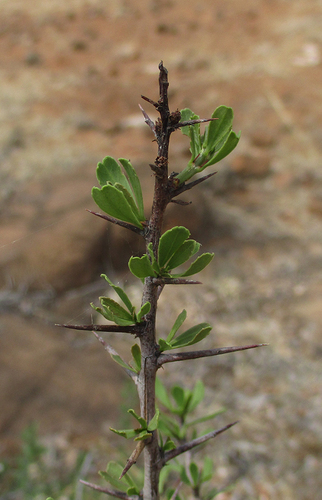
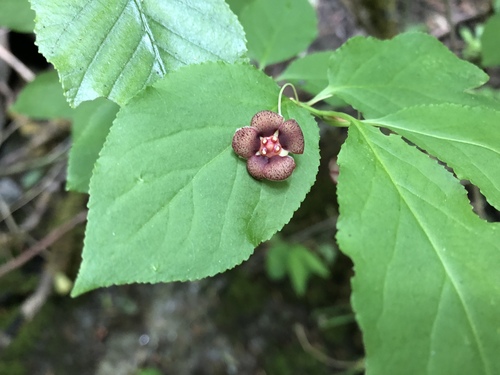
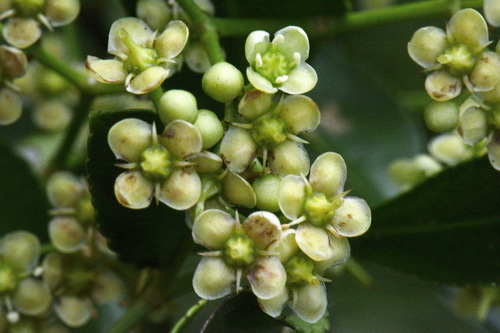
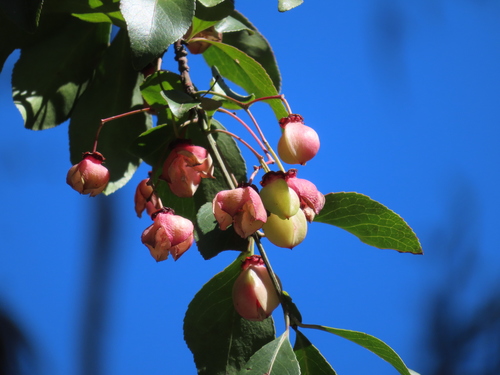
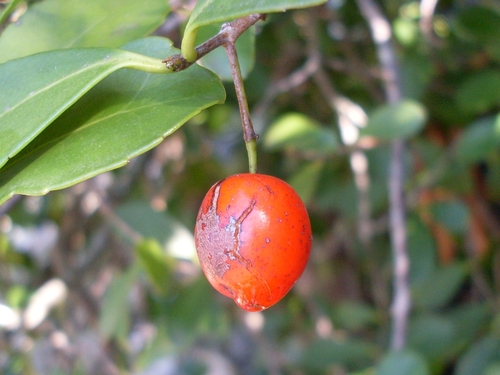
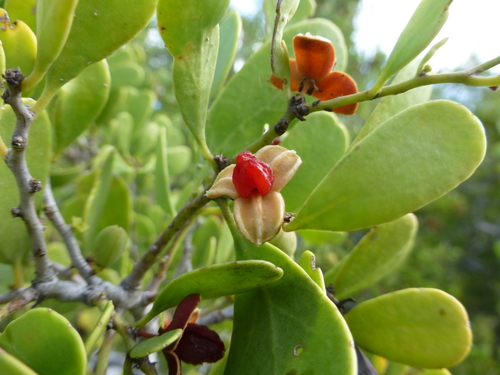
This species is currently classified as Tricerma phyllanthoides (Benth.) Lundell, and was previously known under the name Maytenus phyllanthoides. Mature plants grow up to 7 meters (23 feet) tall, with stems covered in fine, soft hairs. Growth habit varies by variety: plants can be erect, spreading, scandent (leaning on other plants), or prostrate (lying along the ground). Leaves are borne on petioles up to 6 millimeters (roughly 1/4 inch) long. Leaf blades are more or less elliptic, usually wider toward the leaf tip; the tip is blunt to rounded, and sometimes has a tiny tooth or sharp mucro. The blade base typically tapers gradually toward the petiole, though blades of the Gulf Coast variety tend to have rounded bases. Leaf margins may have a few tiny teeth, but are most often toothless, and sometimes wavy. Flowers grow from the stem either singly or in small clusters. They are radially symmetrical, with 5 rounded petals up to 3 millimeters long. A prominent, somewhat flat intrastaminal nectariferous disk sits in the center of the flower, surrounding the pistil; this nectar-secreting structure is a feature found across several plant families. Individual plants can be monoecious (flowers have both male and female reproductive parts) or dioecious (each individual plant bears flowers of only one sex). In male flowers, which have 5 functional stamens, stamen filaments attach beneath the nectar-producing disk. In female flowers, there is one pistil with a superior ovary, and petals alternate with non-functional staminodes. Mature fruits are dry, capsular, up to 12 millimeters long by 6 millimeters wide, and turn pale brownish to orangish. When ripe, the fruit splits open to reveal 1 to 3 seeds, each fully enclosed by a fleshy, bright red aril. Observations of this species recorded on iNaturalist place it in Florida and southern Texas in the United States, across most of Mexico, and in Cuba; additional reports also note its presence in the Bahamas. It grows in hammocks, dunes, and along mangrove forest edges. The variety ovalifolia specifically inhabits coastal prairies, marshes, and clay or sand-clay mounds, and is often found in saline sites. The Mayo people of northwestern Mexico use this species medicinally: leaves are mixed with petroleum jelly and applied to lingering sores, some people chew the leaves to relieve stomach problems, toothache, and scurvy. Gum from the plant has been used to bind splints for broken limbs, alongside other miscellaneous uses. A 2014 study confirmed the species contains lyoniresinol, a compound known to act as an antitrichomonal agent against Trichomonas parasites. In rural areas, the plant’s branches break easily and burn well, so they are used for firewood. Goats feed on the plant’s leaves. It is sometimes planted by gardeners and landscapers, as it forms a mounding evergreen shrub with a manageable size, deep green foliage, produces very little plant litter, and provides good shelter for birds and butterflies. It is highly salt tolerant and grows well with minimal water, though some gardeners dislike its slow growth rate.