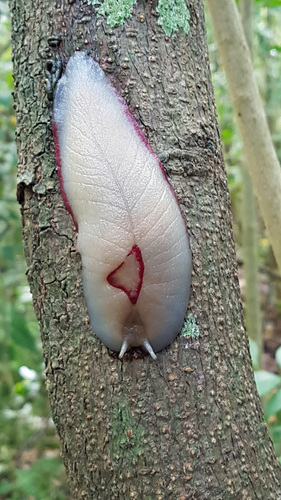
About Triboniophorus graeffei Humbert, 1863
Red triangle slugs, the species Triboniophorus graeffei Humbert, 1863, are easily recognized by having only two tentacles, unlike the four tentacles seen in many other slug species. Like other leaf-vein slugs, they carry a distinctive indented pattern on their back that looks similar to leaf veins. These slugs can reach a maximum length of 14 centimeters. Their coloration is highly variable; individual slugs may be white, off-white, yellow, light grey, dark grey, beige, pink, red, or olive green. No matter the base body color, all adult individuals have a triangular red marking (sometimes orange, magenta, or maroon) on the mantle surrounding the breathing pore called the pneumostome, plus a red line along the edge of the foot. Back texture can also vary between individuals: some have smooth backs, while others have rough backs. Juvenile slugs look very different from adults. They do not have the characteristic red markings, and instead have three dark grey stripes running down their backs, plus a grey outline around their triangular mantle shield. Scientists are still investigating whether some of the observed distinct color forms might actually belong to separate species or subspecies. This slug species is native to the east coast of Australia, where its range extends from New South Wales to Queensland. A closely related, brightly colored pink form, known as Triboniophorus aff. graeffei, is found exclusively on Mount Kaputar in New South Wales. In 1959, malacologist Alan Solem proposed that the species may have been introduced to the New Hebrides, which is now Vanuatu, though no confirmed specimens were available to support this idea when he made the suggestion. Red triangle slugs live in damp locations across a range of habitats, including city gardens, forests, woodland, and heaths.

