About Triakis semifasciata Girard, 1855
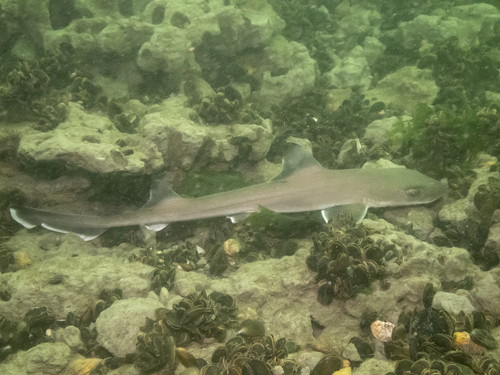
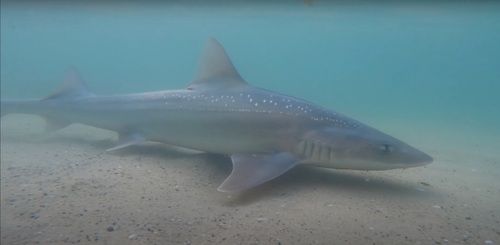
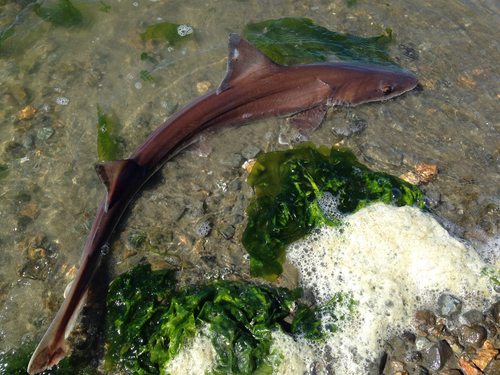
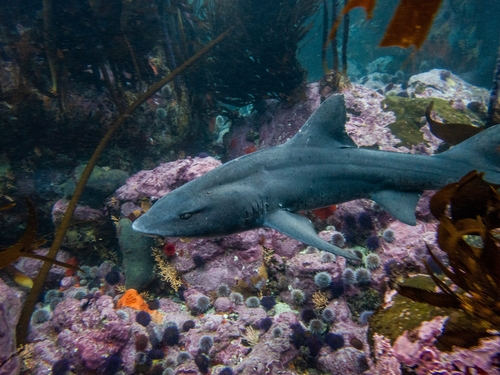
Triakis semifasciata, commonly called the leopard shark, has a moderately stout body and a short, rounded snout. Well-developed triangular flaps of skin sit in front of its nostrils. Its eyes are large and oval, and equipped with a nictitating membrane, a protective third eyelid. The shark's mouth line is strongly curved, with furrows at the mouth corners that extend onto both jaws; the furrows on the lower jaw are almost long enough to meet at the midline. There are 41 to 55 tooth rows in the upper jaw, and 34 to 45 in the lower jaw. Each tooth has a slightly oblique, smooth-edged central cusp, plus 1 to 2 small cusplets on either side. The teeth are arranged into a flat, pavement-like surface with overlapping ridges.
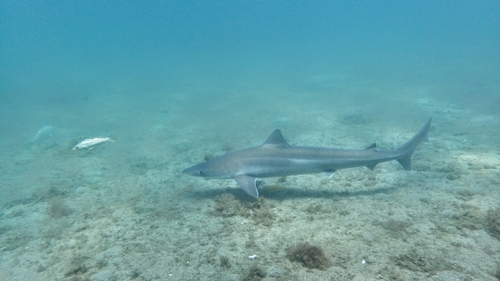
The large first dorsal fin sits roughly halfway between the pectoral and pelvic fins. The second dorsal fin is almost as large as the first, and much larger than the anal fin. The pectoral fins are wide and triangular. In adult leopard sharks, the lower lobe of the caudal fin is well-developed, though it is less than half the length of the upper lobe, which has a distinct strong ventral notch near its tip.
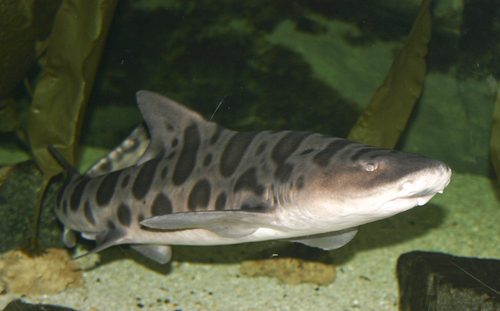
This species has unique coloration: prominent black saddles and large black spots run along its back, set against a silvery to bronzy gray background. Adults typically have more spots and saddles with lighter centers than juveniles. The underside is plain whitish. On average, leopard sharks measure 1.2–1.5 m (3.9–4.9 ft) long. Males rarely reach 1.5 m (4.9 ft), females rarely reach 1.8 m (5.9 ft), and one exceptional recorded female measured 2.1 m (6.9 ft) long. The heaviest known leopard shark weighed 18.4 kg (41 lb).
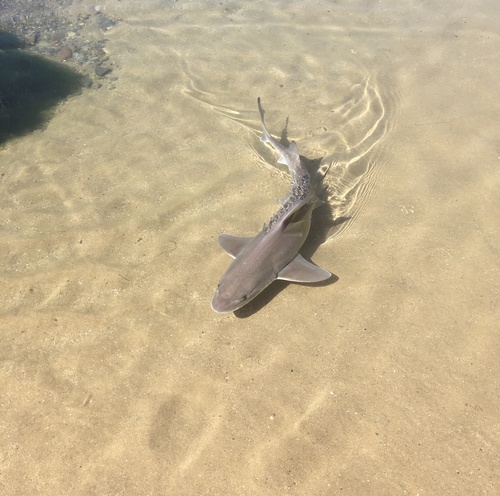
The leopard shark is found in the Northeastern Pacific Ocean, ranging from the temperate continental waters of Coos Bay, Oregon, south to the tropical waters of Mazatlán, Mexico, and including the Gulf of California. It prefers muddy or sandy flats inside enclosed bays and estuaries, but can also be found near kelp beds, rocky reefs, and along the open coast. Groups of leopard sharks often gather near warm effluent discharges from power plants. The species generally swims close to the seabed, and is most abundant from the intertidal zone down to a depth of 4 m (13 ft), though it may occur as deep as 91 m (299 ft).
Many leopard sharks, particularly in the northern part of their range, leave their coastal habitats in winter and return in early spring. A study of the species in Tomales Bay, northern California found that they depart when water temperatures drop below 10–12 °C (50–54 °F); one tagged individual was recorded swimming 140 km (87 mi) south. While a small number of leopard sharks have been documented traveling hundreds of kilometers, most individuals stay in a localized area for most of their lives. This limited dispersal has led to genetic divergence across the species' range. Seven distinct gene pools have been identified along the California coast between Humboldt Bay and San Diego. The Humboldt Bay subpopulation is likely the most isolated, with sharks there maturing at a larger size and producing fewer offspring than sharks from other areas. In contrast, the area around Los Angeles forms a genetic transitional zone between subpopulations with more diffuse boundaries. Off Baja California, leopard sharks on the Pacific side are probably distinct from those in the northern Gulf of California. While evidence for natal philopatry, returning to one's birthplace to breed, is equivocal in this species, proximity to established breeding grounds likely contributes to the structure of these separate subpopulations.
The leopard shark is an active species that swims with a strong undulating motion, and is commonly seen cruising in or just beyond the surf zone. It is more active at night than during the day, and sometimes rests motionless on the bottom. In Tomales Bay and similar regions, leopard sharks follow the tide onto mudflats to forage, retreating quickly enough to avoid becoming stranded as water recedes. At Santa Catalina Island, resident leopard sharks gather in shallow water during the day, and disperse into deeper water at night, traveling up to 10 km (6.2 mi) from their daytime location.
From birth, leopard sharks form large schools, which are generally separated by age and sex. These schools often intermingle with grey or brown smoothhounds (Mustelus californicus and M. henlei) and spiny dogfish (Squalus acanthias). The schools are nomadic, and often appear suddenly in an area for a few hours before disappearing just as quickly. In captivity, larger sharks have been observed establishing dominance over smaller individuals by giving light nips to their pectoral fins. During summer days, large aggregations of mature females gather in shallow bays and estuaries, then disperse at night. These females follow the warmest patches of water, which can raise their internal body temperatures by up to 3 °C, and they are thought to use this extra heat to speed their own growth and the growth of their gestating young. Aggregation membership is not fixed, with individual females regularly switching between different sites spread across several kilometers.
Compared to the closely related grey and brown smoothhounds that share its range, the leopard shark has smaller and more numerous red blood cells, which lets it process oxygen more efficiently. This may be an adaptation for foraging in deoxygenated estuarine environments. The eyes of the leopard shark contain very few cone cells, which is likely a result of the murky water it typically lives in. Small leopard sharks are preyed on by larger sharks, including the great white shark (Carcharodon carcharias) and the broadnose sevengill shark (Notorynchus cepedianus). One broadnose sevengill shark was observed ambushing a leopard shark on a tidal mudflat in Humboldt Bay, striking with so much force that the larger predator temporarily beached itself. Known parasites of the leopard shark include the tapeworms Phyllobothrium riseri, Lacistorhynchus dollfusi and Paraorygmatobothrium barber, as well as the copepods Echthrogaleus eoleoptratus and Achtheinus oblongatus.