About Triakis megalopterus (Smith, 1839)
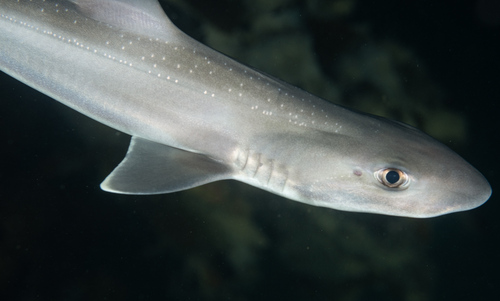
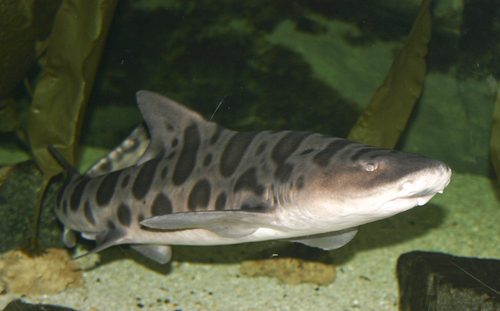
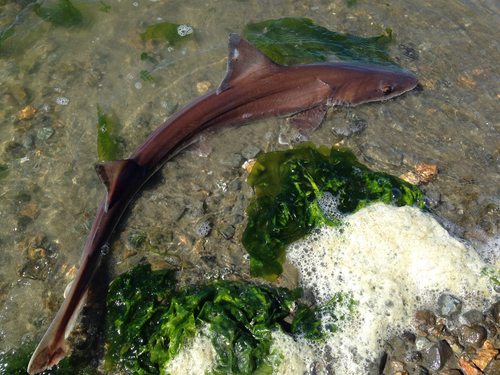
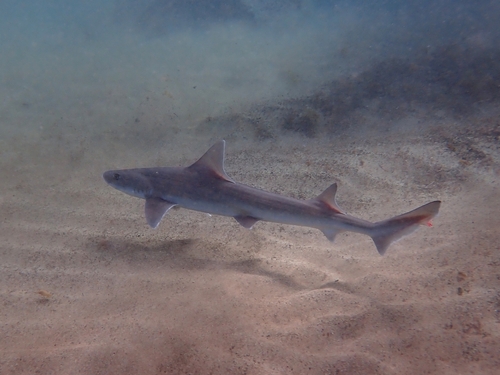
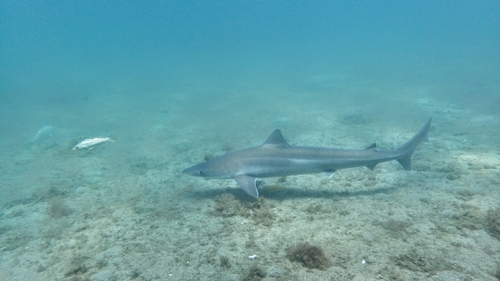
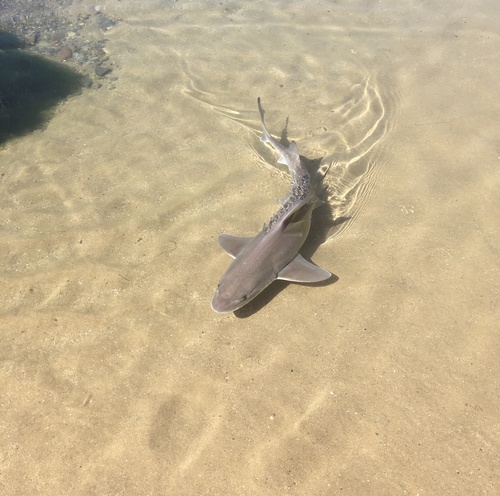
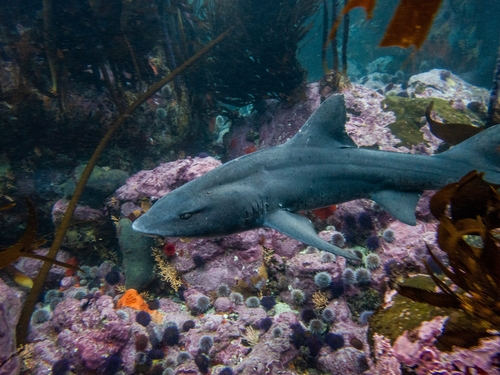
Triakis megalopterus, commonly called the sharptooth houndshark, is a stout-bodied shark with a short, thick, blunt snout. Its nostrils are widely spaced, and each is preceded by a lobe-like skin flap that does not reach the mouth. The horizontally oval eyes, which sit below ridges and have nictitating membranes, are paired with a large mouth that has long, deep furrows at its corners; the lower jaw's corner furrows almost meet at the center of the jaw. The species' teeth are small and tightly packed, forming continuous pavement-like surfaces. Each tooth has a rounded, molar-like base that tapers up to a sharp, upright central cusp, and rarely, a pair of underdeveloped lateral cusplets may also be present. This shark has five pairs of gill slits, and all of its fins are characteristically large with rounded tips. Adult sharptooth houndsharks have broad, falcate (sickle-shaped) pectoral fins. Their dorsal fins have nearly vertical trailing edges; the first dorsal fin originates over the rear tips of the pectoral fins, and the second dorsal fin is roughly three-quarters as tall as the first. The anal fin is much smaller than the second dorsal fin and originates well behind it. The short, thick caudal peduncle has no notches where the caudal fin attaches. The caudal fin has a small but clearly defined lower lobe and a longer upper lobe with a ventral notch near its tip. The skin of this species is often loose. The sharptooth houndshark is dark gray to bronze on its upper body and white on its underside. Young sharks are mostly unmarked, while adults range from solid in color to densely covered with irregular black spots. This species can reach a maximum length of 1.7 m (5.6 ft) and a maximum weight of 40 kg (88 lb), and females grow larger than males. The sharptooth houndshark's range is restricted to the coastal waters of southern Africa, extending from southern Angola to the Eastern Cape of South Africa, with rare occurrences as far east as KwaZulu-Natal. This locally common shark inhabits sandy habitats including bays, and can be found from the surf zone down to a depth of 50 m (160 ft), though most individuals live no deeper than 10 m (33 ft). It typically swims very close to the seabed, prefers flat areas near rocky reefs or gullies, and rarely swims up into open water. The sharptooth houndshark is a highly active species, though it may sometimes rest inside rocky crevices. It primarily hunts at night, and has been recorded chasing prey almost onto shore. The pointed cusps of its teeth let it grip slippery prey, while their broad bases allow it to crush hard-shelled prey. This shark feeds on a wide variety of prey: crustaceans including crabs, slipper lobsters, and spiny lobsters, bony fishes including morwongs, sea catfishes, drums, and porgies, and cephalopods, particularly Octopus vulgaris. For larger individuals, sharks and rays (including catsharks and guitarfishes) and their egg capsules make up a minor part of their diet. Off the coast of South Africa, the most important prey for this species is the crab Plagusia chabrus. The shark's diet changes as it ages: young sharks under 1.0 m (3.3 ft) long feed almost entirely on crabs, while larger sharks consume more bony fishes and cephalopods, as well as a greater overall diversity of prey. This shark has been observed leaving its typical nocturnal habits to feed on chokka squid (Loligo reynaudii) during the squid's mass spawning events. The broadnose sevengill shark (Notorynchus cepedianus) is known to prey on the sharptooth houndshark. During summer, sharptooth houndsharks gather in groups in shallow water. These aggregations are especially well-documented in False Bay, and are likely linked to reproduction, as many pregnant females are present in the groups. This species is aplacental viviparous, meaning developing embryos are nourished mainly by yolk. Mature females have one functional ovary and two functional uteri. Litters of 6 to 12 pups are born between late May and August, after a gestation period of approximately 20 months. Larger females typically give birth to larger litters. Different sources have estimated birth length as either 30–32 cm (12–13 in) or 42–44 cm (17–17 in), and pups within a single litter can vary in size by up to 30%. Females reproduce every two or three years, depending on whether ovarian eggs develop during pregnancy that allow them to mate again within a few months of giving birth. The sharptooth houndshark is slow-growing, and both sexes follow a similar growth pattern. Males reach sexual maturity at 1.2–1.4 m (3.9–4.6 ft) in length and 11–13 years of age, while females reach sexual maturity at 1.3–1.5 m (4.3–4.9 ft) in length and 15–16 years of age. The species' maximum lifespan is at least 25 years.