About Triaenodon obesus (Rüppell, 1837)
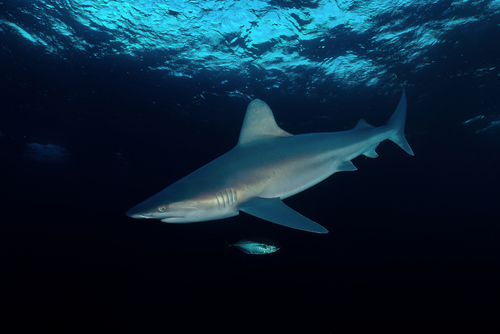
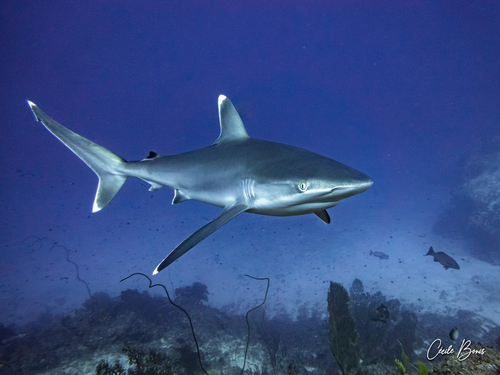
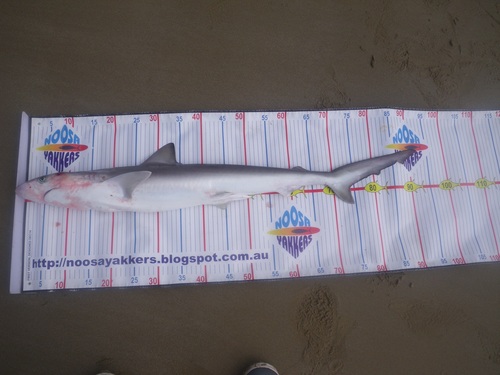
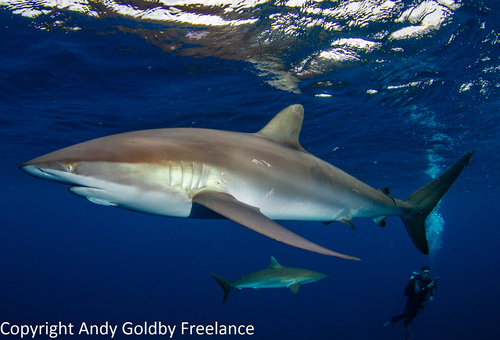
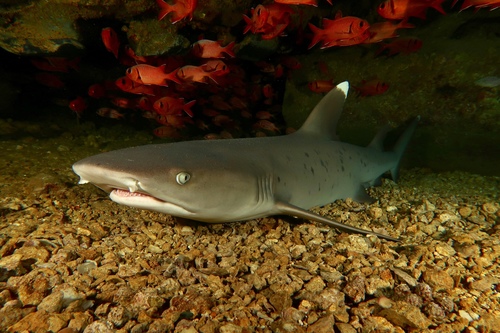
Triaenodon obesus, the whitetip reef shark, is a relatively small shark species. Most individuals reach no more than 1.6 m (5.2 ft) in length. The commonly cited maximum length of 2.1 m (6.9 ft) originates from early visual observations and may not be accurate. The heaviest confirmed individual on record weighs 18.3 kg (40 lb). This species has a slim body and a short, broad head. Its snout is flattened and blunt, with large furled skin flaps shaped into tubes positioned in front of the nostrils. The small, oval eyes have vertical pupils, prominent upper ridges, and often a small notch behind them. The mouth angles distinctly downward, giving the shark what looks like a disgruntled expression, with short furrows at each corner. The upper jaw holds 42–50 tooth rows, while the lower jaw holds 42–48 tooth rows. Each tooth has one narrow, smooth-edged central cusp, flanked by two much smaller cusplets. The first dorsal fin is set far back on the body, closer to the pelvic fins than the pectoral fins. Both the second dorsal fin and anal fin are large, reaching about half to three-quarters the height of the first dorsal fin. The broad, triangular pectoral fins originate at or just in front of the level of the fifth gill slit. No ridge runs between the first and second dorsal fins. The lower lobe of the caudal fin is half the length of the upper lobe, which has a pronounced notch near its tip. The small, overlapping dermal denticles typically bear 7 horizontal ridges, which gives the shark's skin a smooth texture. The species is grayish to brownish on the upper body and white on the underside, with a pattern of scattered small dark spots that is unique to every individual. The tips of the first dorsal fin and the upper caudal fin lobe are bright white; the tips of the second dorsal fin and lower caudal fin lobe may also be bright white. Whitetip reef sharks are widely distributed across the entire Indo-Pacific region. They were once thought to have lived in the Atlantic Ocean, based on Miocene fossil teeth found in North Carolina, but later research determined these teeth belonged to a mackerel shark, and the whitetip reef shark has never populated the Atlantic. In the Indian Ocean, the species occurs off northern KwaZulu-Natal, South Africa, along the entire East African coast from the Horn of Africa to the Red Sea, and around the Indian subcontinent including Sri Lanka. It is also found near major island chains in the region: Madagascar, Mauritius, Mayotte, the Comoros, the Aldabra Group, the Seychelles, and the Chagos Archipelago. In the western and central Pacific Ocean, whitetip reef sharks occur off South China, Taiwan, and the Ryukyu Islands, ranging south to the Philippines and throughout the entire Coral Triangle, including the coasts of Indonesia, East Timor, and Papua New Guinea. Their range extends south to northern Australia and the Great Barrier Reef. They are also found around many Pacific atolls and islands across Melanesia, Micronesia, and Polynesia, reaching as far north as Hawaii and as far south as the Pitcairn Islands, with confirmed sightings near Midway Atoll, Johnston Atoll, and Laysan. In the Eastern Pacific, they can be found off the west coasts of Costa Rica and Panama south to the Galápagos Islands, and as far north as Isla Isabel, Isla Socorro, and the southern tip of Baja California (Cabo San Lucas and Cabo Pulmo National Marine Park). Whitetip reef sharks are almost exclusively associated with coral reef habitats. They are most often found around coral heads and high-vertical-relief ledges, and also occur over sandy flats, in lagoons, and near deep-water drop-offs. They prefer very clear water and rarely stray far from the seabed during the day. The species is most common at depths between 8 m and 40 m (26 ft and 131 ft). Occasionally, individuals will enter water less than 1 m deep while foraging; there is one exceptional record of a whitetip reef shark captured at 330 m (1,080 ft) off the Ryukyu Islands. The whitetip reef shark is one of the three most common shark species that inhabit Indo-Pacific coral reefs, alongside the blacktip reef shark (Carcharhinus melanopterus) and the grey reef shark (Carcharhinus amblyrhynchos). While its habitat preferences overlap with these two species, it does not usually frequent very shallow water like the blacktip reef shark, nor does it favor outer reef areas like the grey reef shark. Whitetip reef sharks swim using strong body undulations, and unlike other requiem sharks, they can lie motionless on the seabed while actively pumping water over their gills to breathe. This species is most active at night and during slack tide; it spends most of the day resting inside caves, either alone or in small groups arranged parallel to one another or stacked on top of each other. Off Hawaii, these sharks may shelter inside underwater lava tubes, while off Costa Rica they are often seen resting in open on sandy flats. Most whitetip reef sharks stay within a small, highly localized home range, and only rarely make long-distance movements, wandering only briefly before settling in a new location. A study conducted at Johnston Atoll found that none of the studied sharks had moved more than 3 km (1.9 mi) from their original capture site over periods of up to one year. A separate study at Rangiroa Atoll in French Polynesia found that after more than three years, around 40% of the originally tagged sharks were still on the same reef where they were first captured. Individual sharks may rest in the same cave for months or even years. The daytime home range of a whitetip reef shark is limited to roughly 0.05 km² (0.019 mi²); the range expands to 1 km² (0.39 mi²) at night. This species is not territorial, shares home ranges with other whitetip reef sharks, and does not perform threat displays. Major predators of the whitetip reef shark include tiger sharks (Galeocerdo cuvier), Galapagos sharks (Carcharhinus galapagensis), and possibly silvertip sharks (Carcharhinus albimarginatus), though silvertip sharks generally live at greater depths than the range preferred by whitetip reef sharks. An 80 cm (31 in) whitetip reef shark was once found in the stomach of a giant grouper (Epinephelus lanceolatus), but giant groupers are not considered significant predators of this species due to their rarity. Known parasites of the whitetip reef shark include the copepod Paralebion elongatus and the parasitic praniza larvae of the isopod Gnathia grandilaris. While resting during the day, whitetip reef sharks have been observed being cleaned by the wrasse Bodianus diplotaenia and the goby Elacatinus puncticulatus. Unusually, there is one recorded observation of seven whitetip reef sharks holding a cleaning posture (with mouth open and gills flared) while surrounded by a swarm of non-cleaning hyperiid amphipods; researchers think the mechanical stimulation from the moving amphipods triggered this behavior because it resembles the movement of actual cleaning organisms.