About Treron vernans (Linnaeus, 1771)
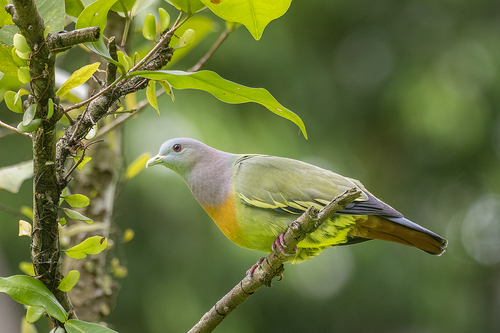
The pink-necked green pigeon, scientifically named Treron vernans (Linnaeus, 1771), is a medium-sized pigeon. It measures 25 to 30 cm (9.8–11.8 in) in length and weighs approximately 105–160 g (3.7–5.6 oz). This species has sexually dimorphic plumage. Males have a grey head, a pinkish neck and upper breast, with the remaining lower breast being orange. Their back is olive green, and their wings are green with black primaries; yellow edging on the tertiaries creates a visible yellow bar across the wing when the bird is in flight. Males have a yellowish belly with grey flanks, a grey tail with a black end band, and chestnut uppertail coverts. Females are smaller overall; they have a yellowish belly, throat and face, plus a greenish crown and back of the neck, and are otherwise similar in appearance to males. For both sexes, the legs are pink or reddish, and the bill is white, pale blue green, or grey. Juvenile birds resemble females but are greyer on their upper bodies. Unlike most other pigeon species in the family, members of the genus Treron do not typically produce cooing calls, instead making whistling and quacking noises. Some cooing notes have been recorded for the pink-necked green pigeon: males produce a trisyllabic whistling call that ends in a coo. This species is also reported to make a rasping krrak krrak... call, but it is generally not considered particularly vocal, and usually only calls when at communal roosts or when it has found food. The range of the pink-necked green pigeon stretches from southern Myanmar, Thailand, Cambodia, and Vietnam south through the Malay Peninsula, across the Greater Sundas and their surrounding islands, Bali, Lombok, Sumbawa, and as far east as the Moluccas, as well as the Philippines. It lives in a wide variety of habitats, including primary forest, forest edge, secondary forest, and coastal mangroves. It prefers more open environments, and when it occurs near denser forest, it is typically found along the forest edges. It is also commonly found in human-dominated environments such as gardens, plantations, and farmland. It is more common in lowlands and near the coast, but can be found at elevations up to 300 m (980 ft) in the Philippines, 750 m (2,460 ft) in Borneo, and 1,200 m (3,900 ft) in Sulawesi. The Handbook of the Birds of the World records this species as non-migratory, but other sources note that it makes local movements. A close relative, the thick-billed green pigeon, travels long distances to search for fruit, so it is likely the pink-necked green pigeon shares this behavior. After the main island of Krakatoa was destroyed by a volcanic eruption in 1883, leaving only a small group of smaller islands, the pink-necked green pigeon was observed during the first bird survey of these remnant islands conducted in 1908. At that time, this pigeon was the only obligate frugivore (a species that eats mostly fruit, rather than eating fruit as part of a broader or opportunistic diet) that had become established on the islands. Within the Krakatoa archipelago, it was able to colonize Anak Krakatau — a volcano that emerged from the sea from the original caldera in 1927 — within 36 years after the new island experienced a large eruption in 1952. The delay between the island stabilizing and colonization was likely due to the time required for fig trees to become established on the island and begin producing fruit. The species later went extinct on Anak Krakatau, due to its small population size and predation. This species has recently expanded its range, having successfully colonized Flores at some point after 2000. Like many fruit-eating pigeons, the pink-necked green pigeon is thought to be an important disperser of fruit seeds in forests and woodlands. Its grinding gizzard was once thought to mean the species was entirely a seed predator rather than a seed disperser, but studies of closely related species show that not every individual has grinding stones in its crop, so some seeds can pass through the gut intact; this is likely true for the pink-necked green pigeon as well. This species is thought to be one of the organisms that helped reintroduce many Ficus (fig) species to the Krakatoa islands after the original island was destroyed by volcanic eruption. It may not have been responsible for bringing the first shrubby fig species, which were likely carried by generalist birds such as bulbuls, but once some fruiting figs became established on the islands, the pink-necked green pigeon likely brought new Ficus species to the islands and moved seeds between the islands. Its flight time to the Krakatoa islands is estimated at 48 minutes, which is far shorter than its estimated gut seed retention time of 60–480 minutes. Pink-necked green pigeons have been recorded as prey of white-bellied sea-eagles, and peregrine falcons are believed to have caused the localized extinction of this species on Anak Krakatau.