About Treron bicinctus (Jerdon, 1840)
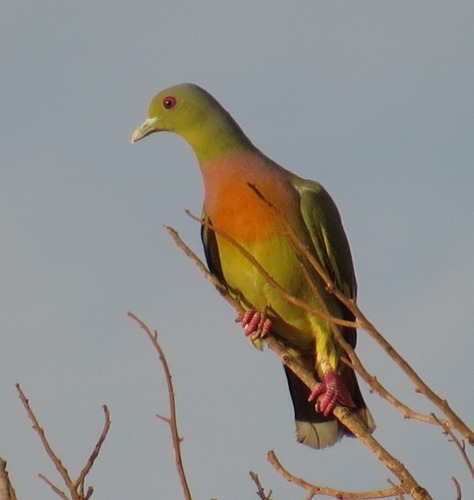
Treron bicinctus, commonly called the orange-breasted green pigeon, resembles other green pigeon species such as the yellow-footed green pigeon and the grey-fronted green pigeon, but can be distinguished by the lack of maroon coloration on its wings. Males have no grey on the head, with a narrow lilac band on the upper breast and a wider orange band below this lilac band. Their undertail-coverts are cinnamon-colored, with longer feathers edged in yellow. The upper side of the tail is grey, with a broad dark subterminal band. Females are yellow on their underparts, and do not have the orange or lilac breast bands found in males. Their undertail coverts are duller cinnamon with greenish spots. Compared to females of T. affinis or T. pompadora, the central tail feathers of female orange-breasted green pigeons are slaty grey rather than green. The Sri Lankan subspecies T. b. leggei has a slightly shorter wing length but is otherwise identical to other populations. Other recognized named subspecies include domvilii (Swinhoe, 1870) from Hainan Island, and javanus Robinson & Kloss, 1923 from Java and Bali. The Thailand population praetermissa is most often grouped into the nominate subspecies. This species inhabits forest environments, and is widely distributed starting from the Terai and lower Himalayas, below 1,500 m (4,900 ft), extending south mainly through the Western and Eastern Ghats and into coastal lowland forests of Sri Lanka. It is also found across Burma, Thailand, the Malay Peninsula, Vietnam, Java, and Hainan. Some seasonal movement is suspected, as vagrant individuals have been recorded in locations such as Sindh. Orange-breasted green pigeons typically occur alone or in small groups. They have the fast, direct flight common to most pigeons, featuring regular wing beats and occasional sharp wing flicks. They feed on the seeds and fruits of a wide range of plants, and often gather with other frugivores at fruiting fig trees. They forage by walking slowly along branches, and are sometimes found feeding on the ground. They are known to consume fruits of Strychnos nux-vomica, which are toxic to mammals. Their call consists of a low, subdued sequence of modulated wandering whistles. During the breeding season, males fight one another by slapping with wings and pecking. In India, the breeding season runs from March to September, with most breeding occurring before June. In Sri Lanka, breeding mainly takes place from December to May. They build the typical flimsy twig platform nest characteristic of pigeons, in which a clutch of two white eggs is laid. Both sexes participate in incubation, and the eggs hatch after roughly 12 to 14 days.