About Tremella mesenterica (Schaeff.) Pers.
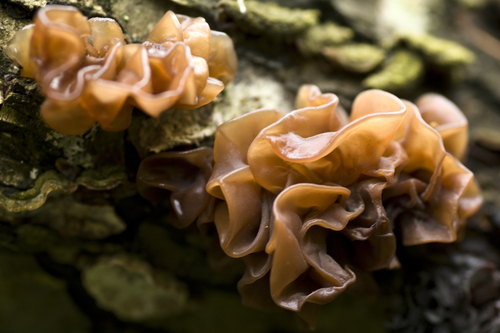
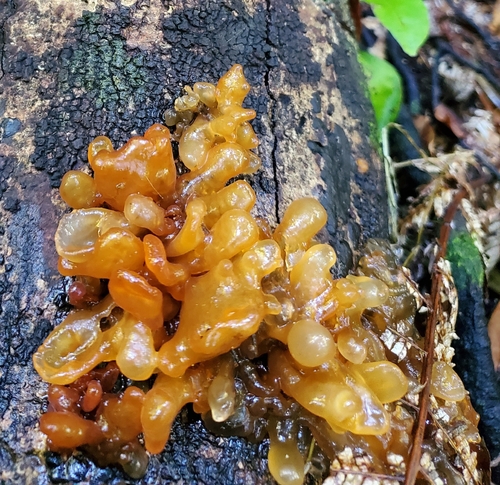
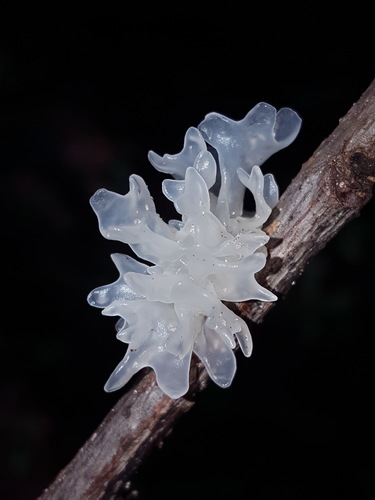
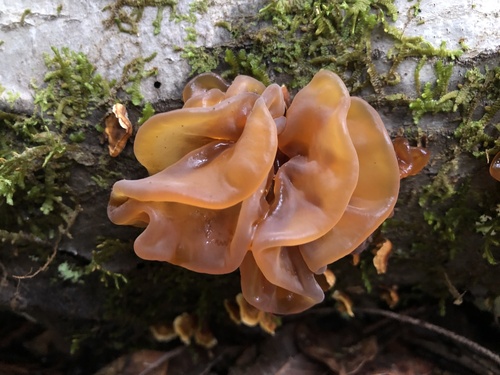
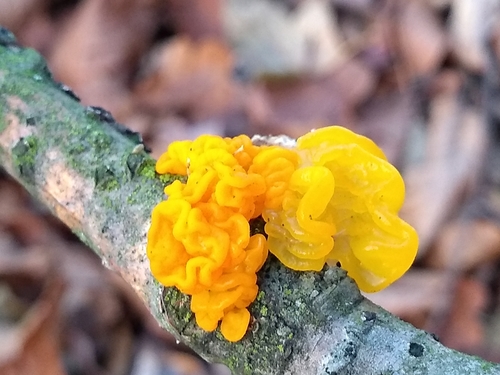
The fruit body of Tremella mesenterica has an irregular shape, and typically breaks through the bark of dead branches. It can reach up to 7.5 cm (3 in) wide and 2.5 to 5 cm (1 to 2 in) high, with an appearance ranging from rounded to variously lobed or brain-like. When wet, the fruit body is gelatinous but tough, and it becomes hard when dry. Its surface is usually smooth, with translucent lobes that are deep yellow or bright yellow-orange, fading to pale yellow as they age; rarely, specimens lack pigment and are white or colorless. Dried fruit bodies turn dark reddish or orange. Spores appear whitish or pale yellow when viewed in mass. Microscopically, the spore-bearing basidia are ellipsoid to roughly spherical, with no stalk or a rare stalk, and typically measure 15–21 μm wide. Each basidia contains two to four septa that divide it into compartments, and these septa are most often diagonal or vertical. Asexual reproduction occurs through spores called conidia, which grow from conidiophores—specialized hyphal cells that are morphologically different from somatic hyphae. The conidiophores are densely branched and usually abundant in the hymenium, and young specimens may be entirely made up of conidia. The conidia are roughly spherical, ovoid, or ellipsoid, and measure about 2–3 by 2–2.5 μm. They can be so numerous that young fruit bodies become covered in a bright yellow conidial slime. The sexually produced basidiospores are broadly ellipsoid to oblong, averaging 10–16 by 6–9.5 μm; they germinate either via a germ tube or by producing yeast-like conidia identical in form to those produced on conidiophores. Tremella mesenterica has a cosmopolitan distribution, and has been recorded from North America, Central America, South America, Africa, Europe, Asia, and Australia. Fruit bodies develop during wet periods throughout the year. In British Columbia, Canada, it is sometimes found growing on maple, poplar, or pine, and is most abundant on red alder. It prefers habitats ranging from mesic to wet. This fungus grows parasitically on the mycelium of wood-rotting corticioid fungi in the genus Peniophora. Occasionally, both Tremella mesenterica and its host fungus produce fruit bodies at the same time. Tremella mesenterica has a yeast-like phase in its life cycle, which forms when basidiospores bud. Alternation between asexual and sexual propagation happens when compatible haploid yeast-form cells of two different mating types mate. Each mating type secretes a mating pheromone that triggers sexual differentiation in target cells of the opposite mating type. Sexual differentiation is marked by growth arrest in the G1 phase of the cell division cycle, followed by development of an elongated mating tube. Mating tube formation, which is initiated by pheromones A-10 and a-13, follows a similar process to bud emergence during bipolar budding in yeasts. Tremerogen A-10 has been purified, and its chemical structure is confirmed to be an S-polyisoprenyl peptide. Fruit bodies develop from a primordium located beneath the bark of wood, and sometimes multiple separate fruit bodies can grow from the same primordium. Regarding uses, some sources categorize this fungus as inedible or only "non-poisonous", while other sources note it is edible but has no distinct flavor. Its gelatinous to rubbery texture adds texture to soups. In China, vegetarians use the fungus to prepare an immunomodulating cooling soup that includes ingredients such as lotus seed, lily bulbs, and jujube.