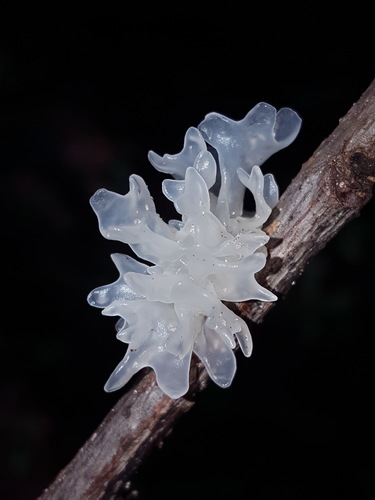
About Tremella fuciformis Berk.
Fruit bodies of Tremella fuciformis Berk. are gelatinous, watery white, and can reach up to 7 centimetres (3 inches) across; cultivated specimens grow larger. They are made up of thin but erect, seaweed-like, branching fronds that are often crisped at the edges. Under microscopy, the hyphae are clamped and embedded in a dense gelatinous matrix. Haustorial cells grow from the hyphae, producing filaments that attach to and penetrate the hyphae of the fungus's host. The basidia are tremelloid (ellipsoid, with oblique to vertical septa), measuring 10–13 μm × 6.5–10 μm, and are sometimes stalked. The spores are ellipsoid and smooth, measuring 5–8 μm × 4–6 μm, and germinate either by hyphal tube or by yeast cells. Tremella fuciformis is a parasite of Hypoxylon, a genus of wood rot pathogens sometimes called "cramp balls". Many species originally placed in Hypoxylon were reassigned to the new genus Annulohypoxylon in 2005; this includes the fungus's preferred host, A. archeri, which is the species regularly used for commercial cultivation. Following the growth range of its host, fruit bodies are typically found on dead, still attached or recently fallen branches of broadleaf trees. This species is mainly found in tropical and subtropical regions, but also extends into temperate areas of Asia and North America. It has been recorded from southern and eastern Asia, sub-Saharan Africa, North America (including Central America), South America, the Caribbean, the Pacific Islands, Australia, and New Zealand; populations in New Zealand may belong to another member of a species complex. Tremella fuciformis has been cultivated in China since at least the nineteenth century. Early cultivation prepared suitable wooden poles, which were then treated in various ways to encourage natural colonization by the fungus. This unpredictable cultivation method was later improved by inoculating poles directly with spores or mycelium. Modern commercial production only began after producers realized that both Tremella and its host species needed to be inoculated into the substrate to guarantee successful growth. The "dual culture" method used commercially today uses a sawdust mix inoculated with both fungal species, kept under optimal growing conditions. The most common species paired with T. fuciformis in this method is its preferred host, Annulohypoxylon archeri. Estimated production of T. fuciformis in China reached 130,000 tonnes in 1997. It is also cultivated in other East Asian countries, with limited cultivation occurring in other regions globally. In Chinese cuisine, T. fuciformis is traditionally used in sweet dishes. It has no distinct flavor of its own, but is valued for its gelatinous texture and its purported medicinal benefits. It is most commonly used to make a Cantonese dessert soup called luk mei (六味), often served alongside jujubes, dried longans, and other ingredients. It is also used as an ingredient in drinks and ice cream. Widespread cultivation has lowered the price of T. fuciformis, so it is now also used in some savory dishes. In Vietnamese cuisine, it is often added to chè, a category of traditional Vietnamese sweet beverages, dessert soups, and puddings.