About Tremarctos ornatus (F.G.Cuvier, 1825)
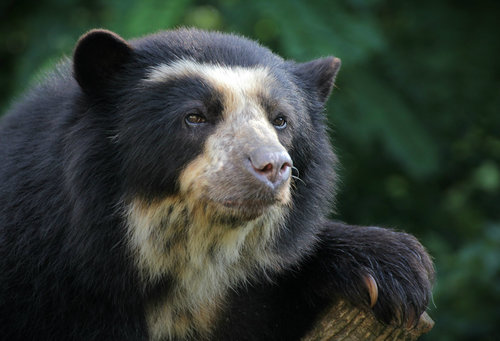
The spectacled bear, whose scientific name is Tremarctos ornatus, is also commonly called the Andean bear. It is a bear species that is native to the Andes Mountains of northern and western South America. It is the only bear species still living that is native to South America, and also the last remaining member of the short-faced bear subfamily Tremarctinae. Unlike other omnivorous bears, the spectacled bear's diet is mostly made up of plant matter. The IUCN has classified this species as Vulnerable due to habitat loss. Aside from rare instances of bears moving into eastern Panama, spectacled bears are mostly limited to specific regions of northern and western South America. Their range covers western Venezuela, Colombia, Ecuador, Peru, western Bolivia, and northwestern Argentina. The species' long, narrow geographical distribution is only 200 to 650 km (120 to 400 mi) wide, but stretches more than 4,600 km (2,900 mi) long. The species is found almost entirely in the Andes Mountains. Before spectacled bear populations became fragmented over the last 500 years, the species was known to be adaptable, as it lives in a wide variety of habitats and altitudes across its range. These habitats include cloud forests, high-altitude grasslands called páramo, dry forests, and scrub deserts. A single spectacled bear population on the Peru-Ecuador border occupied the same wide range of habitat types that the world's brown bears (Ursus arctos) occupy today. The best habitats for spectacled bears are humid to very humid montane forests. These cloud forests typically occupy a 500 to 1,000 m (1,600 to 3,300 ft) elevational band that sits between 1,000 and 2,700 m (3,300 and 8,900 ft), with the exact elevation varying by latitude. Generally, wetter forests hold more food species that can support bears. Occasionally, spectacled bears may reach altitudes as low as 250 m (820 ft), but they are not typically found below 1,900 m (6,200 ft) in the foothills. They can even range up to the mountain snow line at over 5,000 m (16,000 ft) in elevation. It is well documented that spectacled bears use all these habitat types during regional movements, but the seasonal patterns of these movements remain unknown. Today, the distribution of Tremarctos ornatus is shaped by human activity, mainly through habitat destruction and degradation, hunting, and population fragmentation. This fragmentation is most common in Venezuela, Colombia, Ecuador, and Argentina, and creates three major problems for spectacled bear populations. First, small isolated populations have compromised persistence even without additional habitat loss or hunting. Second, landscape transformation reduces the availability of the habitat types spectacled bears need. Third, fragmentation makes bears more accessible to hunters, increasing their exposure to hunting and killing. The most widespread threat to the species is extensive logging and farming, which has caused major habitat loss for these largely tree-dependent bears. Shortages of natural food can push bears to feed on crops or livestock, increasing human-bear conflict that most often ends with the poaching of the individual bear. The impacts of climate change on spectacled bear habitat and food sources are not fully understood, but they may have negative effects in the near future. Limited viable habitat and low overall population can also intensify the effects of poaching, by concentrating bears into smaller areas of suitable habitat that carry higher poaching risk. Most available information about spectacled bear reproduction comes from observations of captive individuals. In captivity, mating is concentrated between February and September, with timing varying by latitude. In the wild, mating can occur at almost any time of year, but mating activity normally peaks in April and June. This peak falls at the start of the wet season, and aligns with the peak of fruit ripening. Mating pairs stay together for one to two weeks, during which they copulate multiple times, with each copulation lasting 12 to 45 minutes. Courtship involves play and non-aggressive fights, and intercourse is often accompanied by loud calls from both animals. In the wild, births usually occur during the dry season, between December and February. In captivity, births can occur year-round across the species' distribution. The gestation period lasts 5.5 to 8.5 months. Litters can have one to three cubs; four cubs is very rare, and two is the average. Cubs are born with their eyes closed, and each weighs about 300 to 330 g (11 to 12 oz). Unlike northern bear species, spectacled bears do not give birth during a hibernation cycle. Births still usually take place in a small den, and the female does not leave the den with her cubs until they can see and walk, which happens three to four months after birth. Female spectacled bears grow more slowly than males. Litter size is positively correlated with both the female's weight and the abundance and variety of available food sources, especially the temporal predictability of fruit production. Cubs usually stay with their mother for one year before becoming independent. This aligns with one year of breastfeeding, but mothers continue providing maternal care for an additional year after weaning. Based only on data from captive bears, both sexes reach breeding maturity between four and seven years of age. Females usually give birth for the first time at 5 years old, and their fertile period is shorter than that of males, who remain fertile for almost their entire lives. The species' longevity supports population persistence, as spectacled bears are able to raise at least two cubs to adulthood, supporting adequate population replacement. Wild spectacled bears have an average lifespan of 20 years.