About Trapezia rufopunctata (Herbst, 1799)
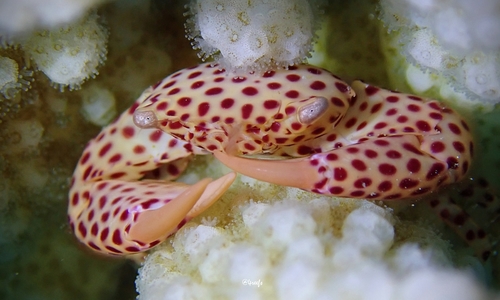
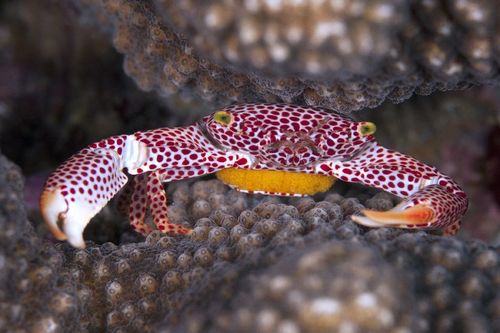
Trapezia rufopunctata, commonly called the rust spotted guard crab, is also known as a commensal crab. Adults reach approximately 5 centimeters in carapace width. It is a true crab, with four pairs of walking legs and one pair of proportionally large, long, flattened clawed legs called chelipeds. Its trapezoidal carapace has a distinct mottled pattern: 100 to 200 reddish or orange spots across a white or pink background, which gives the species its common name. This patterning is thought to help the crab camouflage among the colorful corals it lives on. Unlike its patterned body, its eyes are a contrasting green shade. Trapezia rufopunctata moves via drag-powered swimming. Like other members of its family, this guard crab lives in symbiotic association with corals. This species avoids confrontation, and quickly retreats into coral branches when approached, holding its claws up in a defensive posture. Trapezia rufopunctata is gonochoric, meaning individuals are either male or female. Its mating behavior includes a precopulatory courting ritual, usually triggered by olfactory or tactile cues. The species reproduces sexually; after fertilization, the female carries the fertilized eggs. After mating, the mated pair usually shares the same coral colony. Fertilized eggs hatch into planktonic larvae, which eventually grow into adults with the species' characteristic appearance. This species has a wide distribution across the Indo-Pacific, including the Maldives and Polynesia. It has been frequently observed and photographed near Australia's Great Barrier Reef and Bali, Indonesia. Its range extends west to Hawaii, east to eastern Africa, north to southern Japan, and south to South Africa. Trapezia rufopunctata lives in coastal reefs and lagoons, a habitat tied to its symbiotic relationship with corals. It is found mostly in shallow water, at depths from 0 to 30 meters, in areas with sea surface temperatures between 20 and 36 °C, or 68 to 97 °F.