About Tragus racemosus (L.) All.
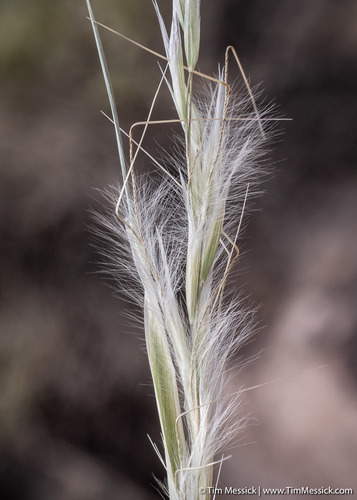
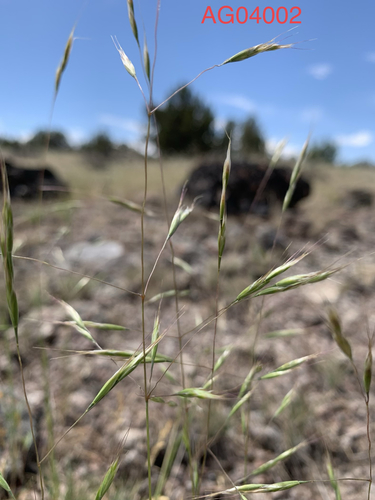
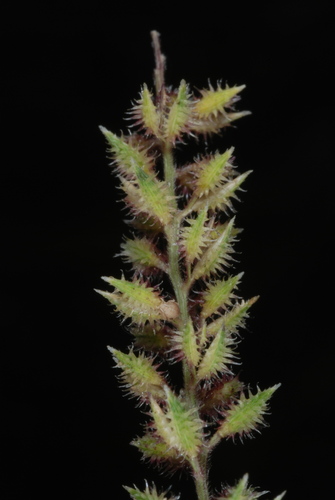
Mature Tragus racemosus plants are typically 0.5 to 1.5 feet (15.24 to 45.72 cm) tall, with clustered stems. Most leaves grow along the stems, arranged in two opposite rows along the stem. Leaf sheaths measure 1.5 to 4 mm long, and do not have auricles. There is a clear distinction between the leaf blade and the leaf sheath. Leaf blades are linear and thread-like, with parallel venation; they are typically 0.5 to 5.5 cm long and 1.5 to 4 mm wide. Most of the leaf surface is hairless, and ligules are present. Inflorescence branches are typically 2.1 to 4.8 mm long, with 2 to 5 paired spikelets growing at nodes along the central rachis. Flowers are borne on these branches in a racemose inflorescence. Each flower holds 3 yellow anthers 0.6 to 0.8 mm long, and 2 white stigmas. Proximal spikelets are 3.8 to 6.6 mm long, the second spikelets are 2.3 to 6.6 mm long, and the third and fourth spikelets are 0.8 to 4.2 mm long. Each spikelet contains a single floret, with a smooth lemma that has 3 veins. Unlike other members of the genus Tragus, which have a chromosome count of 2n=20, Tragus racemosus has a chromosome count of 2n=40. Like other members of the Tragus genus, Tragus racemosus uses C4 photosynthesis.
Tragus racemosus is native to Europe, Asia, and Africa, and has been specifically recorded in Austria, Belgium, Bulgaria, Czechia, Germany, Hungary, Slovakia, Spain, and the United Kingdom. It is an introduced species in North and South America. Established populations are found in Arizona, where it grows in sandy soil; it occurs occasionally in New England. Records of this species from the western coast of the United States come from manmade or disturbed habitats such as dump sites or construction sites, and no established populations have developed there. Past reports of the species from New Mexico and Texas are now recognized to be misidentifications of the closely related congener Tragus berteronianus.
Tragus racemosus is an annual plant. Like most other C4 photosynthetic species, it grows primarily during the hot, dry summer months. In the northern hemisphere, it has been recorded flowering in August and October, and producing fruit in August and October. Its leaves are present from late July through early November.
Within its native range, Tragus racemosus (a grass species) can be used to reduce soil erosion. Species in the genus Tragus, including Tragus racemosus, are not suitable for grazing. When Tragus racemosus grows in large abundance, this can indicate overgrazing: grazing animals have consumed other grass species that are suitable for grazing, removing competition and allowing Tragus racemosus to spread.