About Tragulus napu (F.Cuvier, 1822)
Scientific name: Tragulus napu (F.Cuvier, 1822)
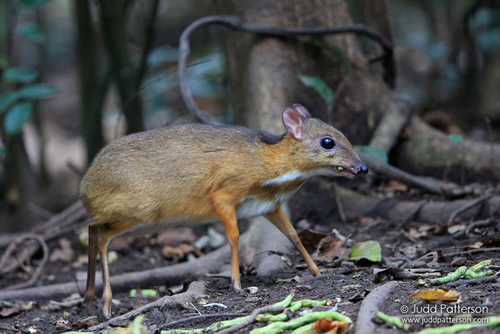
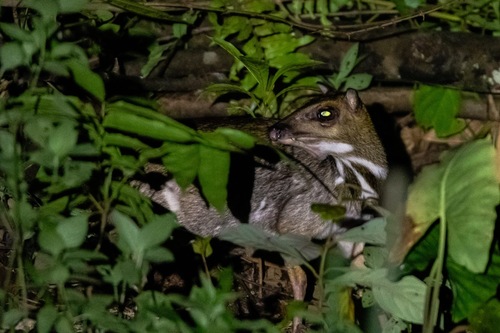
Morphology The greater mouse-deer is an even-toed ungulate. Though it is very small for an ungulate, it is one of the largest members of its genus. Only Williamson's mouse-deer matches it in size. It weighs 5 to 8 kg (11 to 18 lb). Its head-and-body length measures 70 to 75 cm (2.30 to 2.46 ft), its tail length is 8 to 10 cm (3.1 to 3.9 in), and its shoulder height is around 30 to 35 cm (12 to 14 in). It has a small, triangular head with a small, pointed, black nose and large eyes. Its long legs are as thin as a pencil, and the hind legs are visibly longer than the front legs. Its body is rounded in shape. The fur on the upper part of its body ranges from grey-buff to orange-buff. The fur on its sides is quite pale, but darker along the body's midline. The underparts, specifically the neck, stomach, chest, and chin, are white. Males have no horns or antlers, but instead possess small "tusks" which are elongated canines in the upper jaws.
Distribution Greater mouse-deer are found in Sumatra, Borneo, smaller Malaysian and Indonesian islands, southern Myanmar, southern Thailand, and peninsular Malaysia. They live near water, in tropical forests and mangrove thickets. They were thought to be regionally extinct in Singapore, but were rediscovered on a Singaporean offshore island in 2008. Reports of the species occurring in other locations are probably incorrect. They are terrestrial, but spend time in wet, swampy areas.
Reproduction Greater mouse-deer breed throughout the year, and females spend most of their adult lives pregnant. They usually produce one young per birth, after a gestation period of 152 to 155 days. Newborn greater mouse-deer are well-developed and can stand immediately after birth, and are fully active within 30 minutes. Young individuals nurse while standing on three legs. Both males and females reach sexual maturity at 4 and a half months of age. The maximum recorded lifespan of the species is 14 years.
Ecology and Conservation The major threats to Tragulus napu are overhunting by humans and habitat loss caused by rapid deforestation. A study conducted on Pulau Ubin, Singapore found that the greater mouse-deer population density on the island spiked to 293 individuals per square kilometre, the highest density ever recorded for the species. This population boom occurred after a 2023 African Swine Fever (ASF) outbreak that eliminated over 98% of the island's wild boar population. The loss of wild boar created an "ecological release" from competition and possible predation pressures for greater mouse-deer. While the greater mouse-deer population was already growing due to forest restoration, the ASF event dramatically accelerated this growth trend, leading to an over four-fold increase in population density over just five years.