About Tragopogon dubius Scop.
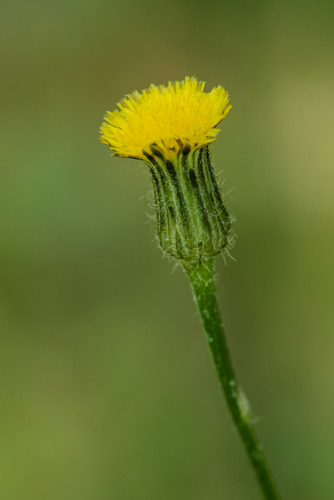
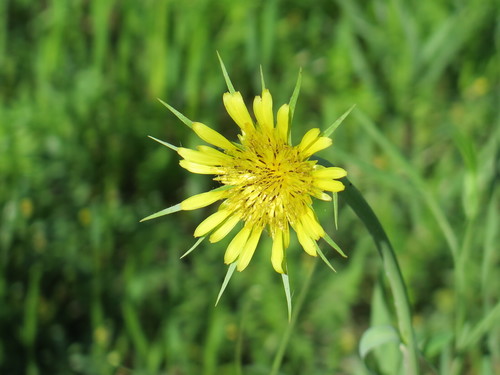
Like most salsifies, Tragopogon dubius grows as an annual or occasionally biennial forb, reaching a height of 40–80 centimetres (15+1⁄2–31+1⁄2 in). Its leaves grow up to 25 cm (10 in) long. Its buds are blue-green, tall, and tapered. Yellow flower heads, 4–5 cm (1+1⁄2–2 in) wide, bloom from late spring to late summer. The inflorescence opens early in the morning and often closes by late afternoon. Later, the plant forms a seed head that resembles a dandelion seed head but is distinctly larger. The seeds, called achenes, are 2–4 cm long and very light, averaging about 8 mg each. Natural variation occurs between the central and peripheral achenes in a single seed head: peripheral achenes are generally darker, heavier, and have a higher concentration of phenolic compounds, which may improve their chance of survival. Tragopogon dubius is native to southern and central Europe and western Asia, and can be found as far north and west as northern France. While it has been reported from Kashmir and India, recent evidence indicates that specimens from these areas may belong to a different species. It has been introduced to North America, where it has become widespread. It has been recorded across most of the continent: it is found in all continental United States except for a few states in the far southeast, and in all Canadian provinces except Newfoundland and the northern territories. It typically grows in fields and disturbed areas. The edibility of wild Tragopogon dubius, also called wild western salsify, is disputed. In their 1962 work The Medicinal and Poisonous Plants of Southern and Eastern Africa, Watt and Breyer-Brandwijk report the species is inedible. However, Stephen Facciola wrote in his 1990 book Cornucopia that the plant's flowering stems, buds, leaves, shoots, and roots are all edible. While purple salsify (Tragopogon porrifolus) is also known as oyster root, the roots of both western salsify and meadow salsify (Tragopogon pratensis) have a much stronger flavor, and are both fibrous and bitter. Garden-grown roots from all Tragopogon species are easier to eat than wild-harvested roots.