About Tragelaphus strepsiceros (Pallas, 1766)
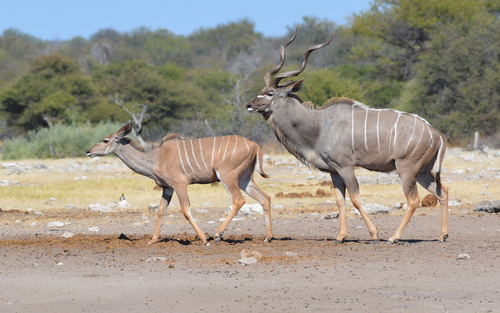
Greater kudu (scientific name Tragelaphus strepsiceros (Pallas, 1766)) is one of the largest antelope species, and it is slightly smaller than the bongo. Greater kudus have narrow bodies with long legs, and their coats range in color from brown or bluish grey to reddish brown. They have between 4 and 12 vertical white stripes across their torso. Their head is usually darker than the rest of the body, and features a small white chevron that runs between the eyes. Male greater kudus (called bulls) are much larger than females (called cows), and vocalize far more frequently. They produce a variety of vocalizations including low grunts, clucks, humming, and gasping. Bulls also have a beard running along their throats, and large horns with two and a half twists. If straightened, the average length of these horns is 120 cm (47 in), and the recorded maximum length is 187.64 cm (73.87 in). The horns diverge slightly as they slant backward from the head. Horns do not start growing until a bull is between 6 and 12 months old. They form their first spiral rotation around 2 years of age, and do not reach the full two and a half twists until the bull is 6 years old. Occasionally, bulls may grow 3 full turns on their horns. Adult bulls weigh between 190 and 270 kg (420–600 lb), with a recorded maximum weight of 315 kg (694 lb), and stand up to 160 cm (63 in) tall at the shoulder. Cows are hornless, and have no beard or nose markings. They weigh between 120 and 210 kg (260–460 lb), and can be as short as 100 cm (39 in) tall at the shoulder. Greater kudus have large, round ears. Their total head-and-body length ranges from 185 to 245 cm (6.07–8.04 ft), and their tail adds an extra 30 to 55 cm (12–22 in) to this length. The greater kudu's native range extends from eastern Africa, where they live in Ethiopia, Tanzania, Eritrea, Kenya, Central African Republic, Chad, Democratic Republic of the Congo, Djibouti, Somalia, and Uganda, southward into Zambia, Angola, Namibia, Botswana, Zimbabwe, South Africa, Eswatini, Malawi, and Mozambique. A small number of greater kudus have been introduced to New Mexico, but they were never released into the wild there. Greater kudus live in mixed scrub woodland, and are one of the few large mammal species that prefer to live in settled areas. Their typical habitat includes scrub woodland and bush on abandoned fields and degraded pastures, mopane bush, and acacia in lowlands, hills, and mountains. They only occasionally enter open plains, and only when these areas have abundant bushes; they normally avoid open areas to avoid being easy prey for predators. Their diet is made up of leaves, grass, and shoots, and they occasionally eat tubers, roots, and fruit, with a particular preference for oranges and tangerines. Greater kudus are normally inactive during the day, and seek cover under woodland, especially on hot days. They feed and drink during early morning and late afternoon. They get water from waterholes, or from roots and bulbs that have a high water content. Although they generally stay in one area, greater kudus may travel long distances to search for water during droughts. In southern Namibia, where water is relatively scarce, they have been documented covering large distances in very short periods of time. Greater kudus reach sexual maturity between 1 and 3 years of age overall; females reach sexual maturity at 15 to 21 months, while males reach sexual maturity at 21 to 24 months. Mating season takes place at the end of the rainy season, and its timing can shift slightly depending on the region and climate. Before mating, bulls and cows engage in a courtship ritual where the male stands in front of the female and often participates in a neck wrestle. The male then trails behind the female while emitting a low-pitched call, until the female allows him to copulate. Gestation lasts around 240 days, or eight months. Most births take place during the wet season between January and March, and calving generally starts between February and March, which is late austral summer when grass reaches its greatest height. Greater kudusuually give birth to one calf, and occasionally have two. Before giving birth, the pregnant female leaves her group. After giving birth, the newborn calf is hidden in vegetation for 4 to 5 weeks, to protect it from predation. After this period, the calf will accompany its mother for short periods of time. By 3 to 4 months of age, the calf stays with its mother at all times. The calf is quite independent of its mother by the time it is 6 months old.