About Tragelaphus spekii Speke, 1863
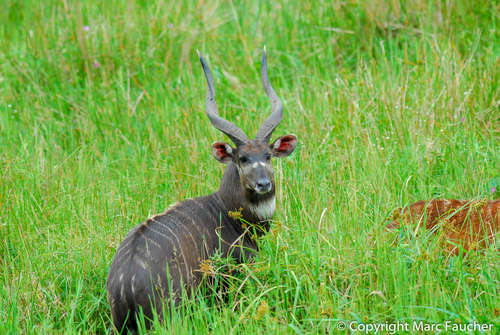
The sitatunga (Tragelaphus spekii Speke, 1863) is a medium-sized antelope that shows clear sexual dimorphism: males are significantly larger than females. Males typically have a head-and-body length of 136 to 177 cm (54 to 70 in), a shoulder height of 81 to 116 cm (32 to 46 in), and a weight of 76 to 119 kg (168 to 262 lb). Females range from 104 to 146 cm (41 to 57 in) in head-and-body length, 72 to 90 cm (28 to 35 in) in shoulder height, and 24 to 57 kg (53 to 126 lb) in weight. The tail measures 14 to 37 cm (5.5 to 14.6 in) long, and the saucer-shaped ears are 11 to 17 cm (4.3 to 6.7 in) long. Only males grow horns, which are spiral-shaped with one or two twists and reach 45 to 92 cm (18 to 36 in) in length. Sitatunga are nearly identical to nyala, differing only in fur and spoor. John Speke noted that while sitatunga are closely related to waterbuck, they lack stripes and have spots instead. Coat color varies across the species' range, but juveniles are generally rufous red and females are chestnut. Faintly visible white facial markings, spots, and stripes appear across the body, with additional white patches on the throat, near the head, and on the chest. A pair of inguinal scent glands is present. Male coats darken with age, turning gray to dark brown; mature males grow a rough, scraggy, usually brown mane, a white dorsal stripe, and a chevron-shaped marking between their eyes. This antelope has specialized body and leg adaptations for its swampy habitat. Male hooves are elongated and widely splayed. The rubbery, shaggy, water-repellent coat resists damage from slimy, muddy vegetation. For males, the wedge-shaped body, habit of lowering the head, and backward-curving horns make it easier to navigate through dense vegetation. Pasterns are flexible, and hooves are banana-shaped, reaching up to 16 cm (6.3 in) on hindlegs and 18 cm (7.1 in) on forelegs. Pointed toes let the sitatunga move slowly and nearly silently through water. Coat color also provides effective camouflage. Sitatunga have acute hearing, and their ear structure lets them accurately pinpoint the direction a sound came from. This adaptation is very useful in their dense, dark habitats where long-distance vision is of little use.
Sitatunga are amphibious antelopes, able to live on both land and water, and are restricted to swampy and marshy habitats. They occupy tall, dense vegetation in both perennial and seasonal swamps, marshy forest clearings, riparian thickets, and mangrove swamps. They travel along clearly marked tracks through their swamp habitat that often lead to reed beds; these tracks can be up to 7 m (23 ft) wide, and connect feeding grounds to nearby riverine forests. Sitatunga hold small home ranges near water bodies. In savannas, they are most often found in stands of papyrus and reeds, including Phragmites species and Echinochloa pyramidalis. In the Sudd swamps, they share their habitat with the Nile lechwe, and they share habitat with the southern lechwe in Angola, Botswana, and Zambia.
The species is native to Angola, Benin, Botswana, Burundi, Cameroon, Central African Republic, Chad, Democratic Republic of the Congo, Equatorial Guinea, Gabon, Gambia, Ghana, Guinea, Guinea-Bissau, Kenya, Mozambique, Namibia, Nigeria, Rwanda, Senegal, South Sudan, Tanzania, Uganda, Zambia, and Zimbabwe. It is extinct in Niger, where it previously occurred in the Lake Chad region, and is thought to be extinct in Togo, where its habitat has been entirely taken over by dense human settlements. It occurs only in localized, scattered populations across West Africa, but remains common in the forests of Central Africa and select swampy areas across Central, Eastern, and Southern Africa.
Sitatunga are primarily active in the early hours after dawn, the one to two hours before dusk, and at night, and spend most of their active time feeding. They are largely sedentary, resting in flat areas and reed beds, especially during the hottest part of the day, and rarely leave their swamp habitat during daytime. Most sitatunga are solitary or form pairs, though larger groups have been recorded; a study in Kenya observed a herd of nine individuals, made up of one adult male, four females, and four juveniles. Loose groups may form, but individual interactions are very rare, and individuals generally only associate with other members of the same sex. Sitatunga are not territorial. Males may lock horns with other males and hit vegetation with their horns; they may also perform a threat display called feinting, where they raise a foreleg while keeping their hindlegs anchored on the ground. When sitatunga interact, they first touch noses, which may be followed by licking and nibbling. When alarmed, a sitatunga will stand motionless, hold its head high, and raise one leg. Sitatunga occasionally produce a series of cough-like barks, usually at night, which can trigger other sitatunga to bark, and these sounds can travel across the swamp. Females may use this barking to warn other females away. During mating season, males often make a low bellow when they encounter a female or a group of females. A low-pitched squeak may be made while feeding, and mothers use bleats to communicate with their calves.
Sitatunga may feed or rest near southern lechwe herds, but do not interact with the species. They often attract yellow-billed oxpeckers, African jacanas, and great egrets. Sitatunga are strong swimmers, but only enter water with abundant vegetation to avoid crocodiles. When bothered by flies or chased by predators, sitatunga may fully submerge their bodies in water, leaving only their nose and eyes slightly above the surface. Due to their close association with water, sitatunga are often called aquatic antelopes, similar to waterbuck. After feeding in water, they typically dry off in the sun. Predators of sitatunga include lions, wild dogs, crocodiles, and leopards.
Females reach sexual maturity at one year of age, while males take one and a half years to mature. Breeding takes place year-round. When females gather, males compete with each other for mating rights, making the species polygynous. A rutting male approaches a female in a lowered, bent posture and sniffs her vulva. The female may move slowly or react nervously; if she flees, the male follows her steadily, without hurrying. A receptive female will raise her head with her mouth open, after which the male will attempt to mount. When mounting, the female lowers her head, while the male bends then straightens his forelegs and rests his head and neck on her back. The pair stays together for one to two days, during which the male prevents other males from approaching the female. Gestation lasts nearly eight months, after which a single calf is generally born. Birth can happen at any time of year, though there is often a peak during the dry season. Calves are hidden skillfully, and are only brought out of cover when many other sitatunga are present. The mother gazes at and nods to her calf to call it out for nursing. A calf will continue to follow its mother even after she gives birth to another calf. Mothers suckle and lick their calves for around six months. Calves take time to learn the sitatunga's specialized walking gait, so they often lose their balance and fall in water. Due to intrasexual competition, males and even some females leave their herd before reaching sexual maturity. The average lifespan of a sitatunga in captivity is 22 to 23 years.