About Tragelaphus imberbis (Blyth, 1869)
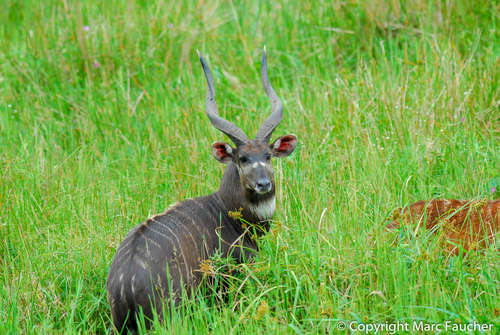
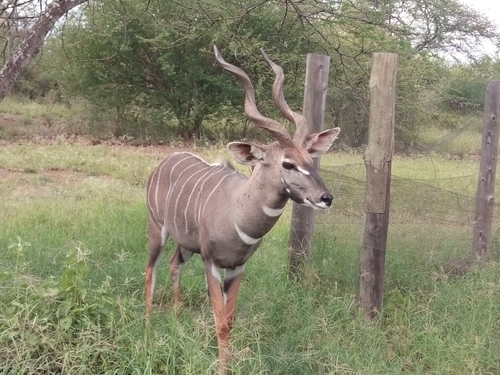
The lesser kudu, scientifically named Tragelaphus imberbis (Blyth, 1869), is a spiral-horned antelope. Its typical head-and-body length ranges from 110 to 140 cm (43 to 55 in). Males stand about 95–105 cm (37–41 in) tall at the shoulder, while females stand 90–100 cm (35–39 in) tall. Males generally weigh 92–108 kg (203–238 lb), and females weigh 56–70 kg (123–154 lb). The bushy tail is 25–40 cm (9.8–15.7 in) long, it is white underneath and ends in a black tip. This species shows clear sexual dimorphism: males are considerably larger than females. Females and juveniles have a rufous coat, while males turn yellowish grey or darker after they reach 2 years of age. Males have a prominent black hair crest on the neck, which is not well-developed in females. One long white stripe runs along the back, and 11–14 white stripes branch out toward the sides. The chest has a central black stripe, and there is no throat beard. A black stripe runs from each eye to the nose, and a white stripe runs from each eye to the center of the dark face. A chevron marking is present between the eyes. The area around the lips is white, the throat has white patches, and two white spots appear on each side of the lower jaw. The underparts are entirely white, the slender legs are tawny and have black and white patches. Lesser kudus have large, rounded ears; their tracks are similar to those of the greater kudu. Females have four teats. Average lifespan is 10 years in the wild and 15 years in captivity. Only males have horns. The spiral horns are 50–70 cm (20–28 in) long, with two to two-and-a-half twists. Their base circumference measures 156–171 cm (61–67 in). The slender horns are dark brown and tipped with white. Young males begin developing horns at 6-8 months old, and horns reach full length after 3 years. The lesser kudu lives in dry bushland regions. It is closely associated with Acacia and Commiphora thornbush in semiarid areas of northeastern Africa. The species avoids open areas and long grass, and prefers shaded areas with short grasses. It can also be found in woodlands and hilly areas. Generally, it occurs at altitudes below 1,200 m (3,900 ft), though individuals have been recorded at up to 1,740 m (5,710 ft) near Mount Kilimanjaro. Individual home ranges for lesser kudus are 0.4–6.7 km² (4,300,000–72,000,000 sq ft); the average home range size is 2.2 km² (24,000,000 sq ft) for males and 1.8 km² (19,000,000 sq ft) for females. The lesser kudu is native to Ethiopia, Kenya, Somalia, South Sudan, Tanzania, and Uganda, and it is extinct in Djibouti. Today it is largely confined to the Horn of Africa. Historically, its range extended southward from Awash (Ethiopia) through southern and eastern Ethiopia, most of Somalia (except the north and the northeast), and most of Kenya (except the southwest). It also originally occurred in southeastern Sudan, and in the northeastern and eastern parts of Uganda and Tanzania. Evidence for the lesser kudu's past existence in the Arabian Peninsula includes a set of horns taken in 1967 from an individual shot in South Yemen, another set from Saudi Arabia, and recent analysis of early and middle Holocene rock art sites in Jubbah and Shuwaymis, Ha'il province, Saudi Arabia. The lesser kudu is mainly active at night and at dawn, and seeks shelter in dense thickets just after sunrise. It can camouflage so well in dense vegetation that only its ears and tail can reveal its location. It rests and ruminates in shaded areas during midday. It spends roughly equal amounts of time foraging, standing and lying, and roaming. As a slender tragelaphine, the lesser kudu can move easily through dense vegetation. It is a shy and wary animal. When alarmed, it stands motionless. If it detects an approaching predator, it gives a short sharp bark similar to that of a bushbuck, then makes multiple leaps up to 2 m (6.6 ft) high with its tail raised. If captured by a predator, it lets out a loud bleat. Lesser kudus are gregarious, especially females. There is no distinct leader or hierarchy in their social structure, and the species has no territorial behavior, so fights are uncommon. When fighting does occur, lesser kudus interlock their horns and push each other. Mutual grooming is rarely observed. Unlike most tragelaphines, females can stay closely associated for several years. Groups may form consisting of one to three females and their offspring. Juvenile males leave their mothers at one and a half years of age, and may form pairs. By 4-5 years old, however, males prefer a solitary lifestyle and avoid other males, though four or five males may share the same home range. Lesser kudus do not usually associate with other species, except when they feed in the same area. Both males and females reach sexual maturity by one and a half years of age, but males do not actually mate until they are 4 to 5 years old. Males remain reproductively active up to the age of 14, while females remain reproductive up to the age of 14–18 years; the maximum age for successful lactation in females is 13–14 years. There is no fixed breeding season, so births can happen at any time of the year. A study at Dvůr Králové Zoo in the Czech Republic found that 55% of births occurred between September and December. A rutting male tests the urine of any female he encounters, and the female responds by urinating. After locating a female in estrus, the male follows her closely, and rubs his cheek on her rump, head, neck, and chest. He makes gasping movements with his lips. Finally, the male mounts the female, resting his head and neck on her back, in the same way other tragelaphines do. The gestation period lasts 7-8 months, after which a single calf is born. A female that is about to give birth isolates herself from her group, and stays alone for several days after birth. A newborn calf weighs 4–7.5 kg (8.8–16.5 lb). Around 50% of calves die within the first six months of birth, and only 25% survive past three years of age. A study at Basle Zoo in Switzerland found that 43% of captive-bred offspring died before reaching six months of age; the main causes of this high juvenile mortality were the spread of white muscle disease and deficiency of vitamin E and selenium in diets. Herd size, sex, interbreeding, and season had no effect on juvenile mortality. The mother hides her calf while she goes out to feed, and returns mainly in the evening to suckle her young. She checks her calf's identity by sniffing its rump or neck. In the first month, suckling lasts about 8 minutes. The mother and calf communicate with low bleats. The mother licks her offspring, particularly the perineal region, and may consume its excreta.