About Tragelaphus eurycerus (Ogilby, 1837)
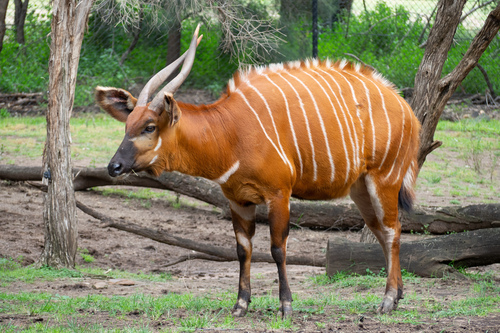
The bongo (Tragelaphus eurycerus) is a large, mostly nocturnal, forest-dwelling antelope native to sub-Saharan Africa. It is characterized by a striking reddish-brown coat, black and white markings, white-yellow stripes, and long slightly spiraled horns. It is the only tragelaphid species in which both sexes have horns. Bongos have complex social interactions and inhabit dense forest mosaics across Africa, and they rank as the third-largest antelope in the world. There are two recognized subspecies: the western or lowland bongo (T. e. eurycerus), which is experiencing ongoing population decline and is listed as Near Threatened by the IUCN Antelope Specialist Group, and the eastern or mountain bongo (T. e. isaaci) from Kenya. The mountain bongo has a more vibrant coat than the lowland bongo, and only occurs wild in a few mountain regions of central Kenya. This subspecies is classified as Critically Endangered by the IUCN Antelope Specialist Group, with fewer wild individuals than captive individuals; mountain bongos breed readily in captivity. In 2000, the Association of Zoos and Aquariums in the US (AZA) added bongos as a participant in its Species Survival Plan, and in 2006 it included the Bongo Restoration to Mount Kenya Project on its list of the Top Ten Wildlife Conservation Success Stories of the year. As of 2013, these conservation successes have been compromised, with reports that only around 100 mountain bongos remain in the wild, due to logging and poaching. Bongos inhabit tropical jungles with dense undergrowth up to an altitude of 4,000 m (13,000 ft) across Central Africa, with isolated populations in Kenya and the West African countries of Cameroon, the Central African Republic, the Republic of the Congo, the Democratic Republic of the Congo, the Ivory Coast, Equatorial Guinea, Gabon, Ghana, Guinea, Liberia, Sierra Leone, and South Sudan. Historically, bongos occupied three separate disjunct regions across East, Central, and West Africa. Today, the ranges of all three populations have shrunk, driven by habitat loss from agricultural expansion, uncontrolled timber cutting, and hunting for meat. Bongos prefer disturbed forest mosaics that support fresh, low-level green vegetation. These habitats can form after heavy elephant browsing, fires, flooding, natural or logging-related tree felling, and agricultural fallowing. In East Africa, mass bamboo die-off creates ideal bongo habitat, and bongos are able to live in bamboo forests.