About Tragelaphus derbianus (Gray, 1847)
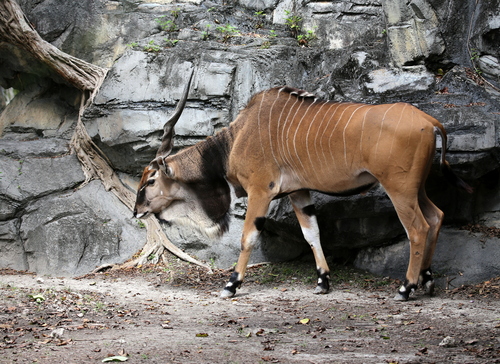
Tragelaphus derbianus, commonly known as the giant eland, is a species of spiral-horned antelope. Despite its common name, this species overlaps broadly in size with the common eland (Taurotragus oryx). However, the giant eland averages somewhat larger than the common eland, making it the largest antelope species in the world. Head-and-body length for giant elands typically ranges from 219 to 291 cm (7.19 to 9.55 ft), and shoulder height ranges from approximately 128 to 181 cm (4.20 to 5.94 ft). The species exhibits sexual dimorphism: males are larger than females, with males weighing 400 to 1,200 kg (880 to 2,650 lb) and females weighing 300 to 600 kg (660 to 1,320 lb). Their long tail, which averages 91 cm (36 in) in length, ends in a dark tuft of hair. Giant elands can live up to 25 years. Their smooth coat ranges from reddish-brown to chestnut, and is usually darker in males than females, with 8 to 12 distinct vertical white stripes on the torso. Male giant elands’ coats darken as they age. Zoologist Jakob Bro-Jørgensen notes that male coat color can reflect androgen (male hormone) levels, which peak during the rutting season. Comparing the two recognized subspecies: T. d. derbianus has 15 body stripes, is smaller in size, and has a rufous coat color, while T. d. gigas is larger, has a sandy coat color, and has 12 body stripes. A crest of short black hair extends down the neck to the middle of the back, and is especially prominent on the shoulders. Their slender legs are slightly lighter on their inner surfaces, with black and white markings just above the hooves, and large black spots on the upper forelegs. The bridge of the nose is charcoal black, and a thin, indistinct tan-colored chevron marking sits between the eyes. The lips and several dots along the jawline are white. When giant elands reach sexual maturity, a pendulous dewlap—larger in males than females—develops between the jowls and hangs to the upper chest, with a fringe of hair along its edge. The species’ large ears function as signaling devices. Compared to the common eland, giant elands have longer legs and much brighter black and white markings on their legs and pasterns. Both sexes have tightly spiraled, V-shaped horns. Male horns can grow up to 124 cm (4.07 ft) long, while female horns reach up to 67 cm (2.20 ft). Male horns are thicker at the ends, longer, and more divergent than female horns; these features suggest the giant eland evolved from an ancestor with true display horns. Giant elands inhabit broad-leafed savannas, woodlands, and glades across central and western Africa, with the two subspecies occupying corresponding ranges. They also live in forests and on the fringes of deserts, and can survive in full deserts because they produce very dry dung. Their current range extends from South Sudan and the Central African Republic into northern Cameroon and southern Chad. They prefer habitats near hilly or rocky landscapes and areas with nearby water sources. Science author Jonathan Kingdon originally thought giant elands only lived in woodlands dominated by Isoberlinia doka, an African hardwood tree, and the species is indeed adapted to these broad-leafed, deciduous Isoberlinia woodlands. Recent studies have confirmed they also inhabit woodlands dominated by trees of the genera Terminalia, Combretum, and Afzelia. Historically, giant elands ranged across a relatively narrow belt of savanna woodland that stretched across West and Central Africa from Senegal to the Nile. Today, they are protected in national parks and reserves, and occur mostly in Senegal. The western giant eland subspecies is largely restricted to Senegal’s Niokolo-Koba National Park. The eastern giant eland is found in multiple reserves, including Bénoué National Park, Faro National Park, and Bouba Njida National Park in Cameroon, and Manovo-Gounda St. Floris National Park in the Central African Republic. Giant elands are also kept in captivity. Giant elands are primarily nocturnal, have large home ranges, and follow seasonal migration patterns. They form separate social groups: one for males, and another for females and juveniles. Adult males are mostly solitary, and will often join females for lengths of time ranging from one hour to a week. As a gregarious species, giant eland herds usually contain 15 to 25 individuals, and sometimes more. Herds do not disband during the wet season, indicating that social rather than ecological factors drive herding behavior. During the day, herds typically rest in sheltered areas. Like many other animals, giant elands use their horns to scrape and loosen soil at mineral lick sites. Giant elands are alert and wary, which makes them difficult to approach, observe, or hunt. If a bull senses danger, he will produce deep-throated barks while leaving the herd, repeating the call until the entire herd is aware of the threat. Giant elands can run quickly at speeds over 70 km/h (43 mph), and despite their large size are exceptional jumpers that can easily clear heights of 1.5 m (4.9 ft). Their primary predators are lions, Nile crocodiles, and spotted hyenas. Young, sick, and rarely adult giant elands may also be preyed on by leopards, cheetahs, and African wild dogs. Due to their large size, giant elands provide a substantial meal for predators, but they are not easy prey. Particularly large, heavy bulls with large horns can be dangerous opponents even for an entire lion pride. Mating can occur throughout the year, but peaks during the wet season. Females reach sexual maturity at around two years old, while males reach sexual maturity at four to five years old. A female can stay in estrus for three days, and the species’ estrous cycle lasts 21 to 26 days. Like all antelopes, giant elands mate when food is abundant. Some populations have distinct breeding seasons: in southern Africa, females give birth from August to October, and males join females from late October to January; in Zambia, calves are born in July and August. Male giant elands fight for dominance by locking horns and attempting to twist their opponents’ necks. During rut, males rub their foreheads in fresh urine or mud, and use their horns to thresh and throw loose earth onto their bodies. Older males’ horns become worn down from rubbing against tree bark. Angry displays are not typically observed. Dominant males may mate with multiple females. Courtship is brief, consisting of penetration and a single ejaculatory thrust. After courtship, the 9-month gestation period begins. Birth usually takes place at night, after which the mother ingests the afterbirth. Generally, a single calf is born, and it stays with its mother for six months. Lactation lasts four to five months. After the first six months, juvenile giant elands may join groups of other juveniles. A Senegalese study examined suckling behavior in giant eland and common eland calves between one and five months old, and found that the length of suckling bouts increased as calves aged. No other changes were seen in farmed common eland calves, but in giant eland calves, males suckled more often than females, and primiparous (first-time) mothers had shorter suckling bouts than multiparous (experienced) mothers. The study’s results suggest that giant elands (Derby elands) in their natural habitat adjust their maternal behavior to maintain constant vigilance against predators and other similar risks, unlike farmed common elands, which behave as expected in predator-free captive conditions. Giant elands produce large quantities of tender meat and high-quality hides even when fed a low-quality diet. They are hunted as game animals and as hunting trophies. Their milk is comparatively richer in protein and milkfat than dairy cow milk, which may explain the quick growth of eland calves. Giant eland milk has roughly three times the fat content and twice the protein of dairy cow milk. The species’ docility and profitable characteristics have made it a target for domestication in Africa and Russia, and have also made it a popular hunting target. Many people prefer to tame and raise giant elands over cattle for a number of benefits: giant elands can survive on limited water, they can eat coarse grasses, they can even consume some poisonous plants that would be fatal for cattle, and they are immune to some diseases that affect cattle.