About Tragelaphus buxtoni (Lydekker, 1910)
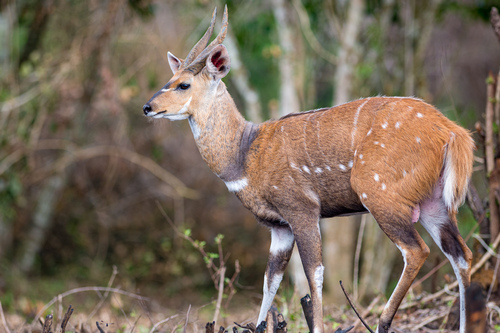
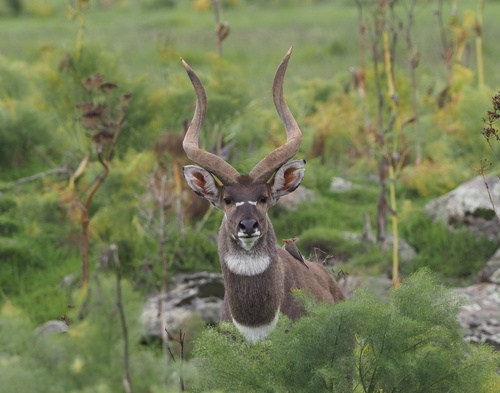
The mountain nyala (scientific name Tragelaphus buxtoni (Lydekker, 1910)) is a large sexually dimorphic bovid. Males measure approximately 240–260 cm (94–102 in) in head-and-body length, while females measure 190–200 cm (75–79 in). Males typically stand 120–135 cm (47–53 in) tall at the shoulder, compared to 90–100 cm (35–39 in) for females. Males weigh 180–300 kg (400–660 lb) and females weigh 150–200 kg (330–440 lb). Its bushy, 20–25 cm (7.9–9.8 in) long tail reaches the heel. It has large sensitive ears lined with white hair. Its coat is grey to brown, marked with two to five poorly defined white stripes extending from the back to the underside, plus a row of six to ten white spots. White markings also appear on the face, throat and legs; the white chevron between the eyes and white patch on the throat are among the most conspicuous markings. The chest and rump are white. The lower legs are pale on the inside, and clear white spots are located just above the hooves. Male juvenile coats are fawn brown, and darken with age, eventually becoming charcoal in old bulls. Males have a short dark erect crest, around 10 cm (3.9 in) high, that runs along the middle of the back from the neck to the tail. Coat texture can vary from smooth to rough, likely changing by season. Females match red deer hinds in size and proportions. Female juvenile coats are bright rufous, and old females are as grey as young males. Females have two pairs of inguinal nipples. Only males have horns, with a maximum recorded length of 188 cm (74 in). Horns start as cream-coloured nubs at around six months old, then begin growing in a spiral pattern, reaching full growth by two years of age. Most horns have only one or two spirals, though a few males have been recorded with two-and-a-half turns. Final horn shape varies between males: horns may form well-defined spirals, or diverge into a lyre-like structure similar to impala horns, but with an incomplete final spiral. Growth rings are visible on the horn sheaths, but their annual growth patterns are difficult to interpret. While horns may wear down with age, the cream colour of their tips remains. The mountain nyala resembles the greater kudu, as both have rows of white spots along their flanks and spiral horns. However, greater kudus can be told apart by their greater height, paler colour, and horns that have two to three spirals with farther apart tips. The nyala is also similar to the mountain nyala, but can be easily distinguished by its smaller size and a fringe of long hair along its throat and neck; nyala horns are very similar in shape, but are more slender and narrower. The mountain nyala's typical habitat is montane woodlands at an altitude of 3,000–3,400 m (9,800–11,200 ft). Lower elevation woodland vegetation generally includes African juniper (Juniperus procera), Afrocarpus gracilior, and Olea, while upper reaches host Hagenia abyssinica, juniper, and Hypericum revolutum. Mountain nyala often visit the edges of montane grasslands at 2,800–3,100 m (9,200–10,200 ft), which are covered with Artemisia afra, Kniphofia, and evergreen Hypericum species. Today, continuous blocks of woodland habitat have been broken up into scattered pockets, interspersed within large cultivated areas. Human settlement and large livestock populations have forced mountain nyala to occupy heath forests above 3,400 m (11,200 ft) that are rich in Erica arborea, Erica trimera, Hypericum, Euphorbia, and Helichrysum species. They may even be pushed into afroalpine grasslands containing Alchemilla and Festuca species, at altitudes up to 4,300 m (14,100 ft). On the eastern borders of its range, mountain nyala have most often been observed in areas at lower altitudes, around 1,800–2,400 m (5,900–7,900 ft). Mountain nyala are endemic to the Ethiopian Highlands east of the Rift Valley, between 6°N and 10°N. Their former range stretched from Mount Gara Muleta in the east to Shashamene and the northern Bale Zone in the south. Up to half of the total mountain nyala population lives in the 200 km2 (77 sq mi) area of Gaysay, in the northern part of Bale Mountains National Park. Smaller relict populations are found in Chercher, mountains such as Chilalo in Arsi Zone, and western Bale. A study identified a 39.38 km2 (15.20 sq mi) area on the southern escarpment of the Bale Mountains as the most sustainable habitat for the species. Mountain nyala are shy and elusive around humans. They spend nights on forest edges, feeding for part of this time. To avoid human disturbance, they choose to move at night. They emerge into grasslands to browse in the morning and late afternoon. They generally seek shelter in woodlands and heather thickets during extremely hot or cold weather. Feeding can occur at midday, but is broken up by resting periods. They tend to come out into open areas when it is overcast or raining. In the dry season (November to March), when grasslands are in poor condition, mountain nyala travel up to wooded areas rich in ericaceous heath. Four to five individuals may gather for short periods to form small herds. However, groups of up to 100 individuals have been reported from the Bale Zone, made up of multiple family units that periodically move in and out. The size and longevity of these large groups depends on season, habitat type, and time of day. Female and juvenile groups consist of adult females accompanied by a calf from their previous year and another from the current year. These groups are led by adult males when a female is in oestrus. Bachelor herds are formed by non-dominant adult bulls and young males, and can contain up to 13 individuals. Mixed-sex groups may also form. Old bulls tend to live solitary lives, though they may occasionally visit female herds looking for oestrous females. Dominance hierarchies have been observed in both sexes. Males are not territorial, and have home ranges covering 15–20 km2 (5.8–7.7 sq mi) in the wet season. By contrast, females and juveniles occupy much smaller ranges of around 5 km2 (1.9 sq mi) in the wet season. For both sexes, dry season home ranges are much larger than wet season ranges. Males often wrestle using their horns. While usually silent, mountain nyala may "cough" when they notice a potential threat, or let out a low bark if the threat is more serious. The leopard is the main predator of the mountain nyala. Females begin mating at two years of age, and males also become sexually mature by this age. Sexual dimorphism, larger male home ranges, and a female-biased population indicate this species is polygynous. Mountain nyala breed year-round, but the breeding peak is in December. Before and during the breeding season, adult males tend to join mixed-sex herds. Bulls continuously follow receptive females and test their vulvas. Three to four males may pursue a single female, and if they are equally ranked in the dominance hierarchy, they will perform circling displays. In these displays, males move very slowly and stiffly, with their back crest erect and tail raised. Aggressive fights are less likely, and if they do occur, they only last a short period. Flehmen response follows vulva testing. Gestation lasts eight to nine months, after which a single calf is born. In Bale Mountains National Park, births happen throughout the year, but peak from September to November. Calves stay in cover for the first few weeks after birth. Calves remain near their mothers for nearly two years. By this time, young females may become pregnant. As young males mature at two years, they are challenged by other males and driven out of their herds. The lifespan of a mountain nyala is around 15 to 20 years.