About Tragelaphus angasii Angas, 1849
Scientific name: Tragelaphus angasii Angas, 1849
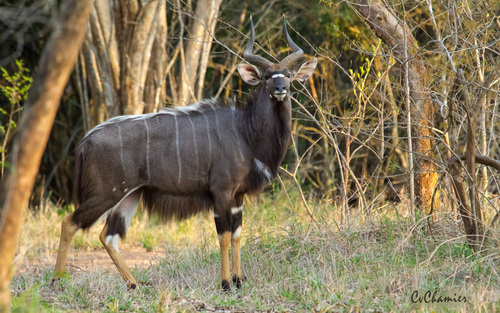
Physical description: The nyala is a middle-sized spiral-horned antelope, sized between a bushbuck and a kudu. It is recognized as the most sexually dimorphic antelope. Head-and-body length typically ranges from 135–195 cm (53–77 in). Males grow up to 110 cm (43 in) tall at the shoulder, while females reach a maximum height of 90 cm (3.0 ft). Males weigh 98–125 kg (216–276 lb), and females weigh 55–68 kg (121–150 lb). The nyala has an average life expectancy of about 19 years.
Females and juveniles have a rusty or rufous brown coat; adult males develop a dark brown or slate grey coat, often with a bluish tinge. Females and young males have ten or more white vertical stripes on their sides, with additional markings on the face, throat, flanks and thighs. Stripes are very reduced or completely absent in older males. Both sexes have a white chevron between the eyes, a 40–55 cm (16–22 in) long bushy tail with a white underside, and a dorsal crest of hair running from the back of the head all the way to the end of the tail. Males have an additional line of hair along the midline of their chest and belly. Only males grow horns, which are 60–83 cm (24–33 in) long with yellow tips and one or two twists.
The nyala's spoor is similar to that of the bushbuck but larger, measuring 5–6 cm (2.0–2.4 in) long. Its feces are round to spherical pellets. Hairy scent glands on the nyala's feet leave scent wherever it walks. Body condition often differs between the sexes, which a study attributes to differences in their body sizes. During periods of nutritional stress, more old adults die, and most of these deaths are males. Vitamin E levels in nyala have been observed to change during stress, found during blood sampling attempts.
Habitat and distribution: The nyala lives in dense lowland woodlands and thickets, primarily across southern Malawi, Mozambique, Zimbabwe, and eastern South Africa. It prefers areas with good quality grassland and access to fresh water, and also inhabits lush green river country. Its natural range extends across southeast Africa from the Lower Shire Valley in Malawi, through Mozambique and Zimbabwe, to eastern South Africa and Eswatini.
Geographic distribution of the nyala may be linked to genetic variation. A study of nyala populations in South Africa, Mozambique, Malawi and Zimbabwe found marked differences in gene frequencies at three microsatellite loci. Mitochondrial DNA analysis identified a unique haplotype in individuals from each location, indicating geographic variation may stem from a distribution pattern shaped by habitat specificity. Today, nyala are found in South African protected areas including Ndumo Game Reserve, uMkuze Game Reserve, Hluhluwe–Umfolozi Game Reserve (all in KwaZulu-Natal), and Kruger National Park. As of 1999, 10–15% of the nyala population lives on private land. Conservation efforts are underway to maintain nyala populations in Mozambique's Gorongosa National Park and Banhine National Park, and nyala thrive in Malawi's Lengwe National Park.
Nyala have never been observed to be territorial, and home ranges of both sexes overlap extensively. Male and female home ranges are roughly equal in size, at around 10 square kilometres (3.9 sq mi).
Ecology and behavior: Nyala are mainly active in the early morning and late afternoon. They browse during the day when temperatures are between 20–30 °C (68–86 °F), and browse at night during the rainy season. They rest in thick bushes during the hottest hours of the day. The nyala is naturally very shy and cautious, and often stays hidden rather than entering open areas; most wild sightings occur at water holes. In protected areas, they are less shy and often appear openly around tourists.
Nyala form either single-sex or mixed groups. Herds usually browse and drink water together, and typically contain 2 to 10 individuals. A study in Mozambique's Zinave National Park found 67% of observations were of groups with 1 to 3 nyala, with remaining herds reaching up to 30 individuals. Herds frequently break up and re-form. Adult males generally stay solitary. When females have offspring, they often remain close to their own mothers, so relationships within female herds are closer than those among males.
As an alert and wary species, nyala use a sharp, high, dog-like bark to warn other group members of danger, a call used mainly by females. Nyala react to the alarm calls of impala, baboon and kudu, and impala have been found to react to nyala alarm calls as well. The main predators of adult nyala are lion, leopard, cheetah, spotted hyena, African wild dog and Nile crocodile; baboons and raptorial birds prey on juvenile nyala.
Reproduction: Nyala breed year-round, but mating peaks in spring and autumn. The reason for this peak is still unknown, though it has been linked to the species' photoperiod sensitivity and feeding habits. Females reach sexual maturity at 11 to 12 months of age. Males reach sexual maturity at 18 months and begin active spermatogenesis at 14 months, but remain socially immature until five years old. Before ovulation, Graafian follicles reach a length of at least 6.7 cm (2.6 in). A female's estrous cycle is around 19 days long. Males attempt to mate with females for two days of each cycle, but females only allow mating for six hours per cycle.
When a male enters a female herd to mate, he displays by raising his white dorsal crest, lowering his horns, and moving stiffly. As with many other species, males fight over dominance during the mating season. Kidney fat indices (KFIs), a measure of animal health where higher kidney fat indicates better health, have been studied in nyala and impala to understand how social class and reproduction affect body condition. To calculate KFI, the kidney is weighed both with and without its fat, and the difference gives the amount of kidney fat. Male nyala in rut had lower KFIs, and this did not vary much by season. Pregnant female nyala had higher KFIs than non-pregnant females. There is a significant increase in the size of the corpus luteum during the last third of gestation.
Gestation lasts seven months, and results in the birth of a single calf that weighs approximately 5 kg (11 lb). Birth generally occurs in a hidden spot away from predators, such as a thicket. The calf stays hidden for up to 18 days, and the mother nurses it at regular intervals. The calf remains with its mother until her next calf is born, at which point rutting males drive the older calf away from the mother.