About Tradescantia virginiana L.
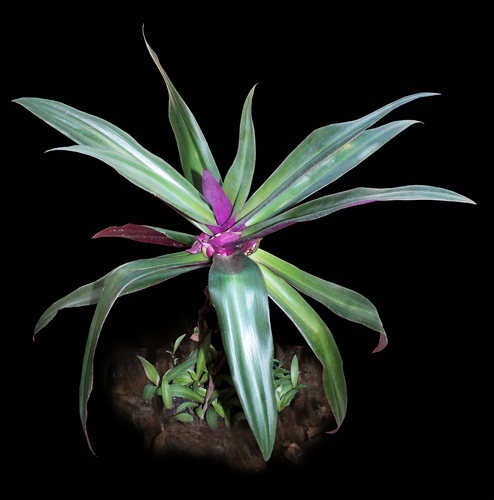
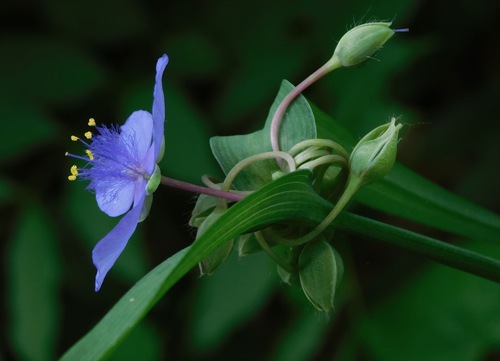
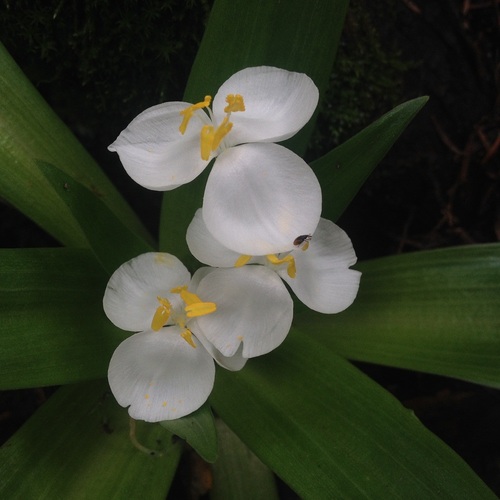
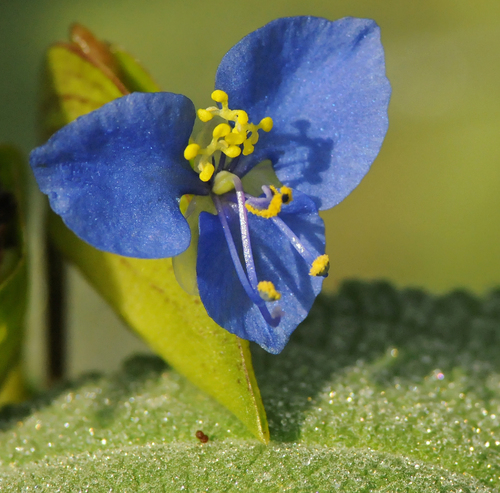
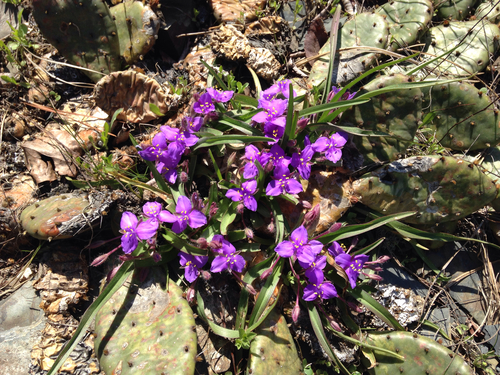
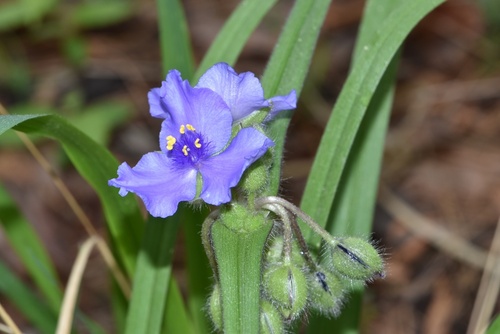
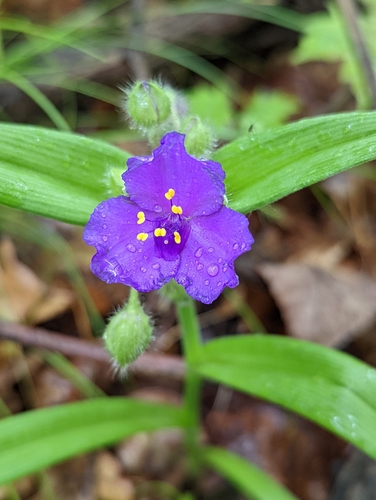
Tradescantia virginiana L., commonly known as Virginia spiderwort, is an herbaceous perennial clump-forming wildflower native to eastern and central United States and Ontario, Canada. Its whole growth habit can be arching, clumping, erect, or spreading. It grows from a cluster of stout overwintering roots, and spreads via underground stems to form large colonies. Mature plants reach 1.5 to 3 feet tall and 1 to 1.5 feet wide. Its stems are usually clumped, but may be solitary; they can be smooth or bear scattered short hairs, and typically grow unbranched. Each stem holds 2 to 5 leaves attached via a 1 to 3 centimeter long leaf sheath. Leaf blades are long, narrow, elongate, and arching, with a prominent midrib that tapers gradually to a pointed tip. Leaves can grow up to 1 foot long and 1 inch wide. Lightly fragrant flowers grow in tight clusters at the stem apex, with leaf-like bracts located below each flower. Open flowers sit above the bud cluster on a hairy pedicel that can reach up to 3.5 cm long. This species has three green, ovate, hairy sepals; most of each sepal is hidden by petals in open flowers, with only the tips exposed. It also has three broadly ovate petals that measure 1.2 to 1.8 centimeters long, and petals can be rose, pink, white, blue, or purple. Flowers are bisexual, with six stamens clustered at the flower center. Stamens have filaments covered in dense hairs, topped with yellow anthers. The superior, three-lobed ovary is hidden by the hairy stamens. The fruit is a hairless capsule 4 to 7 millimeters long that produces 6 or fewer seeds. The flowers of this species are ephemeral, each lasting only around half a day. After blooming, the petals dissolve into drops of purple liquid, and the pedicels curve downward to position the fruit capsules below the bracts. Even though individual flowers are short-lived, new flowers open daily over a period of several weeks. This species is native to eastern and central United States, occurring specifically in Alabama, Connecticut, Delaware, Georgia, Illinois, Indiana, Kentucky, Louisiana, Maine, Maryland, Massachusetts, Missouri, New Hampshire, New Jersey, New York, North Carolina, Ohio, Pennsylvania, Rhode Island, South Carolina, Tennessee, Vermont, West Virginia, and Wisconsin. Its native range extends north to Ontario, Canada and south to Cuba. Outside of its native range, it has been introduced to the U.S. state of California and to multiple other regions: France, Germany, Great Britain, Italy, Madeira, North Caucasus, and Transcaucasus. Virginia spiderwort grows in wood edges, upland forests, rocky open woods, moist meadows and prairies, fertile woodlands, and limestone outcrops. It can also be found growing alongside roadsides, railway lines, and fence rows. While it is often described as inhabiting acidic soils, it is most commonly found in neutral soils with a pH ranging from 6.0 to 8.0. It prefers shaded areas but can occasionally grow in full sun. Bumblebees (Bombus sp.) are the main pollinators of this species, though hummingbirds (Archilochus sp.) and butterflies (Order Lepidoptera) also act as pollinators. In cultivation, Virginia spiderwort is a sturdy plant that can persist in a range of sunlight and soil conditions. It prefers moist soils and shade, but adapts well to drier soil and full sun. It can be grown from seed, but propagates more successfully from cuttings or divisions. Established plants self-propagate readily, and stalks lying on the ground will root from their nodes. To manage the plant, it can be partially cut back after blooming. It can also be kept controlled by dividing clumps and regularly removing slumping stalks every 2 to 4 years. Its flowering season occurs from April to July.